
Part 2
The laughter that followed was not loud at first. That made it worse. It spread in soft bursts from table to table, elegant little cuts disguised as amusement.
I sat very still.
I had been poor before. I had been underestimated more times than I could count. I had stood in bank offices with men who called me son while refusing me loans. I had been dismissed by men in better suits who later came to work for me without knowing it. I had heard words sharpened by class and cruelty.
But I had never watched my son stand ten yards away from me while it happened.
Reginald was not finished.
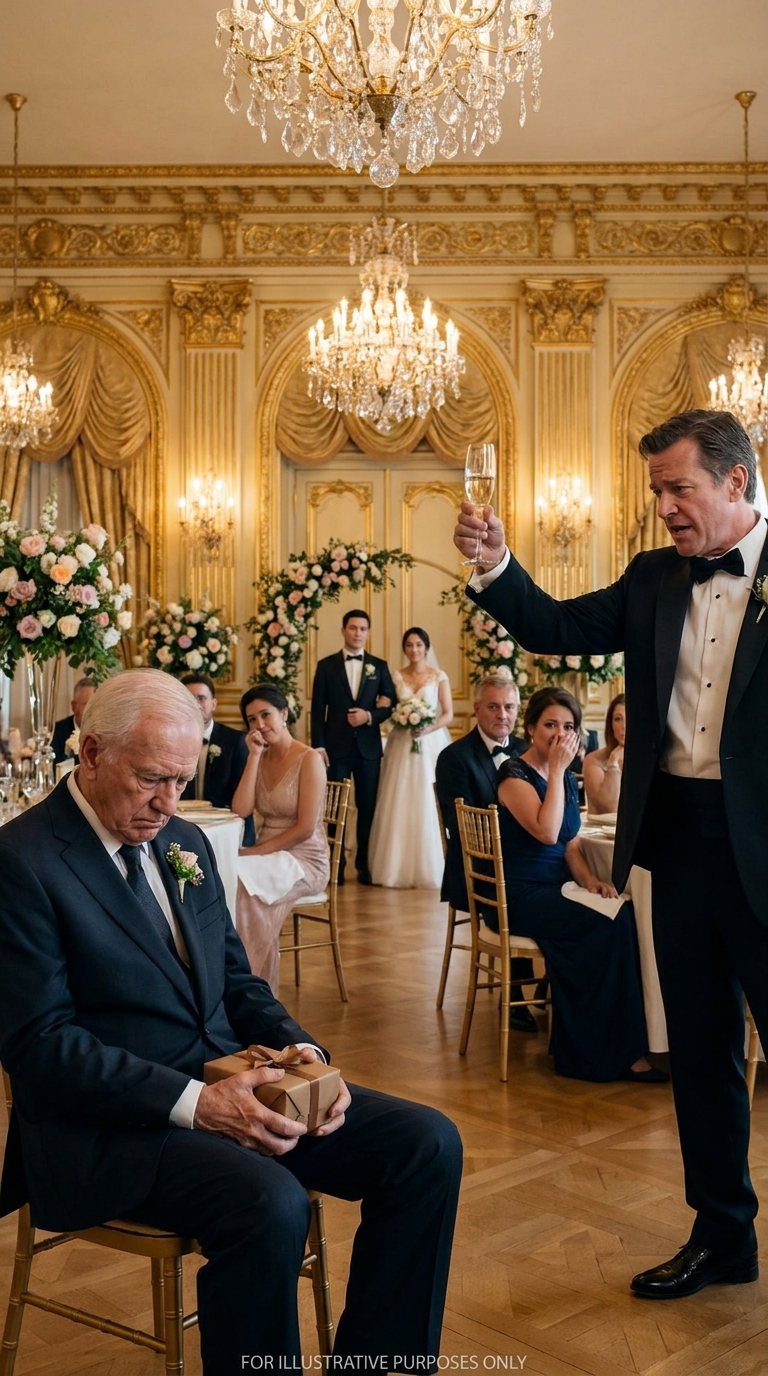
“It is a pity,” he said, “that good breeding is not always inherited from both sides. But perhaps that is the miracle of America. A boy may rise. He may overcome certain genetic disadvantages.”
Cordelia’s mother, Felicity, pressed a napkin to her mouth, but not to hide horror.
To hide laughter.
Cordelia’s brother, Preston, had his phone half raised, his smug face lit blue by the screen.
Reginald let the room settle, then delivered the line he had been building toward.
“Frankly, I think Mr. Whitaker should consider himself lucky that the Kingsley family has agreed to absorb his son into respectable society at all.”
There are humiliations that strike the skin.
There are humiliations that strike the bone.
Then there is the kind that enters a room through your own child’s silence.
I looked at Nathan.
My son. My boy. The baby Eleanor had placed against my chest on a rainy April morning in Boston, whispering, “Be careful with him, Harold. He’s brand new.” The teenager I had taught to parallel park in an empty Stop & Shop lot. The young man who had sat beside his mother’s hospital bed and read her the Red Sox box scores because she was too tired to open her eyes but still wanted to know whether they had won.
He stood at the front of that ballroom beside his bride.
His face had gone white.
His jaw trembled.
His eyes were fixed on the floor.
He did not say a word.

That was when something inside me, something old and patient and loyal beyond reason, cracked quietly in half.
I did not raise my voice. I did not throw a glass. I did not answer insult with insult. Eleanor would not have liked that. She believed dignity was not the absence of pain, but the refusal to let pain make you ugly.
I placed my linen napkin neatly beside my untouched plate.
The retired dentist stared straight ahead as if hoping invisibility might save him.
Aunt Margaret buttered her roll.
I reached down, lifted the small brown-paper gift from the floor, tucked it carefully under my arm, and stood.
A few people noticed.
Then more.
The ballroom had that strange hush that comes when cruelty realizes its target has chosen not to perform the role assigned to him.
Reginald kept talking, but his rhythm faltered.
I walked.
Past table thirty-six. Past a woman with emerald earrings who looked at me as if I had ruined her dessert. Past the champagne tower. Past the swan-shaped ice sculpture sweating under the lights. Past Preston Kingsley, who was still filming until he realized my face held nothing he could use.
I did not look at Cordelia.
I did not look at Nathan again.
I had almost reached the tall double doors when I heard footsteps behind me.
Fast footsteps.
“Dad.”
The word hit me harder than Reginald’s entire speech.
I stopped.
“Dad, please.”
I turned.
Nathan was coming toward me, almost running, his bow tie crooked, his face stripped of the numbness he had worn at the altar. Behind him, Cordelia stood frozen beneath the flowers, her mouth open in a perfect oval of panic.
Nathan reached me and stopped so abruptly that he nearly stumbled.
“Dad,” he said again, and his voice broke. “Please don’t go. I’m sorry. I should have said something. I should have stopped him.”
I looked at him for a long time.
Long enough to see the boy inside the man.
Long enough to remember the day he was eight and fell off his bike, skinning both knees on the pavement, and tried not to cry because he thought brave meant silent.
Long enough to hear Eleanor’s voice in my head.
Let him choose, Harold. Character only matters when it costs something.
“Nathan,” I said quietly, “are you going back in there, or are you coming with me?”
The ballroom seemed to hold its breath.
He did not hesitate.
Not for one second.
He reached up, pulled the white rose from his lapel, and let it fall to the marble floor.
Then he took my arm.
“Let’s go,” he said.
Behind us, Cordelia made a sound I had never heard from her before. Not grief. Not love. Alarm.
“Nathan,” she called. “Nathan, wait.”
Reginald’s voice followed, sharp now. No velvet in it. “Nathaniel Whitaker, don’t you dare make a scene.”
My son did not turn around.
Neither did I.
We walked out of Rosecliff into the warm Rhode Island night.
Outside, the air smelled like cut grass, ocean salt, and expensive flowers beginning to wilt. The mansion glowed behind us, every window bright, every chandelier pretending nothing shameful had happened beneath it. Beyond the lawn, the Atlantic moved in the dark with the ancient indifference of something that had watched millionaires rise and rot for longer than any family name could matter.
I took my phone from my pocket.
My hand was steady.
The call connected on the second ring.
“Mr. Whitaker,” Edmund said.
“Edmund,” I replied. “It’s time.”
There was no pause. Edmund Bell had worked for me for thirty-one years. He knew more about silence than most men know about speech.
“Shall I proceed with the full sequence, sir?”
“Yes,” I said. “All of it. Tonight.”
“Understood.”
I ended the call.
Nathan was staring at me.
His face had not recovered from the ballroom. It had only changed kinds of shock.
“Dad,” he said. “Who was that?”
“My secretary.”
“You have a secretary?”
“Yes.”
“What sequence?”
I put my hand on his shoulder.
He was thirty-one years old, taller than I was now, broader across the chest, a man with a career and a mortgage and opinions about coffee beans. But in that moment, under the warm wash of mansion lights, he looked like the little boy who used to climb into my bed after nightmares, careful not to wake his sick mother.
“Nathan,” I said, “sit with me for a minute.”
There was a stone bench beneath a copper beech tree near the edge of the lawn. We sat there while the wedding continued behind us in broken pieces. Voices rose, then dropped. Somewhere inside, a microphone squealed. Someone was trying to manage the unmanageable.
Nathan’s hands were locked together between his knees.
“What is going on?” he asked.
I looked toward the dark water.
There are secrets kept out of shame. There are secrets kept out of fear. Then there are secrets kept out of love, which are sometimes the most dangerous kind because they can look like betrayal when they finally step into the light.
“What do you know about my work?” I asked.
He frowned, shaken by the question.
“You’re retired. You consulted for energy companies. Logistics, acquisitions, that sort of thing.”
“That’s what I told you.”
He stared at me.
“That’s what I told your mother for the first ten years of our marriage, too.”
His expression changed.
“Dad.”
“My name is Harold Whitaker. That part is true. But I am not a retired consultant. I am the founder, majority shareholder, and chairman of Whitaker Bell Holdings.”
He blinked as if the words had no place to land.
“We do not put our name on many buildings. We operate through subsidiaries, partnerships, voting trusts, private funds, and companies most people never notice. We hold controlling or influential stakes in energy infrastructure, rail logistics, agricultural land, commercial real estate, and several regional banks across New England and the Midwest.”
Nathan did not move.
“As of the close of business yesterday,” I said, “my net worth was approximately four point eight billion dollars.”
The ocean moved in the dark.
Behind us, someone called his name again.
Nathan did not answer.
He looked at me as if I had become a stranger wearing his father’s face.
“No,” he said softly.
“Yes.”
“No. Dad, no.”
“I understand.”
“You drove a Buick until the transmission died.”
“I liked that car.”
“You clipped coupons.”
“Your mother clipped coupons. I obeyed.”
“You made me work at McKenna’s hardware store every summer.”
“You were terrible at mixing paint.”
He let out a sound that might have been a laugh if it had not broken halfway through.
“You let me take out student loans.”
“I let you take out some student loans. I paid the rest quietly.”
He stood, turned in a circle, then sat again, overwhelmed by the size of the lie and the love tangled inside it.
“Why?” he asked.
“Because your mother and I made a decision when you were born. We wanted you to grow up human before you grew up rich.”
He looked down.
“Eleanor was firm,” I said. “You know how she was when she believed something. She said she would rather raise a decent boy with calluses than a spoiled one with a trust fund. She wanted you on the school bus. She wanted you mowing lawns. She wanted you to know what groceries cost and how it feels to save for something. She wanted your first car to be ugly enough to teach humility.”
His mouth trembled.
“That Honda was ugly.”
“It had spiritual value.”
He covered his face with both hands.
For a moment, I saw Eleanor in him so clearly that it hurt. The same slope of the shoulders when wounded. The same stubborn refusal to cry until crying became the only honest thing left.
“When your mother got sick,” I said, “I wanted to tell you. She said no. She told me to wait until you were settled. Until you had built your own life. Until you knew who you were without it.”
“You promised her.”
“I did.”
He rubbed his eyes.
“And Cordelia?”
I looked toward the mansion.
Through the tall windows, figures moved quickly across the ballroom. A celebration had become a machine losing bolts.
“Cordelia has known me for two years,” I said. “She has been to the house in Fall River.”
“The small one?”
“Yes.”
“The one with the bad porch light?”
“Yes.”
“I thought you lived there.”
“That was the point.”
Nathan’s face tightened.
I hated what I had to say next.
“Your mother and I bought a house in Newport in 1994. On Ocean Avenue. Eleven bedrooms if you count the carriage house, which your mother refused to do because she said no room over a garage should contribute to anyone’s vanity. We planned to grow old there together.”
Nathan stared at the grass.
“I wanted to see how Cordelia treated a man she thought had nothing,” I said. “I wanted to believe I was being unfair. For a long time, I tried to convince myself I was. But every visit, every dinner, every little silence told me something.”
He swallowed.
“She didn’t like visiting you.”
“No.”
“She said it made her sad.”
“I know.”
“She said your neighborhood was depressing.”
“I know that, too.”
He closed his eyes.
I had never enjoyed being right less.
Footsteps came across the lawn.
Not the uncertain footsteps of a guest. Fast. Angry. Desperate.
Cordelia was running toward us, her satin dress lifted in both hands, her veil dragging behind her through the damp grass. Her makeup had started to break under her eyes. Even distressed, she looked arranged, as if panic were simply another pose she had been taught to perform.
“Nathan,” she called. “Darling, please.”
He stood.
I stood beside him.
She stopped several yards away, breathing hard.
“My father was wrong,” she said quickly. “He had too much champagne. You know how he gets when he’s nervous.”
Nathan looked at her as if seeing her for the first time without candlelight.
“He called my father trash.”
Cordelia flinched.
“He did not use that exact word.”
“No,” Nathan said. “He dressed it better.”
“Please don’t do this outside. Everyone is looking.”
“That’s what you care about?”
Her eyes shifted toward me, then back to him.
“I care about us.”
“In there,” Nathan said, his voice low and shaking, “your father humiliated my dad in front of hundreds of people. Your mother laughed. Preston filmed it. You held my hand and said nothing.”
Her lips parted.
“What was I supposed to do? It was my father. You don’t understand my family.”
“I think I do now.”
“Nathan, don’t be cruel.”
He almost smiled at that. Almost.
“I’m not being cruel, Cordelia. I’m leaving.”
The word struck her like a slap.
“You can’t leave your own wedding.”
“I just did.”
“You’re embarrassed. You’re upset. We’ll talk tomorrow.”
“No.”
Her face changed again. Behind the tears, calculation moved like a shadow under water.
“Nathan,” she said more softly, “you love me.”
“I loved who I thought you were.”
“I am who you think I am.”
“No,” he said. “You’re who you are when someone you think is beneath you is being hurt.”
For the first time, she looked frightened.
Not heartbroken.
Frightened.
“Nathan, please. We can fix this.”
He turned to me.
“Dad, where do we go?”
“Edmund is on his way.”
“I don’t want to wait here.”
“Then we walk.”
We walked.
Past Cordelia, who reached for his sleeve and missed. Past the cluster of guests gathering near the terrace doors. Past Preston, still holding his phone but no longer smiling. Past Felicity Kingsley standing under the portico with one hand pressed to her pearls and the other gripping her husband’s arm.
Reginald shouted Nathan’s name.
My son did not look back.
We reached the seawall at the edge of the property, where the Atlantic slapped softly against stone and the lights from passing boats trembled across the water. The wind had shifted cooler. Nathan leaned both hands on the wall and bowed his head.
“Tell me the rest,” he said.
I stood beside him.
“The phone call,” he said. “The sequence. What did you do?”
I had rehearsed this conversation in my head many times. I had imagined it in my library, over coffee, perhaps after a family dinner, with Nathan calm and ready to hear the truth. I had not imagined his tuxedo collar open, his wedding behind him, and his heart breaking in real time.
“Six months ago,” I said, “I asked Edmund to begin looking into the Kingsleys.”
Nathan did not lift his head.
“Reginald Kingsley’s wealth is not what it appears to be. His grandfather made a fortune in shipping and textiles. His father preserved it well enough. Reginald has been dismantling it for twenty years while pretending to expand it.”
“How?”
“Bad investments. Luxury developments in Florida that never sold. A private equity deal in timberland that collapsed. A chain of boutique hotels financed almost entirely by debt. He covered the losses by borrowing against family properties and moving money between trusts he manages for relatives.”
Nathan looked at me.
“That’s illegal.”
“Some of it. Some of it is merely desperate. Desperate men often wait too long to recognize the difference.”
He breathed unsteadily.
“There’s more.”
He laughed once, hollow and disbelieving.
“Of course there is.”
“Preston has been running an unregistered investment fund through his consulting firm. He took money from forty-six investors. Mostly retirees. Mostly people who trusted the Kingsley name.”
Nathan’s jaw tightened.
“How much?”
“About fourteen million dollars. Most of it is gone.”
“Jesus.”
“The Securities and Exchange Commission received a complete dossier this afternoon. Bank records. Emails. Offering materials. Witness statements.”
He looked at me sharply.
“You sent it?”
“Edmund’s office did.”
The headlights of a car appeared at the far end of the drive, moving slowly through the trees.
I continued before I lost courage.
“And Cordelia.”
Nathan went still.
I hated her then. Not for betraying him. Betrayal is common enough. I hated her for making me become the man who had to tell him.
“What about Cordelia?”
“She has been in a relationship with a man named Thomas Harrow for nearly three years. He is a corporate attorney in Boston. Married. Two children.”
Nathan turned away.
The wind lifted his hair.
“No.”
“I’m sorry.”
“No.”
“There are emails. Hotel reservations. Photographs. They were together the night before the rehearsal dinner.”
He sat down on the seawall as if his legs had failed.
For a long moment, he made no sound.
Then he said, “Why didn’t you tell me?”
The question had been waiting for me all night.
Maybe all year.
“Because if I had told you six months ago, you would have defended her. You would have told me I misunderstood. You would have said evidence can be explained. You would have believed love required loyalty, and you would have confused loyalty with blindness.”
He stared at the grass beneath his shoes.
“I might have.”
“I know.”
“You let me walk all the way to the altar.”
“I let you walk far enough to see who stood there with you.”
He looked up then, and the pain in his face nearly undid me.
“That’s a terrible thing to do to your son.”
“Yes,” I said.
The answer surprised him.
I did not soften it.
“Yes, it was. I have lived with that for months. I will live with it longer. But I had to choose between hurting you tonight and watching you build a life with a woman who measured people by money while hiding her own betrayal behind your trust.”
His eyes shone.
“And you chose tonight.”
“I chose tonight because tonight she had one last chance to be decent when it cost her something. So did you.”
He lowered his head.
“I failed.”
“No.”
“I stood there.”
“And then you came after me.”
“Too late.”
“You came.”
The black car stopped at a respectful distance. Edmund got out but did not approach. He was a lean man in his early sixties, with a neat gray beard and the calm of someone who knew where every fire exit was before entering a building.
Nathan noticed him.
“Uncle Eddie,” he whispered.
Edmund smiled faintly.
“Nathaniel.”
My son stared at him, stunned by memory.
“You gave me a model train.”
“I did. A Pennsylvania Railroad GG1. You corrected my pronunciation.”
Nathan almost smiled, then broke.
His shoulders folded inward.
I sat beside him on the seawall and put one arm around him.
He cried then.
Not the embarrassed tears of a groom whose wedding had collapsed. Not the sharp tears of wounded pride. These were deep, ugly, necessary tears, the kind that rise from the cellar of a man and bring old dust with them. He cried for Cordelia. For his mother. For the father he thought he knew. For the self who had stood silent in a ballroom while cruelty dressed itself as wit.
I held him as best I could.
The music inside the mansion had stopped.
After a while, he wiped his face with both hands.
“What else happens tonight?” he asked.
I looked at Edmund, then back at my son.
“Two months ago, through three intermediary entities, Whitaker Bell acquired the bank that holds the primary loans on the Kingsley properties. The Newport house, the Manhattan apartment, the Vermont lodge, and the development parcels in Palm Beach.”
Nathan stared.
“You bought their debt?”
“Yes.”
“Why?”
“To control the timing.”
He shook his head slowly.
“Dad.”
“The loans are legal. The terms are enforceable. Reginald has been in technical breach of several covenants for months. Until tonight, I chose not to act.”
“And now?”
“Tonight, Edmund authorized notices of default and acceleration on every Kingsley entity we hold. Reginald has seventy-two hours to satisfy roughly sixty-three million dollars in obligations.”
“He can’t.”
“No.”
“So he loses everything.”
“He loses what he borrowed against.”
Nathan stood and walked a few steps away, dragging both hands through his hair.
“You destroyed them.”
“No,” I said. “They destroyed themselves. Reginald gambled with money that was not his. Preston stole from people who could not afford to lose. Cordelia lied to you every day she let you love her. I chose when the bill came due.”
He turned back.
“Did you know he would insult you tonight?”
“I suspected he might.”
“You let him.”
“Yes.”
“You sat there and let him humiliate you in front of everyone.”
“Nathan,” I said, “Reginald Kingsley’s opinion of me means less than the weather report in a town I’ll never visit.”
“That’s not true.”
“It is.”
“He hurt you.”
I looked at my son.
“The only person in that room who could have truly hurt me was you.”
His face crumpled.
“And you came after me,” I said. “So I am all right.”
He cried again then, but less violently. The second breaking is quieter. It does not tear the house down. It lets the air in.
Edmund walked over only when Nathan straightened.
“Sir,” he said gently, “Mrs. Kingsley is approaching with several guests.”
I looked over my shoulder.
Felicity Kingsley was crossing the lawn with Cordelia and Preston behind her. Reginald was not with them. Perhaps he had already received the first call. Perhaps some lawyer somewhere had interrupted his outrage with numbers.
Felicity reached us breathless, her composure cracked but not gone.
“Harold,” she said, using my name for the first time all evening. “This has gone far enough.”
I said nothing.
“Nathan,” she continued, turning to him, “sweetheart, emotions are high. Come inside. We’ll smooth it over. Your father has made his point.”
Nathan looked at her.
“My father didn’t make the toast.”
Her mouth tightened.
“Reginald can be theatrical.”
“He was cruel.”
“He was protecting Cordelia.”
“From what?”
Felicity’s eyes flicked over my old suit.
She did not answer quickly enough.
Cordelia pushed past her mother.
“Nathan, please,” she said. “I made mistakes. I should have spoken up. I know that now.”
Nathan’s voice was flat.
“Did you sleep with Thomas Harrow last night?”
The question landed in the grass between them like a body.
Cordelia’s face emptied.
Felicity inhaled sharply.
Preston lowered his phone.
For once, no one performed.
Nathan nodded, as if her silence had signed the paper.
“I’m done.”
“Nathan,” Cordelia whispered.
“I said I’m done.”
Her eyes moved to me.
And there it was.
Not remorse. Not grief. Accusation.
“What did you do?” she asked.
I held the brown-paper gift tighter under my arm.
“I attended my son’s wedding.”
“You planned this.”
“No,” I said. “You planned this. All of you. I only refused to leave my son inside it.”
Felicity stepped closer, lowering her voice.
“Mr. Whitaker, I don’t know what you think you know, but families like ours do not handle private matters in public.”
I looked back at the mansion.
“Madam, your husband made my poverty public. He was mistaken about the poverty.”
Her face changed.
Just slightly.
Enough.
Edmund opened the rear door of the Bentley.
Cordelia saw the car then. Saw Edmund. Saw me. Saw all the pieces begin arranging themselves into a picture she did not like.
“Harold,” she said carefully. “Who are you?”
I walked to the car.
Nathan followed.
Before getting in, he looked back one last time at the woman who, ten minutes earlier, had been his bride.
“I hope someday you become someone you can stand to be alone with,” he said.
Then he got in beside me.
Edmund closed the door.
As the car moved down Bellevue Avenue, the mansions slid past in the dark, huge and silent behind gates and hedges. Nathan stared out the window, his face reflected faintly in the glass. He looked ruined. He looked reborn. Often those are the same face.
The gift still sat on my lap.
Nathan noticed it.
“What is that?”
I looked down.
“It was supposed to be for you and Cordelia.”
“What is it?”
I untied the twine carefully and folded back the brown paper.
Inside was a framed photograph.
Eleanor, Nathan, and me on Second Beach when Nathan was nine. Eleanor’s hair was tied back with a red scarf. She was laughing at something outside the frame. Nathan was holding a plastic shovel like a sword. I had one hand on each of them, sunburned and happy and still foolish enough to think time was generous.
Nathan took the frame.
His thumb moved over his mother’s face.
“I miss her,” he said.
“So do I.”
“She would hate tonight.”
“Yes.”
“She would have liked that I came after you.”
“She would have pretended not to cry. Then she would have cried in the pantry.”
He laughed through his tears.
Edmund drove us through the gates of the Newport house a little after midnight.
Nathan sat forward when he saw it.
The house rose beyond the drive in pale stone and dark windows, its wide porch facing the ocean, hydrangeas moving in the night wind. It was not the largest house on that road. Eleanor had refused two larger ones because she said any home requiring a map would encourage bad manners. But it was beautiful in the way old houses can be beautiful when they have survived both weather and ego.
“This is yours?” Nathan asked.
“Ours, if you want it to be.”
He did not answer.
Inside, the house smelled faintly of lemon oil, old books, and the sea. Edmund disappeared toward the kitchen without being asked. Lights came on softly as we entered. The foyer held Eleanor’s umbrella stand, Eleanor’s blue vase, Eleanor’s stubborn little chair no one ever sat in because she had once declared it perfect exactly where it was.
Nathan stood beneath the staircase and looked around like a man entering the childhood he had been denied and protected from at the same time.
“I don’t know how to feel,” he said.
“That is understandable.”
“I’m angry.”
“That is also understandable.”
“At Cordelia. At them. At myself.”
He looked at me.
“At you, too.”
I nodded.
“You are entitled to that.”
“You lied to me my whole life.”
“Yes.”
“For my own good.”
“Yes.”
“That’s what everyone says when they lie.”
I absorbed that because it was fair.
“You’re right.”
He seemed startled.
“I am?”
“Yes.”
He looked away.
I set my hat on the hall table, though I had not worn a hat in twenty years. The gesture belonged to some older version of myself.
“I cannot make the lie smaller by calling it love,” I said. “I can only tell you that love is why we chose it, and accept that the choice still wounded you.”
He studied me.
For the first time that night, he was not only my son. He was a man judging another man.
That, too, was necessary.
“What happens now?” he asked.
“Now Edmund makes tea because he believes tea can negotiate with tragedy. Then you sleep, if sleep will have you. Tomorrow, lawyers will come. The wedding will have to be untangled. The marriage license was signed, but not yet filed with the clerk, according to what you told me yesterday. That helps.”
He closed his eyes.
“I almost married her.”
“Yes.”
“I almost gave my life to her.”
I wanted to tell him he had not. I wanted to soften the sentence. But there are moments when a father’s comfort becomes another lie.
“You came close,” I said.
He nodded.
“And after that?”
“After that, we talk. About your mother. About the company. About what you want. Not what I want. Not what the money wants. What you want.”
“I don’t know anything about your world.”
“You know more than you think.”
“I sell insurance software.”
“You understand risk.”
He gave me a tired look.
“That is the most billionaire thing you have ever said.”
I smiled.
“Possibly.”
He looked around again.
“Do I have a room here?”
“Your mother decorated one when you were born.”
His face changed.
“She did?”
I led him upstairs.
The room was at the end of the east hall, facing the water. Eleanor had chosen pale blue walls, white curtains, a brass bed, and shelves she once imagined filling with model ships and baseball trophies. We had never brought Nathan there as a child. That had been part of the bargain. Still, Eleanor had dusted it herself when she was well enough, calling it our act of hope.
Nathan stepped inside.
On the dresser stood a small wooden train.
A Pennsylvania Railroad GG1.
He picked it up with both hands.
For a while, neither of us spoke.
Then he sat on the edge of the bed, still in his tuxedo, holding the train like an artifact from a life that had been waiting behind a locked door.
“I need to be alone,” he said.
“I know.”
I left him there.
Downstairs, Edmund had made tea.
Of course he had.
I sat in the kitchen while dawn slowly diluted the windows. My phone buzzed several times. Lawyers. Board members. A discreet message from the editor of a newspaper I owned through two holding companies and never interfered with except to ensure the investigation into Reginald Kingsley would not be killed by social pressure. Another from the general counsel confirming notices had been served.
At 4:12 a.m., Reginald called.
I watched his name appear on my phone.
I did not answer.
At 4:16, Felicity called.
At 4:22, Cordelia sent a message.
Please don’t do this to him. He loves me.
I deleted it.
At 5:03, Nathan came downstairs barefoot, his tuxedo shirt wrinkled, his face pale and hollow.
“I don’t want the company,” he said.
It was the first thing out of his mouth.
“All right,” I said.
He stared at me.
“That’s it?”
“That’s it.”
“You don’t want to argue?”
“No.”
He leaned against the counter.
“What if I never want it?”
“Then I will make other arrangements.”
“What if I want to learn but not inherit?”
“Then you learn.”
“What if I’m bad at it?”
“Then you will be bad at something with excellent advice available.”
He almost smiled.
Then he said, “I don’t want to become like them.”
I understood then what truly frightened him. Not wealth. Not responsibility. Contamination.
“You will not become like them by having money,” I said. “You become like them by believing money reveals human worth instead of human temptation.”
He sat across from me.
“Did Mom really want this?”
“She wanted you free.”
“This doesn’t feel free.”
“No. Not yet.”
He looked toward the windows, where morning had begun to silver the lawn.
“I want to work from the bottom.”
“If you choose to work at Whitaker Bell, that can be arranged.”
“No special office.”
“No.”
“No pretending I understand things I don’t.”
“God forbid. That would make you like half my board.”
This time he did smile.
A little.
It was enough to keep me breathing.
The Kingsley collapse did not happen all at once for the public, though for Reginald it happened the moment his lawyers confirmed what he already knew. Wealth often dies privately before anyone smells smoke.
The first story ran forty-eight hours later in the Boston Globe, followed by the Journal, then every financial outlet that enjoyed watching old money discover gravity. Reginald Kingsley III, once photographed at charity galas and museum openings, was suddenly described in colder terms. Overleveraged. Under investigation. Removed from foundation leadership pending review. Questioned by creditors. Facing civil claims from family members whose trusts had been treated like private wells.
The Newport house went first.
Not Rosecliff, of course. That belonged to the Preservation Society. But the Kingsleys’ own estate near Ocean Drive, with its imported hedges and absurd pool house, fell into receivership within the month.
The Manhattan apartment followed.
Then the Vermont lodge.
The Palm Beach parcels were sold at a loss so steep it made even Edmund wince.
Preston Kingsley was arrested nine weeks after the wedding. Cameras caught him leaving his office in a navy suit, his wrists restrained in front of him, his face wearing the offended disbelief of a man who thought consequences were for clients. The retirees did not recover everything. They rarely do. But through a donor-advised fund and several intermediaries, I made sure many of them recovered enough to pay mortgages, medical bills, and the ordinary expenses that theft makes terrifying.
No one knew I did it.
Nathan found out anyway.
He came into my study one afternoon holding a folder.
“You paid them.”
I looked up from the quarterly report.
“Paid whom?”
“The investors Preston stole from.”
I sighed.
“Edmund is losing his touch.”
“Dad.”
“Yes.”
“Why hide it?”
“Because restitution is not theater.”
He stood there for a while, then nodded.
“Mom would have liked that.”
“She would have asked why I didn’t give more.”
“Did you?”
I looked back at the report.
Nathan laughed softly.
It was the first unbroken laugh I had heard from him since the wedding.
Cordelia tried to reach him for months.
At first, she sent long emails filled with apology, memory, and explanations that bent themselves into excuses. She said she had been afraid of her father. She said Thomas had meant nothing. She said the wedding pressure had confused her. She said Nathan was punishing her for being imperfect.
Nathan read the first two.
Then he stopped.
One evening in October, she arrived at the gate of the Newport house in a rented car, wearing dark glasses though the sky was overcast. Edmund informed us through the intercom with the same tone he might have used to announce a package requiring a signature.
Nathan went pale, but he did not hide.
“I’ll go,” he said.
I watched from the upstairs window because fatherhood does not end just because a child becomes brave.
Cordelia stood outside the gate, thinner than before, her hair loose around her shoulders. She cried when she saw him. He did not open the gate.
They spoke for eleven minutes.
I know because I counted.
At one point she reached through the bars. He stepped back. Not cruelly. Finally.
When he returned, his face was calm in the exhausted way of someone who has closed a door that was once a dream.
“What did she say?” I asked.
“She said she loved me.”
“What did you say?”
“I said I believed her, but not enough to marry the version of her that love didn’t improve.”
I sat back.
“That is a very good sentence.”
“I practiced it in therapy.”
“Therapy suits you.”
“Secrets made it necessary.”
I accepted that because it was true.
He started at Whitaker Bell in January.
By his own insistence, he began nowhere near my office.
For six weeks, he made coffee, printed briefing books, sat quietly behind analysts half his age, and learned how little inherited proximity means when everyone in the room knows the numbers and you do not. Some employees whispered, of course. Some resented him. Some tried to flatter him so obviously he called them out on it, politely but firmly, which pleased me more than any spreadsheet could have.
He spent three months in agricultural assets under Marisol Vega, who had run that portfolio for me for twenty years and feared no man, including me. Marisol was born in El Paso, educated at Cornell, and capable of making a roomful of executives feel like lazy schoolboys with one raised eyebrow.
After Nathan’s first week, I asked her how he was doing.
“He listens,” she said.
“Is that good?”
“It’s rare.”
After six months, she gave him real work.
After eight, she told me, “He has his mother’s spine.”
I went to my office, closed the door, and cried so hard I had to cancel lunch.
Time did not heal everything. That is one of the lies people tell because they dislike grief’s lack of manners. Time changed the shape of things. It made some memories less sharp and others sharper. The ballroom remained. Reginald’s voice remained. Nathan’s silence remained, but so did the sound of his footsteps behind me. So did the white rose falling to marble. So did his hand taking my arm.
One afternoon the following spring, Nathan came to the house carrying two coffees and wearing the expression of a man trying to appear casual and failing badly.
“There’s someone I’d like you to meet,” he said.
I lowered my newspaper.
“A woman?”
“Yes.”
“Does she have a last name?”
“Parker. Amelia Parker.”
“What does Amelia Parker do?”
“She works for a wetlands restoration nonprofit. Mostly coastal resilience projects. Salt marshes, flood mitigation, policy grants, that kind of thing.”
“She sounds underpaid and useful.”
“She is both.”
“Does she know?”
“About the company? No.”
I folded the paper.
“Nathan.”
“I know.”
“Do you?”
“I’m not hiding it forever. I just want to know who we are before she knows what we have.”
I studied him.
There was fear there. But also wisdom. And caution earned through pain.
“Bring her Sunday,” I said.
“To this house?”
“Yes.”
He hesitated.
“I was thinking maybe Fall River first.”
“No.”
“Dad.”
“I am done with tests disguised as humility.”
He looked surprised.
I took off my reading glasses.
“Cordelia failed because she was cruel when she believed cruelty was safe. Amelia does not need a shabby porch light to prove she is decent. You can observe how she treats waiters, strangers, clerks, old men, animals, people who interrupt her, people who cannot help her. Life provides enough examinations without our staging them.”
Nathan was quiet.
Then he nodded.
“You’re right.”
“I enjoy hearing that.”
“Don’t get used to it.”
Amelia came that Sunday wearing jeans, a navy sweater, and no visible terror at the sight of the house, though I noticed she paused on the porch and took one deep breath before ringing the bell. She had chestnut hair, clear eyes, and the practical hands of someone who had planted things in mud and written grant proposals after midnight. When Edmund opened the door, she introduced herself to him first.
Not as staff.
As a person.
That was the first thing I liked.
At lunch, she asked me about Eleanor.
Not about the house. Not about the company. Not about the paintings. Eleanor.
Nathan looked at me across the table, and I could see the question in his face.
Is this what decency feels like when it is not performing?
I told Amelia about my wife’s habit of rescuing dying plants from supermarket clearance racks. I told her about the time Eleanor argued with a surgeon until he apologized to a nurse. I told her how she believed wealth should move quietly, like groundwater, reaching roots without demanding applause.
Amelia listened.
Really listened.
After dessert, she helped Edmund carry plates into the kitchen despite his formal objection. From the dining room, I heard her laugh at something he said. A few minutes later, Nathan followed her, and I sat alone at the table beneath the afternoon light, feeling the old house breathe around me.
For the first time in many years, it did not feel like a museum of what I had lost.
It felt like a place something might still begin.
Months later, Nathan and I returned to Rosecliff.
Not for a wedding.
A children’s hospital fundraiser rented the ballroom, and Whitaker Bell had underwritten the event anonymously until the director insisted I attend. I nearly refused. Nathan knew why.
“We can leave whenever you want,” he said.
It was almost funny, hearing my own words returned to me in a different coat.
We walked in together.
The chandeliers were the same. The gilded ceiling, the marble, the ocean beyond the windows. A string quartet played near the fireplace. Waiters carried champagne. Laughter floated above the tables.
For a moment, my body remembered humiliation faster than my mind could argue.
Then Nathan touched my elbow.
Not because I needed support.
Because he knew.
Our table was near the center of the room.
I looked toward the far corner by the service doors.
Table thirty-seven was gone. Or rather, the room had been rearranged, as rooms are, indifferent to the meanings we attach to furniture.
During dinner, the hospital director spoke about a new pediatric wing. She thanked donors without naming most of them. She spoke of families sleeping in chairs, parents counting insurance approvals, children brave because adults had given them no other option.
Nathan leaned toward me.
“Mom would have donated twice.”
“Three times,” I said.
He smiled.
When the applause rose, I felt Eleanor near me in the impossible way the dead sometimes arrive. Not as a ghost. Not as comfort exactly. More like an old truth standing quietly behind your chair.
After the speeches, Nathan and I stepped onto the terrace.
The ocean was black beyond the lawn.
“I’ve been thinking,” he said.
“That sounds expensive.”
He laughed.
“I want to stay with the company.”
I turned to him.
“For now?”
“For real. But not because it’s mine. Because I think we can do things other people won’t.”
I waited.
“I want to build a fund for communities like the ones we pretended I came from. Small towns, flood zones, aging infrastructure, family farms getting squeezed by debt. Not charity exactly. Investment with patience. Money that doesn’t strip people for parts.”
I looked at him for a long time.
The boy with the plastic shovel had become a man speaking of stewardship in a voice that did not need an audience.
“What would you call it?” I asked.
He looked embarrassed.
“The Eleanor Fund.”
I turned toward the ocean.
I had survived boardroom coups, recessions, oil shocks, lawsuits, and the kind of loneliness that makes a large house sound hollow at sunset. But nothing had prepared me for the mercy of hearing my wife’s name carried forward by our son.
“She would like that,” I said.
“Would you?”
I cleared my throat.
“Yes.”
He looked away too, giving me the dignity of not watching my face too closely.
That is love also.
Reginald Kingsley died two years after the wedding.
A heart attack, I was told, in a rented condominium in Sarasota. Felicity sent no message, and I sent no flowers. I did read the obituary. It mentioned his charitable service, his family lineage, his love of sailing, and none of the people whose savings had passed through Kingsley hands and vanished. Obituaries are often the final fiction families tell together.
Preston pleaded guilty.
Cordelia divorced Thomas Harrow after less than a year.
Nathan heard this from a friend of a friend and told me over breakfast with no satisfaction in his voice. That was how I knew he was truly free.
Amelia learned the truth about the money on her fourth visit to the Newport house, when a Wall Street Journal reporter called Nathan directly and asked for comment on his appointment to a Whitaker Bell advisory committee.
He told her everything that evening.
The next day, he came to see me alone.
“She’s angry,” he said.
“At the money?”
“At the secrecy.”
“Good.”
“That’s good?”
“Anger at secrecy suggests a healthy respect for truth.”
He gave me a look.
“You could just say I messed up.”
“You messed up.”
“Thank you.”
Amelia did not leave him. She did make him work for trust, which I respected. When she returned to the house a month later, she brought Eleanor’s favorite grocery store daisies because Nathan had told her the story. She placed them in the blue vase in the foyer without asking whether it was valuable.
It was.
Not because of money.
Nathan married Amelia eighteen months later in a small ceremony on the lawn behind the Newport house.
Forty-two guests. No champagne tower. No swans carved from ice. Edmund officiated because he had quietly obtained the proper authorization and because Nathan said no one else had earned the right. Amelia wore a simple ivory dress and muddy boots under it because it had rained that morning and she refused to be carried over wet grass like porcelain.
I wore the same charcoal gray suit.
The cuffs were still worn.
Amelia’s father, a high school biology teacher from Maine, stood during dinner and gave a toast so plain and sincere that half the guests cried.
He raised his glass and said, “Harold, thank you for raising a son who knows how to come back when it matters.”
I had to sit down before he finished.
That night, after the guests left and the house quieted, Nathan found me on the back veranda. The ocean was dark. The windows glowed behind us. Music drifted faintly from the kitchen, where Amelia and Edmund were arguing cheerfully about whether leftover cake should be frozen.
Nathan sat beside me.
“Do you ever regret it?” he asked.
“Which part?”
“Hiding the money.”
I watched the water.
“Yes.”
He nodded.
“Do you ever think it saved me?”
“Yes.”
“Both can be true?”
“Most painful things are painful because both are true.”
He leaned back.
“I used to think that night was when everything fell apart.”
“And now?”
“Now I think it was when everything stopped pretending to be whole.”
The sentence settled between us.
From inside came Amelia’s laugh, then Edmund’s offended reply, then the sound of a cabinet closing.
Nathan looked at me.
“I’m glad I came after you.”
“So am I.”
“I wish I’d spoken sooner.”
“I know.”
“I’m still sorry.”
“I know that, too.”
We sat together without saying anything for a while.
The older I get, the more I believe silence has different species. There is the silence of cowardice. The silence of contempt. The silence of fear. But there is also the silence of two people who have said the necessary words and no longer need to fill the air to prove they remain.
At last, Nathan reached into his jacket and took out something small.
A white rose.
Pressed flat between two pieces of glass in a narrow wooden frame.
“I kept it,” he said.
I stared at it.
“The one from the ballroom?”
He nodded.
“It was on the floor by the doors when I went back the next morning with the lawyer. I don’t know why I picked it up.”
“I do.”
He handed it to me.
“I want it in the house somewhere.”
“Where?”
“Not hidden. Not displayed like a trophy either. Just somewhere we’ll pass it and remember.”
We hung it the next day in the narrow hallway between the kitchen and the back veranda, where people pass carrying coffee, newspapers, flowers, crying babies, muddy boots, and all the ordinary evidence of a life being lived.
Guests rarely notice it.
Family does.
Years have passed since that wedding in Newport. I am an old man now, older than I expected to become, and some mornings my hands ache before the weather changes. Edmund pretends not to hover. Nathan pretends not to notice. Amelia does neither and simply tells me when I am being stubborn, which is often.
There is a little girl in the house now.
Eleanor Rose Whitaker.
She is three years old and believes the world exists mostly to provide her with pockets for acorns. She has her grandmother’s eyes and her father’s seriousness when concentrating. Sometimes she climbs into my lap on the veranda and asks about the ocean as if I personally arranged it.
I tell her what I can.
I do not tell her yet about table thirty-seven.
One day, perhaps, when she is old enough to understand how people reveal themselves. I will tell her that the world will sometimes mistake gentleness for weakness, old suits for failure, quietness for emptiness, and kindness for lack of power. I will tell her that some people look down because they are terrified of looking inward. I will tell her that money can protect and money can poison, and the difference is usually whether love or vanity holds the key.
I will tell her about her grandmother, who knew that character was not inherited like property, but taught in small daily lessons no child recognizes at the time.
I will tell her about her father, who made the wrong silence in a ballroom and the right choice at the door.
And I will tell her this, because it is the truest thing I know.
Never judge a man by the chair he has been given at someone else’s table.
Watch what he does when he stands.
THE END