
The judge read two lines from my husband’s will, looked over the top of his glasses, and gave the smallest, driest laugh I had ever heard inside a courthouse.
Across the table, my daughter-in-law Deanna stopped smiling.
Only a minute earlier, she had leaned toward me in that cold, perfumed confidence of hers and whispered, “You will never touch that money again, Martha.”
My son Julian sat beside her, silent as always, his eyes fixed on his folded hands. He did not correct her. He did not look at me. He did not even flinch.
I had expected that.
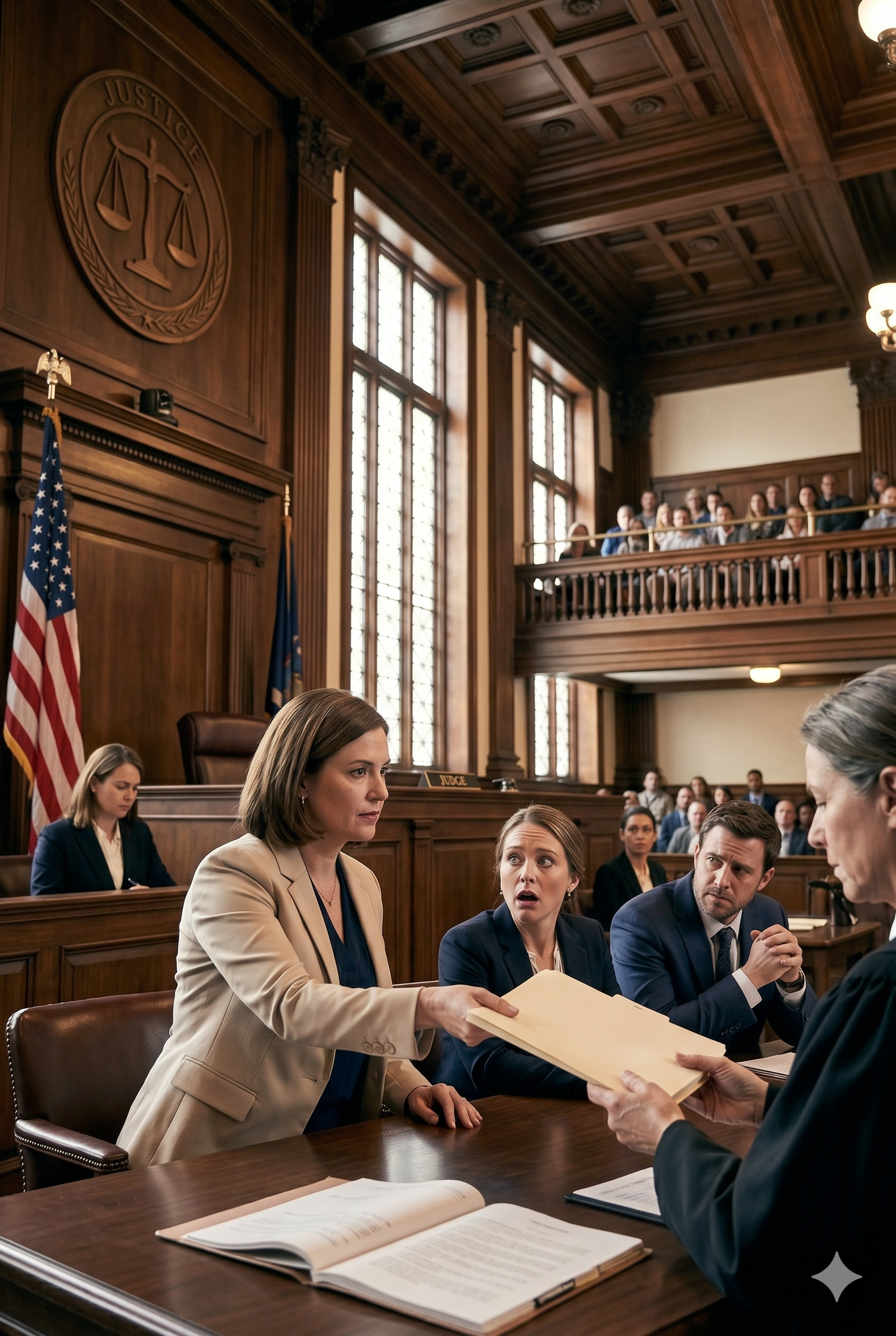
What Deanna had not expected was the folder in my lap.
Blue. Plain. Organized.
The kind of folder a woman keeps when she has spent a lifetime learning that feelings are often dismissed, but paper has a way of standing upright in a room full of lies.
I placed it on the long conference table at the Dane County courthouse in Madison, Wisconsin. The room was cold, practical, and almost aggressively ordinary, with beige walls, fluorescent lights, and a small American flag standing in the corner beside a filing cabinet. Outside the narrow window, a March wind dragged dirty snow across the courthouse steps. Inside, Deanna sat in a new cream dress she had clearly bought for the occasion, her posture straight, her mouth curved with the smug little certainty of someone who had already spent money she did not own.
The probate judge opened my folder, read the first page, then the second.
His mouth twitched.
“Oh,” he said. “This changes everything.”
That was when Deanna’s face began to lose its color.
But the truth had started two weeks earlier, in my kitchen, with my coffee mugs.
It had only been fourteen days since I buried my husband, Arthur.
Fourteen days since I stood beside a dark hole in the frozen Wisconsin ground while a pastor spoke about devotion, service, and everlasting peace. Fourteen days since Julian held my elbow too lightly, like a man doing a task he wanted credit for but not responsibility. Fourteen days since Deanna dabbed at perfectly dry eyes beneath a black wool hat and accepted sympathy from neighbors as though she were the widow.
Arthur and I had been married for forty-three years.
We had built our life slowly. A brick house on a quiet street not far from Lake Wingra. A kitchen with marble counters we saved eight years to install. A garage workshop where Arthur repaired furniture, restored old tools, and listened to Brewers games on the radio. A garden full of roses that never bloomed exactly when he said they would. A dining room where every Thanksgiving left someone too full and every Christmas morning smelled of cinnamon, coffee, and pine.
After he died, the house felt impossible.
Too still.
Too clean.
Too full of his absence.
So when Julian and Deanna said they wanted to move in “for a while” to help me through the hardest part, I let them.
I was grieving. That is not the same thing as being foolish, but grief makes certain mistakes easier to excuse while you are making them. I wanted my son nearby. I wanted voices in the house. I wanted someone else to hear the pipes at night and the wind against the windows. I wanted not to sit alone with Arthur’s empty chair at the breakfast table.
At first, Deanna was careful.
She brought soup. She answered the door when neighbors came by with casseroles. She told people, “Martha shouldn’t have to worry about the little things right now.” She wore soft cardigans and spoke in a gentle voice when others were present.
Then the guests stopped coming.
The casseroles were eaten.
The sympathy flowers wilted.
And Deanna began unpacking her real self.
The first thing she moved was my coffee mugs.
I came downstairs one Tuesday morning to find her standing at the open kitchen cabinet, sliding my old mugs into a cardboard box. Not chipped mugs. Not junk. My mugs. The green one Arthur bought me in Door County. The heavy blue one Julian made in eighth-grade ceramics. The white one with tiny painted violets that had belonged to my mother.
Deanna stood on her toes, reaching for the top shelf, her blonde hair twisted into a sleek knot.
“What are you doing?” I asked.
She did not turn around.
“Making some space,” she chirped. “Your mugs are sweet, but they make the kitchen look cluttered. I ordered a set of matcha bowls that will fit the aesthetic better.”
The aesthetic.
Arthur had hated that word.
Julian stood near the doorway, holding his phone. He looked up, then quickly down again.
“Deanna,” he said weakly.
She waved one hand.
“It looks so much more modern this way, Martha. Trust me.”
Trust me.
Two words people use when they know they have not earned the right.
I stood at the island with my fingertips resting against the cool marble Arthur had picked out himself. I could still hear him in that showroom, arguing with the salesman about veining and durability as if we were buying a piece of national infrastructure instead of countertops.
Deanna placed my mother’s violet mug into the box.
Something in me tightened.
But I did not cry.
I was sixty-eight years old. A widow, yes. Heartbroken, yes. But I was not a piece of fragile china to be wrapped and stored wherever Deanna found convenient.
Maybe I had protected Julian too much. Maybe I had taught him that discomfort was something his mother would always remove from his path. Maybe his softness had started in my hands before it ended in Deanna’s pocket.
That was a hard truth to face while watching my son avoid my eyes in my own kitchen.
I did not argue about the mugs.
I picked up the box, carried it to my bedroom, and set it beside the dresser.
Then I returned to the kitchen, lifted my small coffee maker from the counter, and carried that upstairs too.
If Deanna wanted to rule the kitchen, fine.
But I would not drink my morning coffee from one of her bowls.
That night at dinner, Deanna talked as if she were narrating a home renovation show nobody had asked to film.
“We should paint the dining room,” she said, cutting into the chicken I had cooked. “Something warmer. And the living room rug needs to go. It makes the whole house feel older than it is. Oh, and Arthur’s truck should probably be sold before it loses value. No point keeping a gas-guzzling old thing just because of sentiment.”
Julian chewed slowly, nodding in little pieces.
Arthur’s truck.
The old green Ford sitting in the garage bay, still holding one of his flannel jackets behind the seat. Arthur had loved that truck. Not because it was valuable, but because it started in winter, hauled mulch in spring, carried lumber, tools, grandkids, Christmas trees, and once a very offended golden retriever we watched for our neighbors.
Deanna spoke about selling it the way someone might discuss clearing a dead branch.
She did not say if.
She never said if.
She said when. Should. Need. We.
At one point, she leaned back in her chair and said, “We should probably transfer the household account into my name too. It would be easier if I managed the groceries, utilities, and daily expenses. You shouldn’t have to think about all that right now.”
I set down my fork.
Quietly.
The room did not notice, but I did.
That was the first test.
And I was not going to fail it.
The next morning, I drove to the bank before either of them came downstairs.
The streets were still crusted with old snow, and the Capitol dome gleamed pale in the distance under a flat winter sky. Madison looked gray and practical, like a city that understood grief but still expected you to shovel your walk.
I sat across from a bank manager named Ellen, a woman around my age with silver hair, red glasses, and the steady manner of someone who had watched enough family finances unravel to recognize trouble before it introduced itself.
“I need to separate some accounts,” I said.
She nodded once and reached for a pen.
For years, I had kept an automatic monthly transfer going to Julian. It had started when he was in college, then continued during his first apartment, his first job loss, his first car repair, his “temporary” tight months, his wedding expenses, his second job transition, and then simply by habit.
My habit.
My fault.
Not entirely, but enough.
I had told myself a good mother helped. But somewhere along the way, help became an invisible floor under Julian’s life, and he stopped wondering who was holding it up.
I cancelled the transfer.
Then I opened a private account in my name only for my pension income and Arthur’s life insurance proceeds. I left exactly enough in the old family account for a week of groceries and household basics.
Not a rug.
Not renovation supplies.
Not matcha bowls.
Groceries.
When I returned home, Deanna was waiting in the hallway holding a receipt.
Her face looked pinched.
“Martha, my card was declined at the furniture store. Did you do something to the household account?”
I took off my coat and hung it neatly.
“What were you buying?”
“A rug for the living room.”
“The household account is for groceries.”
Her jaw tightened.
“Julian and I thought we’d modernize the place.”
“With my money?”
“We all live here now.”
I looked at her.
“No, Deanna. You and Julian are staying here. There is a difference.”
Her cheeks flushed.
“If you want to modernize something, use your own money.”
I walked past her into the kitchen.
That evening, Julian came home to an ambush.
Deanna met him at the door and spoke in a sharp whisper she clearly intended me to hear.
“She changed the account. Your mother is being stubborn and difficult. I tried to buy one rug, one basic thing, and she cut me off like I’m some stranger.”
Julian walked into the kitchen with the exhausted face of a man hoping I would make his life easier by surrendering.
“Mom,” he said. “Is there a problem with the bank?”
“No.”
He blinked.
“The money is exactly where it belongs.”
His mouth opened, then closed.
Deanna stood behind him with her arms crossed.
Julian looked at me, then at her, then at the floor.
That was the entire map of his adult life.
The next boundary broke on a rainy Tuesday afternoon.
I was reading in the living room, wrapped in Arthur’s old navy cardigan, when the front door unlocked.
Not opened.
Unlocked.
The sound was unmistakable.
I looked up as a woman stepped into the hallway, shaking water from a black umbrella onto the rug.
Brenda.
Deanna’s mother.
I had met her three times. Once at the wedding, once at a Christmas brunch, and once at Arthur’s funeral, where she told me, “At least you had many years,” as though grief kept a calendar and became polite after a certain number of anniversaries.
“Oh, hi, Martha,” Brenda said brightly, as if she had just walked into a coffee shop. “Deanna gave me a key. She wanted me to check on things while she and Julian are at work.”
Check on things.
In my house.
With my late husband’s key.
My muscles tightened, but my voice stayed smooth.
“That won’t be necessary. I’m home.”
Brenda waved a hand.
“Oh, don’t mind me.”
Then she went into my kitchen and opened my refrigerator.
I did not shout.
I did not order her out.
I watched.
Sometimes a person tells you more when you let them complete the insult.
Brenda poked around the fridge, commented that I had “too much full-fat dairy,” asked where Deanna kept the good sparkling water, then wandered into the dining room and said the curtains made the room feel “heavy.”
By the time she left, my decision was already made.
The next morning, while Julian and Deanna were at work, I called a locksmith.
He replaced the deadbolts by noon.
When Julian and Deanna came home that evening, rain still falling in silver lines from the gutters, their old key did not work. I let them stand on the porch for exactly one minute before opening the door.
Deanna stormed in first.
“What is this? My key won’t work.”
“I changed the locks.”
“You did what?”
“For security reasons,” I said. “Brenda surprised me yesterday. I would like to know exactly who has access to my home.”
Julian stood behind her, rain shining on his coat, shame already rising in his face.
I handed him one new key.
Deanna snatched it from his hand.
“This is our home too.”
“No,” I said softly. “It is my home. You are guests here because you said you wanted to help me. Did you forget that?”
For once, Julian looked at me.
Really looked.
Then he looked away.
Deanna stomped upstairs.
The lines were drawn.
But the estate battle had not even begun.
Arthur’s workshop was in the garage, and I had avoided it since the funeral.
It smelled like cedar, motor oil, sawdust, and the peppermint candies he kept in an old coffee tin near the drill press. His tools hung on pegboard outlines he had drawn himself. Clamps, chisels, saws, wrenches, a planer he loved more than most people love jewelry. There were half-finished shelves stacked near the back wall and a radio still tuned to the oldies station.
I had not been ready to touch it.
Deanna was.
On Saturday morning, I heard banging outside.
I found Julian loading Arthur’s power tools into plastic bins while Deanna stood nearby with a clipboard. A clipboard. In my husband’s workshop.
“What are you doing?” I asked.
Deanna gave me her practical smile.
“We’re clearing space. I need room for my online boutique inventory. This old stuff is just collecting dust.”
Julian did not meet my eyes.
His hands kept moving.
That was when I stepped forward, took the bin from him, and set it firmly on the concrete.
“Put it back.”
My voice did not rise.
It did not need to.
Deanna sighed.
“Martha, Arthur is gone. He doesn’t need this.”
“No. But I do.”
“It’s just stuff.”
“It is his stuff. And now it is mine.”
I turned to Julian.
“You do not touch your father’s tools until I say so. Is that clear?”
He nodded.
Deanna gave a sharp laugh.
“You’re being sentimental.”
“No,” I said. “I am being the owner.”
I put the tools back myself, closed the garage door, locked it, and placed the key in my pocket.
The next day, I called a local tool dealer Arthur had trusted. He came to the house, assessed everything carefully, and made a fair offer. I sold the equipment myself, on my terms, after choosing a few hand tools to keep for memory.
Eight thousand dollars went straight into my private account.
When Deanna saw the empty space in the garage, her face tightened with rage, but she said nothing.
She was waiting.
I could feel it.
The will reading was coming, and Deanna believed that would change the weather in her favor.
Over the next two weeks, the house turned cold.
Not in temperature. In atmosphere.
Deanna spoke to me only when necessary. Julian avoided me almost completely. He worked late, ate quickly, and sat in front of the television at night with the blank expression of a man who did not want to hear his own thoughts.
I watched them both from a distance.
Deanna was not a cartoon villain. Life is rarely that neat. She was calculating, yes. Entitled, certainly. But she was also a woman who had looked at weakness and decided to build on it. Julian’s weakness. Mine. The soft place grief had left in the house.
And Julian?
He was not innocent.
He was lazy in the way passive people can be lazy. He let others make hard choices, then suffered the consequences as if they had fallen from the sky.
One afternoon, I spread ten years of bank statements across the dining table.
The numbers hurt.
I had bailed Julian out more often than memory had allowed me to admit. Car repairs. Security deposits. Credit card balances. Vacation money. Wedding extras. Medical deductibles. Moving costs. Small “temporary” transfers that never returned. Every time, I had told myself it was just this once. Every time, he learned that consequences had a mother.
Deanna had seen the opening.
Of course she had.
I wrote a letter.
No tears. No accusations. No pleading.
Facts.
I listed the voluntary financial support I had given Julian and Deanna over the years. I stated that all support was ending immediately. I documented that the family account was no longer available for personal purchases. I noted that they would need to establish their own phone plan, car insurance, and household accounts where they had been relying on mine. Then I drafted a rental agreement: if they wanted to remain in my house, they could sign a lease and pay fair market rent for the upstairs rooms.
Eighteen hundred dollars a month.
More than they were used to.
Less than they would pay elsewhere in Madison for that amount of space in a well-kept home.
I placed everything in the blue folder.
Meanwhile, Deanna grew strangely cheerful.
I heard her on the phone with friends discussing “future plans.” A trip. A boutique expansion. An interior designer. She said things like “once the estate clears” and “after the inheritance is settled.” Once, I heard her tell someone, laughing, “Martha won’t need much. She’s simple.”
Simple.
That one almost made me smile.
She assumed Arthur had left the bulk of the money to Julian. She assumed the house would become “family property.” She assumed I would receive some manageable widow’s allowance while she and Julian took control of everything useful.
She had never bothered to ask about the will.
Arthur and I had signed what our attorney called sweetheart wills twenty years earlier. The surviving spouse inherited everything outright. The child was a contingent beneficiary only after both spouses were gone.
Arthur had been clear.
“I worked for this life with you, Marty,” he said the day we signed. “Not for anyone to supervise you after I’m gone.”
I let Deanna believe what she wanted.
The night before the court appointment, she opened a bottle of wine and poured a glass for Julian.
Not for me.
I sat in Arthur’s chair with tea, pretending to read.
“With the inheritance,” Deanna said loudly, “we can finally finish the attic. And we should talk about Martha’s monthly allowance. She doesn’t really need much anymore.”
Julian’s face tightened.
“Deanna, let’s wait until tomorrow.”
“I’m just being realistic.”
I turned a page.
Realistic.
Another pretty word wearing someone else’s coat.
Before bed, I made the last changes. I contacted the insurance company and confirmed that Julian would need to transfer responsibility for his vehicle policy into his own name by the renewal date. I removed them from my family cell phone plan, giving written notice so they had time to open their own accounts.
No drama.
Just responsibility returning to its rightful address.
The blue folder waited on my nightstand.
I slept well.
The next morning, I dressed simply. Navy dress. Gray coat. Arthur’s watch on my wrist. I drank coffee upstairs from my own machine, in my mother’s violet mug, and met Julian and Deanna in the hall.
They were dressed like people expecting a payday.
Deanna wore a new cream dress, expensive heels, and a pearl necklace I had never seen before. Julian wore a suit that fit too tightly across the shoulders. He looked pale.
“Ready?” Deanna asked, jingling her keys. “I have an appointment at the interior design studio this afternoon.”
“I’m ready.”
The room at the probate court was colder than it needed to be. A judge sat behind a heavy desk, his expression sharp and tired. The clerk arranged files. A flag stood in the corner. Outside the window, Madison looked gray and windblown.
Deanna sat upright, legs crossed, purse placed neatly in her lap.
Then she leaned toward Julian and whispered, loud enough for me to hear, “You will never touch that money again, Martha.”
Julian gave the smallest nod.
That small nod told me everything I still needed to know.
The judge opened the file.
“It states here,” he began, “that Arthur and Martha Whitmore designate each other as sole and unrestricted heirs.”
The words hung in the air.
Clean. Heavy. Final.
Deanna froze.
“What does that mean?” she asked.
The judge looked at her.
“It means the son is a contingent beneficiary. As Arthur’s surviving spouse, Mrs. Whitmore inherits the estate outright.”
Deanna’s mouth opened.
No sound came out.
I opened my folder.
“Your Honor,” I said, “I would like to submit a written declaration for the record. It concerns my voluntary financial support to my son and daughter-in-law and my decision to end that support immediately.”
The judge took the document and scanned the first page.
Then the second.
He paused.
Read again.
Then gave that dry, brief laugh.
“Well,” he said, “that certainly simplifies things.”
Deanna gasped.
“You can’t do that.”
I looked at her.
“I already have.”
Julian turned toward me, shattered.
“Mom, why?”
“Because I am done being your ATM.”
No bitterness.
No shouting.
Just the truth finally said in a room where paper could hear it.
The ride back felt like traveling inside a storm cloud.
Deanna stared out the window, furious and silent. Julian gripped the steering wheel as if it might be the last stable thing in his life. I sat in the back seat, Arthur’s watch warm against my wrist, and watched the city move past: office buildings, snowbanks, flags outside government buildings, coffee shops, people hurrying through wind with their collars turned up.
Life continued.
That was both cruel and comforting.
The moment we entered the house, Deanna snapped.
“This is a joke, right?” she said, throwing her purse onto the floor. “You’re just going to dump us after everything we’ve done for you?”
I took off my coat.
“What exactly have you done?”
She stared.
“I organized this house.”
“You moved my mugs.”
“We moved in to help.”
“You tried to move into my life.”
I placed the rental agreement on the kitchen table.
“This is a standard lease. Rent is fair market for this neighborhood. If you want to stay, you sign it. If not, you have thirty days to find another place.”
Julian stared at the paper.
“You’re charging us rent in my own house?”
“My house,” I corrected gently. “And yes.”
Deanna laughed, high and sharp.
“I am not signing that.”
“Then pack.”
Her face twisted.
“You bitter, greedy old woman.”
“Pack,” I repeated.
“Julian, say something.”
My son looked from her to me.
For one terrible moment, he looked like the little boy who used to wait for me to rescue him from hard things.
I did not move.
Deanna’s right,” he said quietly. “We’re not signing.”
I nodded.
“Fine. Your thirty days start today.”
Then I took a glass of water and went upstairs to my room.
I locked the door.
And for the first time in years, I felt no guilt.
Only relief.
The next month was a war of nerves, but a quiet one.
I bought groceries only for myself. I kept my coffee, tea, and pantry items in my room. I cleaned my own spaces and stopped touching messes that were not mine. If Deanna left trash out, I placed it neatly by the upstairs door. If she parked her car where it blocked me, I used a rideshare and documented the date. If Julian tried to talk about family loyalty, I answered with rent, dates, and responsibility.
One evening, he stood in the kitchen, shuffling his feet.
“Family is supposed to stick together,” he said.
I looked at him.
“I raised you to run from hard things, Julian. I am sorry for that. But I will not fund it anymore. You have to learn to walk on your own.”
He left without another word.
Without my money, their life became expensive quickly.
The insurance notices came. The phone plan changed. The groceries shrank. Deanna’s boutique inventory did not grow because inventory requires cash, and cash no longer flowed from my accounts. By the middle of the second month, they had found an apartment on the edge of town. Smaller. Plain. Affordable only if both of them worked and no one pretended luxury was a need.
On moving day, I stood in the garden pruning roses.
I did not carry a box.
Deanna marched past me with her head high, refusing to look in my direction. Julian lingered near the walkway, looking exhausted and older than his years.
“Mom,” he said. “We’ll call you.”
“Take care of yourself, Julian.”
That was all.
No dramatic farewell.
No final insult.
No pleading.
When the moving truck pulled away, I set down my shears, went inside, and breathed.
The air felt cleaner.
The house felt larger.
Not empty.
Mine.
I put the kitchen back the way I loved it. My mugs returned to the cabinet. My mother’s teapots gleamed behind glass. Arthur’s workshop became a small studio and storage space, not Deanna’s boutique warehouse. I sold Arthur’s old truck after taking one last careful drive around the neighborhood, then bought a compact hybrid that made me laugh every time I passed a gas station.
The quiet healed me.
Not all at once.
Healing is not a lightning strike. It is a cup of coffee in your own mug. A drawer that stays organized. A front door that opens only when you choose. A garden chair exactly where you left it. A Saturday morning without someone else’s plans sitting on your chest.
I also faced my own mistakes.
That mattered.
I had loved Julian, but I had softened too many consequences. I had mistaken rescue for care. I had made it easy for him to become the kind of man who waited for women to decide his life, first me, then Deanna. My kindness had opened the door, and Deanna had walked through carrying a clipboard.
I could not rewrite all of that.
But I could stop continuing it.
My contact with Julian became sparse.
A text now and then. Weather. Work. A photo of a meal Deanna made in their small apartment, perhaps meant to show me they were surviving. I did not push for more. If he wanted a real relationship as an adult, not as someone looking for a handout, my door would be open.
But only then.
Last Sunday, my old friend Sarah came over for coffee.
We sat in the garden with mugs that Deanna had once packed into a cardboard box. The roses were beginning to bloom, and the Wisconsin air smelled of damp soil and lilacs. Sarah looked around the yard, then at me.
“You look good, Martha,” she said. “More relaxed.”
“I am relaxed.”
And I meant it.
No one was taking up my space. No one was forcing their rules onto my grief. No one was standing in my kitchen, spending money they had only imagined inheriting.
After Sarah left, I walked through the house slowly.
Kitchen.
Living room.
Garage.
Bedroom.
Hallway.
Every room still held Arthur, but no longer only as absence. He was in the woodwork, the tools I kept, the little marks on the doorframe, the garden beds, the old clock, the habits we had built together. Deanna had mistaken my grief for vacancy.
She was wrong.
I stood by the front door and turned the new lock.
The click was clean and solid.
It was not just the sound of security.
It was the sound of my own life returning to my hands.
I did not need a grand courtroom speech. I did not need revenge. I did not need to become cruel to stop being used.
I only needed paper.
A folder.
A bank account.
A locked door.
And the courage to let my grown son face the life he had allowed someone else to design.
For the first time in a long time, I was not waiting for anyone to decide what I deserved.
The house was mine.
The money was mine.
The future was mine.
And the woman Deanna had mistaken for fragile had finally remembered she was the last signature that mattered.
For six weeks after Julian and Deanna moved out, my house sounded like itself again.
That may not seem like much to someone who has never lost the sound of a home. But a house has a voice. Mine had been buried under Deanna’s cabinet doors, Julian’s anxious footsteps, the television murmuring late at night, delivery boxes on the porch, arguments half-swallowed behind closed doors, and the constant scraping sensation of other people making plans for rooms that had never belonged to them.
Now the house spoke softly.
The grandfather clock ticked in the hallway. The furnace breathed through the vents. The refrigerator hummed. The old maple outside the kitchen window tapped its branches against the glass on windy mornings. In the garage, the empty space where Arthur’s tool wall used to be no longer felt like a wound. It felt like a cleared room waiting for a new purpose.
I took my time deciding what that purpose would be.
At first, I did almost nothing.
That was my first act of ownership.
I made coffee in my own kitchen. I drank it from the violet mug Deanna had packed away. I left the mug in the sink until I felt like washing it. I bought groceries only for myself and took unreasonable pleasure in seeing the refrigerator remain exactly as I had arranged it. I moved my mother’s teapots back into the oak cabinet and polished the glass until they shone like little witnesses.
Every morning, I opened the front door and stood on the porch for a minute. Madison was still cold, the kind of early spring cold that makes people suspicious of every patch of sunlight. Snow lingered in gray ridges along the curb. The American flag on Gary’s porch across the street lifted stiffly in the wind. Somewhere toward the Capitol, traffic hummed like a distant machine.
I was alone.
And for once, alone did not mean abandoned.
It meant no one was asking me to disappear.
The first message from Julian came at the end of March.
Mom, hope you’re doing okay.
I looked at the text for a long while.
It was safe. Small. The kind of message a man sends when he wants to touch a door without knocking too hard.
I typed back: I am.
That was all.
Three days later, another message arrived.
We’re settling in. Apartment is small but fine.
I replied: Good.
A week after that:
Deanna says we should come by and talk about everything.
I set the phone down on the kitchen table and let the words sit there.
Deanna says.
Even after the will reading, the lease refusal, the move, the loss of my financial support, the smaller apartment, the canceled phone plan, the shock of discovering that Arthur’s estate belonged to me, my son was still beginning sentences with his wife’s name.
I made tea before answering.
Then I wrote: If you want to see me, you may come alone. Deanna is not invited into my home.
The response did not come for two hours.
Okay.
That one word told me there had been an argument.
Good.
Some arguments are overdue.
Julian came the following Sunday.
He parked at the curb instead of in my driveway. I noticed. Maybe he did it out of caution, maybe out of respect, maybe because Deanna had told him not to look like he was returning home. Whatever the reason, I appreciated the small distance.
He stood on the porch in a navy jacket, thinner than before, hair uncombed, face drawn. For the first time in years, he looked less like a man avoiding discomfort and more like one who had finally been forced to live with it.
I opened the door.
“Hello, Julian.”
“Hi, Mom.”
He glanced past me into the hallway.
I did not step aside immediately.
That pause mattered.
His eyes lowered.
“May I come in?”
There it was. The first correct sentence.
“Yes.”
He entered carefully, like a guest.
I had already set coffee on the kitchen table. No cookies. No pie. No performance of comfort. Just coffee.
He looked around as we walked through the house. The mugs were back. The curtains were back. The dining room rug Deanna had wanted to replace was still there. Arthur’s photo was back on the mantel, no longer crowded by Deanna’s white ceramic vases.
Julian’s face tightened when he saw the garage through the side door.
“You changed things.”
“I restored things.”
He nodded slowly.
We sat at the kitchen table.
For several minutes, neither of us spoke.
Then he said, “Deanna thinks you overreacted.”
I lifted my mug.
“And what do you think?”
His hands tightened around his coffee.
“I think we were wrong.”
It was not a grand confession. It did not come with tears, speeches, or sudden transformation. But it was his sentence. Not Deanna’s. Not mine.
His.
I took a sip of coffee.
“Be specific.”
He swallowed.
“We moved in saying we wanted to help you, but we let you keep taking care of us. We let Deanna rearrange the house. I let her speak for both of us. I let her assume things about Dad’s estate that were never true.”
He stopped.
I waited.
His voice dropped.
“And I let her disrespect you because it was easier than fighting with her.”
That was the first real apology.
Not “I’m sorry you felt that way.” Not “Things got out of hand.” Not “Deanna can be intense.” Those are phrases people use when they want forgiveness without naming the damage.
Julian had named the damage.
“I appreciate you saying that.”
His eyes reddened.
“But I’m still angry,” I added.
He nodded quickly.
“I know.”
“No,” I said. “You know now. There is a difference.”
He stared down at the table, and for a moment I saw the little boy he used to be, the one who spilled orange juice and looked at me with terror because Arthur had just mopped the floor. I had always stepped in too quickly. Always softened the edge. Always said, “It’s all right,” before he had time to feel the weight of what he had done.
This time, I let the weight stay.
“Deanna wants to apologize,” he said.
“Does she?”
He looked away.
“She says she does.”
“That was not my question.”
His mouth tightened, but he did not defend her.
Progress can be very quiet.
“Mom,” he said after a while, “we’re struggling.”
“I assumed.”
“The apartment is expensive. Deanna’s boutique isn’t doing well. My car insurance is more than I expected. The phone plan too. Everything feels like it doubled overnight.”
“No,” I said. “It stopped being hidden inside my budget.”
He closed his eyes.
“That’s fair.”
“I will not resume financial support.”
“I’m not asking.”
I looked at him.
He opened his eyes.
“I mean it. I’m not asking. I just wanted you to know.”
“Why?”
He thought about that.
“I don’t know. Maybe because I’m used to telling you when life is hard.”
That answer was honest enough to soften something in me.
“Life is often hard, Julian. That does not mean someone else is supposed to pay the bill.”
He gave a small, tired laugh.
“I’m learning.”
“Good.”
After he left, I stood in the doorway and watched him walk to his car. He did not turn around and wave. He did not linger. He simply got in, sat there for a moment, then drove away.
I closed the door and locked it.
The lock still sounded new.
The next storm came from Deanna.
Not directly at first. She was too clever for that.
It arrived through neighbors, relatives, and the careful language of concern.
My sister-in-law Patricia called me one Thursday afternoon while I was sorting old photographs in the dining room.
“Martha,” she said, “I had the strangest conversation with Deanna.”
“I’m sure.”
“She said she’s worried about you.”
I placed a photo of Arthur holding a Fourth of July sparkler into a small stack.
“Is she?”
“She says you’ve become isolated since the will reading. That you made impulsive financial decisions. That Julian is worried you might be acting out of grief.”
I looked toward the hallway where the grandfather clock stood.
Grief.
There it was. The word people use when they want to make a widow sound unreliable.
“I see.”
“Are you all right?”
“I am very all right.”
“I thought so. But she sounded so…”
“Polished?”
Patricia sighed.
“Yes.”
“Deanna is rarely messy when she is being dishonest.”
There was a pause.
Then Patricia said, “Do you need me to do anything?”
That question touched me.
“No. But thank you for telling me.”
After we hung up, I opened the blue folder again. I added a note: Deanna speaking to Patricia regarding grief/capacity. Date. Time. Summary.
I did not do it out of paranoia.
I did it because paper had already saved me once.
Two days later, Gary knocked on my door.
He stood on the porch in a thick flannel jacket, holding a small cardboard box.
“Brought you some screws from Arthur’s old stash,” he said. “Figured you might still want them.”
I invited him in for coffee.
Gary sat at the kitchen table and looked around with a satisfied expression.
“Feels like your place again.”
“It is.”
He nodded.
Then his face shifted.
“I ran into Julian at the hardware store yesterday.”
I kept my tone even.
“Oh?”
“He looked rough.”
“I know.”
“Said Deanna wants to contest something about the estate.”
I set my cup down.
“Contest what?”
Gary winced.
“He didn’t say much. Just looked like he’d been told to say more and couldn’t manage it.”
After Gary left, I called Ms. Hargrove, the attorney who had helped Arthur and me update our wills years before. She remembered us immediately.
“Mrs. Whitmore,” she said, “I was sorry to hear about Arthur.”
“Thank you.”
“What can I do for you?”
I told her everything. The will reading. The folder. The ended support. The lease refusal. Deanna’s new whispers about grief. Gary’s warning.
Ms. Hargrove listened without interrupting.
When I finished, she said, “The will is clear. The estate passed to you. But clarity does not always prevent nuisance.”
“I thought as much.”
“My advice is to update your own estate documents now. Not because you are in danger, but because you are seeing people reveal their expectations.”
That sentence stayed with me.
People reveal their expectations.
Deanna had certainly revealed hers. Julian had too, though his were sadder than hers. He had expected me to rescue him forever. Deanna had expected to manage the rescue.
It was time to write a different future.
The following Tuesday, I sat in Ms. Hargrove’s office downtown, not far from the Capitol Square. Outside, Madison was beginning to thaw. Students walked by in sweatshirts, coffee cups in hand. A food truck idled near the corner. The Wisconsin flag and the American flag snapped hard in the wind above a government building.
Inside, we discussed the shape of my life after I was gone.
That is never an easy conversation.
Death had stopped being theoretical when Arthur’s chair went empty.
I had no interest in punishing Julian. But I also had no interest in leaving my life’s work loose enough for Deanna to wrap her hands around it the moment I was no longer there to say no.
So we built a trust.
The house would remain mine for life, of course. After my death, Julian would not receive the property outright if he was still financially unstable or married under conditions that put the asset at risk. A trustee would manage any inheritance. Funds could be used for housing, health, education, and reasonable support, but not luxury spending, speculative business schemes, or debts created by Deanna’s boutique. A portion would go to local charities Arthur loved: the veterans’ shelter, the tool library, and a small scholarship fund for trade school students.
Arthur would have liked that.
He believed useful skills deserved more respect than expensive opinions.
When I signed the papers, I did not feel cruel.
I felt married again, in the strangest way. As if I were still keeping a promise to Arthur.
Not to preserve everything exactly as it was.
To protect what we built from people who mistook inheritance for entitlement.
Deanna found out about the trust through Julian.
Of course she did.
He came to see me again in May, alone, and I could tell before he sat down that he had brought more weather with him.
“She’s furious,” he said.
I poured coffee.
“About the trust.”
He nodded.
“She says you’re controlling everything from beyond the grave now.”
I almost laughed.
“That is dramatic, even for her.”
“She says it proves you never cared about me.”
“No, Julian. It proves I do care about you. Enough to keep you from handing your future to the loudest person in the room.”
He looked down.
“She says a wife should be trusted.”
“Trust is earned.”
“She says I’m letting you treat her like an outsider.”
“She is an outsider to my estate.”
He flinched.
I let the sentence stand.
Then I softened the next one.
“She may be your wife, Julian. She is not Arthur’s daughter. She is not my child. She is not the woman who paid the mortgage, nursed your father, kept this house standing, and covered your bills long after she should have stopped.”
He nodded slowly.
“I know.”
This time, those two words sounded less automatic.
“Do you want to stay married to her?” I asked.
He looked startled.
“I don’t know.”
That was the first honest answer he had given about Deanna.
“Then do not let uncertainty spend your life for you.”
His eyes filled.
“She’s not always like this.”
“No one is always like anything.”
“She can be kind.”
“I believe you.”
“She’s scared.”
“I believe that too.”
He looked up.
“Then why are you so hard on her?”
“Because being scared does not give a person the right to take what belongs to someone else.”
He sat with that for a long time.
By early summer, Deanna’s boutique was failing.
I heard it from Julian, then from Patricia, then finally from Deanna herself in a letter she mailed to my house instead of delivering by hand. That was one of the few polite choices she had made.
The letter was written on expensive stationery with her boutique logo at the top.
Martha, I know things have been tense. I also know you believe I have behaved poorly. But Julian and I are under enormous pressure. If we had access to a small loan, just enough to stabilize inventory and rent, I truly believe we could recover. I am asking you, as family, to consider helping us once.
As family.
There it was again, that word dragged out whenever someone needed something.
She included a business plan.
It was terrible.
I had worked with Arthur on enough budgets to know when numbers were more hope than math. The projected sales were inflated. The expenses were undercounted. There was no marketing strategy beyond “social media engagement.” The rent was too high. The customer base was too vague. The entire plan depended on a miracle wearing a credit card.
I wrote one word on a blank sheet of paper.
No.
Then I added a second sentence, because I was trying not to become unkind.
I hope you find a path forward that does not require my money.
I mailed it back.
Two days later, Julian texted.
Deanna cried when she got your response.
I wrote back: Tears are not a repayment plan.
He did not answer.
That may have been harsh.
It was also true.
Independence made room for unexpected things.
Without Julian and Deanna in the house, without their bills tucked into mine, without Deanna’s constant commentary on my furniture, groceries, clothing, time, grief, and future, I began to remember interests I had stored away without noticing.
I joined a gardening club near Lake Wingra.
I took a watercolor class at the community center.
I went to the Dane County Farmers’ Market on Saturdays and bought things only because I wanted them: rhubarb, honey, fresh bread, sunflowers, a jar of cherry jam from Door County that cost too much and tasted like summer.
One afternoon, Sarah came over and found me in Arthur’s old workshop, now scrubbed, painted, and half-converted into a studio.
“You look ten years younger,” she said.
“I think I look unsupervised.”
She laughed and helped me hang shelves.
On the wall, I kept three of Arthur’s tools: his old hammer, a small hand plane, and a measuring tape with his initials written in black marker. The rest of the room was mine now. Paints. Garden pots. A worktable. A radio.
I had thought reclaiming a space meant removing the dead.
It did not.
It meant making room for the living beside them.
On the Fourth of July, I hosted a small cookout.
Not a family obligation. Not a performance. Just people I wanted in my yard: Sarah, Gary, Patricia, two neighbors, and, after a long moment of consideration, Julian.
I invited him alone.
He came alone.
He brought potato salad from a grocery store and looked embarrassed when Patricia teased him for not making it himself.
Deanna sent no message.
That was fine.
We ate under the maple tree. Fireflies began to blink near the roses as evening fell. Someone down the street set off early fireworks. The little flag near the porch moved gently in the warm air. For once, the house was full of voices that did not take ownership of it.
Julian stayed after the others left to help bring dishes inside.
At the sink, he said, “I forgot what this house felt like before.”
“Before Deanna?”
He looked ashamed.
“Before me too.”
That surprised me.
He dried a plate slowly.
“I thought Deanna was the one taking over. But I let myself take from you for years before she came along. Money, time, comfort. I just did it more quietly.”
I leaned against the counter.
That sentence mattered.
“Yes,” I said.
He nodded.
No defense.
No flinch.
Just acceptance.
“I’m sorry,” he said.
“I know.”
He looked at me, almost smiling.
“You’re not going to say I’m beginning to know?”
“No,” I said. “Tonight I think you know.”
He cried then.
Not loudly. Just tears slipping down his face while he stood at my sink holding a dish towel.
I did not rush to fix it.
I put a hand on his arm and let my son feel something fully.
That was new for both of us.
Autumn brought change.
Julian moved again.
Not back to my house. Not closer. Into a smaller apartment of his own after he and Deanna separated.
He told me at the kitchen table on a rainy September afternoon. The same table where Deanna had once planned my allowance. The same table where I had placed the lease. The same table that had survived more truth than some people do.
“We’re taking time apart,” he said.
“I’m sorry.”
He looked up, surprised.
“Are you?”
“Yes. I never wanted your marriage to fail. I wanted you to stop failing yourself inside it.”
He closed his eyes.
“That sounds like Dad.”
“No. Your father would have said it shorter.”
He smiled sadly.
“Probably with a tool in his hand.”
“Almost certainly.”
Deanna did not vanish from the story.
People rarely do.
She sent me one letter after the separation. This one was handwritten.
Martha, I am angry at you. I am also beginning to understand that my anger may not be proof that you were wrong. I wanted security so badly that I treated your life as if it were a storage unit for mine. I am not ready to apologize for everything. But I know I was wrong about the mugs.
That last line made me sit very still.
The mugs.
A small thing. A ridiculous thing, almost.
But not really.
Because domination often begins with small things. A mug moved. A key shared. A cabinet taken. A workshop cleared. A bank transfer assumed. A widow’s future discussed over wine.
I folded the letter and placed it in my blue folder.
Not with the financial statements.
In the back pocket, beside a photo of Arthur holding a rose from our garden.
Winter returned.
Wisconsin winter does not ask permission. It arrives with gray skies, hard wind, and snow that makes every house look briefly innocent. I settled into my routines. Coffee upstairs some mornings, kitchen coffee others. Painting in the workshop. Farmers’ market when weather allowed. Calls with Sarah. Occasional dinners with Julian, who was learning to live inside his own budget and did not enjoy it, which was healthy.
One Sunday, he came over with a toolbox.
“What is that?” I asked.
“Dad’s old storm window needs tightening. Gary mentioned it.”
“Gary talks too much.”
“He does.”
Julian smiled.
“May I fix it?”
May I.
I stepped aside.
He spent an hour in the cold, adjusting screws, replacing weather stripping, muttering at the frame in a tone so much like Arthur’s that I had to walk into the kitchen and steady myself against the counter.
When he finished, he came in with red hands and a proud, nervous face.
“Done.”
“Thank you.”
He waited.
I knew what he wanted, though he would not ask.
“It’s a good repair,” I said.
His smile came slowly.
For years, I had praised him too easily.
That day, he had earned it.
The second spring after Arthur died, the roses bloomed hard.
That was how Sarah described it.
“They’re blooming hard, Martha. Like they have something to prove.”
Maybe they did.
I hosted coffee in the garden again. Sarah, Patricia, Gary, and Julian. No Deanna. Not yet. Maybe not ever. I no longer needed every broken thing to become whole in order for my life to be good.
We drank from my favorite mugs.
The violet one. The green Door County one. The heavy blue one Julian had made in eighth grade.
He picked it up and looked at it.
“I can’t believe you kept this.”
“Of course I kept it.”
“It’s ugly.”
“Yes.”
He laughed.
Then his face softened.
“She shouldn’t have packed them.”
“No.”
“I should have stopped her.”
“Yes.”
He looked at me.
“I would now.”
That was the sentence I had been waiting for.
Not the apology.
The future.
I nodded.
“I believe you.”
Later, after everyone left, I carried the mugs inside and washed them by hand. The kitchen window was open, and the smell of roses drifted in on the warm air. Somewhere down the street, a lawn mower started. A flag snapped on Gary’s porch. The house held its quiet around me, not empty, not lonely, but deeply settled.
I placed the mugs back in the cabinet.
Exactly where I wanted them.
Then I walked to the front door and turned the lock, just to hear the clean, solid click.
It still sounded like my life.
But it also sounded like something else now.
Not just defense.
Not just refusal.
A beginning.
I had loved badly in some ways. Too softly. Too protectively. I had mistaken giving for guidance and silence for patience. Julian had learned the wrong lessons from my kindness, and Deanna had used them.
But I had learned too.
A mother can open her door without surrendering her house.
A widow can grieve without becoming available.
A family can fracture and still leave room for truth.
And a woman can spend decades building a life with someone she loves, lose him, nearly lose herself, and still return to the kitchen one morning, lift her favorite mug from the shelf, and know exactly who she is.
Martha Whitmore.
Arthur’s wife.
Julian’s mother.
Owner of the house.
Signer of the papers.
Keeper of the keys.
And finally, at last, the woman no one else was allowed to pack away.