
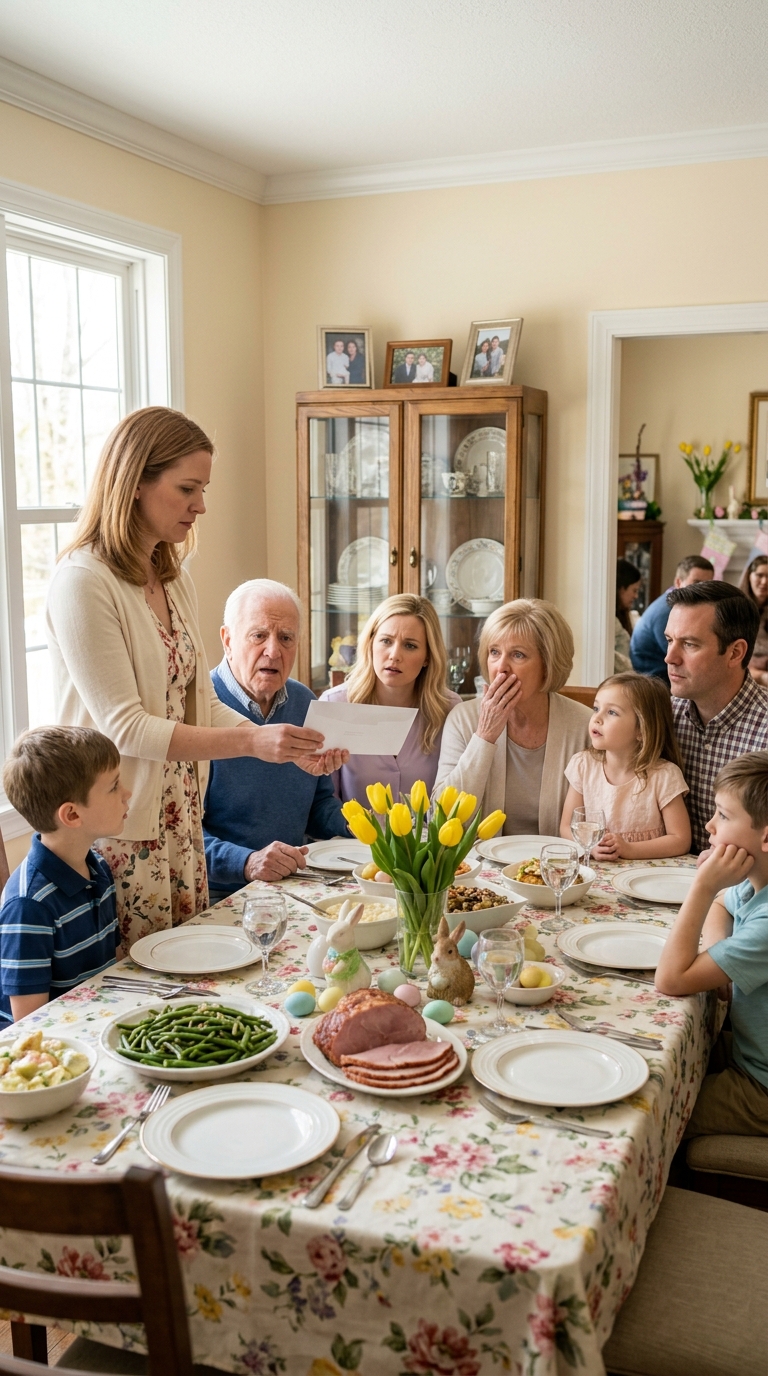
Easter at my parents’ house always looked perfect from the outside.
That was my mother’s gift.
She could make a table look like love even when half the people sitting around it were afraid to speak honestly. She could arrange flowers in a crystal vase, polish silver until it caught the morning light, and place a honey-glazed ham at the center of the dining room table so beautifully that anyone walking in would think our family was warm, generous, and whole.
That Sunday, sunlight poured through the kitchen windows in soft gold sheets. The good plates were stacked beside the ham. Deviled eggs sat in rows on the platter my grandmother used every spring. My mother’s floral linen covered the table, pressed smooth except for one tiny crease near the corner where my daughter Lily had tugged it earlier while trying to reach a bowl of jelly beans.
From the outside, it looked like a family holiday.
From the inside, it felt like a room holding its breath.
My wife, Marianne, had been helping since before most people arrived.
She did not have to. That was the first thing people always missed about her. Marianne never helped because she was trying to prove something. She helped because that was how she moved through the world. Quietly. Faithfully. Not asking for applause.
She refilled iced tea before anyone noticed their glass was empty. She pulled the rolls from the oven just before they browned too much. She checked the casseroles my mother had forgotten while answering the door. She brought coffee to my father, who was still moving slowly after surgery, and placed it on the side table beside his chair exactly where he could reach it without straining.
“Thank you, sweetheart,” Dad said.
Marianne smiled. “Of course.”
That was how she loved people.
Through effort.
Through attention.
Through remembering the small things other people forgot.
We had been married eight years by then, and in those eight years, Marianne had shown up for my family more consistently than some people born into it. She sat beside my mother during hospital visits. She took meals to my grandmother in the last months of her life. She planned birthday dinners for relatives who barely thanked her. She remembered which cousin had a nut allergy, which uncle needed a ride after eye surgery, and which kid liked chocolate cake better than vanilla.
She was family in every way that mattered.
But Aunt Carol never accepted that.
To Carol, Marianne remained “the woman Ryan married,” a phrase she used when she thought she was being subtle. She never said it loudly. Carol’s cruelty did not come in the form of shouting or scenes. It came dressed as manners.
At Thanksgiving, she once asked Marianne, “Will your real family be expecting you later?”
At Christmas, she said, “It must be hard learning how our side does things.”
At my father’s surgery, after Marianne had been at the hospital since five in the morning, Carol smiled across the waiting room and said, “You’re certainly trying.”
Trying.
As if love was an audition and Carol owned the casting rights.
Marianne always heard the edge beneath those sentences. I knew she did because her shoulders would stiffen for half a second before she softened herself again.
I hated that.
I hated that my wife had learned to protect other people’s comfort from their own cruelty.
That Easter, Carol arrived twenty minutes late in a pastel dress, carrying a designer purse and a bakery box from the most expensive place in town. She swept into the kitchen like a woman entering a room she expected to rearrange.
“Happy Easter,” she sang.
She kissed my mother’s cheek, kissed the air near my father, and gave me a hug that smelled like gardenias and judgment.
Then her eyes landed on Marianne.
Marianne was standing near the oven in a pale blue dress, holding a dish towel and checking the sweet potatoes.
Carol looked her up and down with a small smile.
“Oh, Marianne,” she said. “You’re still working.”
Marianne smiled politely.
“The rolls were almost ready.”
Carol’s smile sharpened.
“How useful.”
There it was.
The first cut.
Not deep enough for most people to call it blood.
Deep enough for me to feel it.
I looked at my aunt, but she had already turned away, opening her bakery box and announcing that she had brought lemon cake because “someone had to bring a dessert that wasn’t from a grocery store.”
My mother laughed nervously.
Marianne said nothing.
I should have said something then.
That is one of the truths I still carry.
I should have stopped it before the table. Before the envelopes. Before my children stood in the middle of a holiday gathering learning that grown-ups could dress rejection in good china and call it tradition.
But I had spent years telling myself Carol was just difficult. Old-fashioned. Protective of the family. Lonely after Uncle Robert died. Used to getting her way because my grandparents had trusted her with too much.
Excuses are small doors that open into bigger rooms.
By the time lunch was served, the house was full. My parents’ living room overflowed with cousins, spouses, kids, and the kind of noise that makes holidays feel both cheerful and slightly dangerous. Children ran through the hallway with plastic eggs. Adults leaned against counters, balancing plates and gossip. My father sat in his recliner with a blanket over his knees, pretending not to be tired.
My son Ethan was eleven. Tall for his age, quiet, with serious brown eyes and a habit of listening before speaking. Lily was seven, all curls, questions, and sudden hugs. Marianne had adopted Ethan before I met her, after his biological father disappeared. Lily was Marianne’s daughter from a brief first marriage that ended before Lily was old enough to remember it.
When Marianne and I married, I adopted them both.
Not because anyone pressured me.
Not because it looked good.
Because they were mine.
I still remember the day the judge signed the papers. Ethan tried to look serious in a little navy jacket, but his hands trembled when the judge asked if he understood what adoption meant.
“It means he’s really my dad?” Ethan asked.
The judge smiled.
“If that is what all of you want.”
Ethan looked at me.
I said, “It already happened in my heart. The court is just catching up.”
He cried then.
So did I.
Lily had been too young to understand all of it, but she understood enough to crawl into my lap afterward and ask if she could have my last name “forever and ever.”
I told her yes.
From that day forward, there was no step in my mind.
No almost.
No different.
My children were my children.
I thought my family understood that.
Or maybe I only hoped they did.
Lunch passed in the usual way. My mother worried the ham was dry even though it wasn’t. My father told the same story about my first Easter suit, the one where I apparently cried because the collar scratched my neck. Cousin Amy’s twins knocked over a basket of plastic eggs. Marianne helped clean it up before Amy even stood.
Carol sat near the center of the table, where she preferred to sit, letting people bring things to her as if age and money had combined to make her royal.
After lunch, coffee and cake were set out. The kids gathered near the living room rug, tired from hunting eggs in the yard. Their cheeks were flushed. Their baskets were full of candy. Lily leaned against my knee, unwrapping a chocolate bunny with great concentration. Ethan sat beside her, reading the label on a jelly bean bag because he had recently become suspicious of artificial dyes.
The room was warm, lazy, almost peaceful.
Then Aunt Carol tapped one polished nail against her purse.
“Children,” she called, “come here. I have something special.”
Every child in the room turned.
Carol smiled like a benefactor in an oil painting.
The kids rushed over.
Lucas first, because he was always fastest. Emily and Noah pushed in behind him. Little Sophie toddled after them, clutching a stuffed rabbit.
Carol opened her designer purse and removed a stack of thick white envelopes.
The room perked up immediately.
Adults smiled. Phones came out. My cousin Mark said, “Oh, Carol, what did you do now?”
Carol pretended to be embarrassed.
“Just a little Easter blessing from the family trust,” she said.
She handed one envelope to Lucas.
One to Emily.
One to Noah.
One to Sophie.
Inside each was five hundred dollars.
The kids gasped. Parents laughed. Someone said, “Carol, that’s too much,” in the exact tone people use when they are pleased it is not too much at all.
My son Ethan stood slowly.
He was trying not to look eager, which somehow made it worse. He had been saving for a robotics kit for months, doing small chores and refusing to spend birthday money. Five hundred dollars to him would have felt like a miracle.
Lily slid off my knee and took one step forward, her chocolate bunny forgotten in her hand.
Carol closed her purse.
The room changed before anyone spoke.
Sometimes silence has a temperature.
This one turned cold.
Lily looked at Carol’s purse, then at the other children holding envelopes.
Then she tugged my sleeve.
“Daddy,” she whispered, “did she forget us?”
The room froze.
My mother’s hands tightened around the stack of dessert plates.
My father stopped lifting his coffee cup.
Marianne’s hands went still in her lap.
I looked at Carol and gave her one chance.
One chance to laugh and say, Oh goodness, I left two in the car.
One chance to fix it.
One chance to be decent.
My mother spoke first, softly.
“Carol, you skipped Ethan and Lily.”
Carol smiled.
That was when I knew.
It had not been an accident.
“I didn’t skip anyone,” she said.
Every adult in the room seemed to stop breathing.
Carol placed her purse carefully beside her chair.
“The money comes from the family trust,” she continued. “I gave it to the family children.”
The word family hit the table like broken glass.
For a second, I could not move.
I looked at Ethan.
His face had gone red, but he was staring down at the floor, trying to make his expression disappear before anyone saw the hurt. Lily pressed herself against my side, confused and embarrassed, still young enough to think adults always had reasons that made sense.
Marianne’s face closed.
I knew that look.
It was the look she wore when pain had to be folded and put away because children were watching.
I kept my voice calm.
“What is that supposed to mean?”
Carol turned her head toward Marianne.
“It means the trust is for blood relatives. Marianne isn’t family. She is someone you married. Why should her children benefit from our family’s work?”
Someone gasped.
I do not know who.
Maybe my cousin Amy.
Maybe my mother.
Maybe me.
Marianne flinched, but only once.
“They are my children,” I said.
Carol lifted one shoulder in a delicate shrug.
“Adopted or not, Ryan, it’s different.”
Different.
That word has done more damage in families than most people admit.
“If Marianne wants them to have money,” Carol continued, “she can work an extra shift.”
The room went utterly silent.
Then Lily began to cry.
Not loudly. Not dramatically. Just a small broken sound before she buried her face against my side.
Ethan did not cry.
That broke me more.
He stood there with his ears burning red, hands clenched at his sides, trying to become invisible at a family table.
My son was eleven years old, and he was already learning how humiliation works.
Not from strangers.
From people who had eaten his birthday cake.
Not from bullies.
From his father’s aunt.
And every adult in that room, every cousin, every sibling, every person who had smiled while Marianne filled their coffee, sat there silent.
That was what snapped something inside me.
Not Carol’s cruelty.
Not even my parents’ hesitation.
It was Ethan trying to disappear.
I stood.
The chair legs scraped against the floor.
“Then don’t call us family anymore.”
Carol blinked.
I took Ethan’s hand.
Then I lifted Lily into my arms.
“Marianne,” I said. “We’re leaving.”
My wife looked at me.
There was surprise in her face.
And something else.
Relief.
Carol gave a little laugh behind us.
“Ryan, don’t be dramatic. It’s just an inheritance policy.”
I kept walking.
My mother said my name once.
“Ryan—”
But she did not stand.
My father looked down into his coffee.
No one followed us outside.
Not my mother.
Not my father.
Not one cousin.
The spring air hit my face when I opened the front door. The sky was bright. The neighborhood lawns were green. Somewhere down the street, a child laughed, and the sound felt like it belonged to a different world.
We got into the car in silence.
Lily cried against Marianne’s shoulder.
Ethan buckled himself in without a word and stared out the window.
I sat behind the steering wheel with my hands gripping it so hard my knuckles ached.
Marianne reached over and touched my arm.
“I’m sorry,” she whispered.
I turned toward her sharply.
“You did nothing wrong.”
Her eyes filled.
“I know.”
But she did not sound like she believed it.
That was the damage Carol had done.
A woman who had spent eight years loving my family had just apologized for being rejected by them.
I started the car.
The drive home took twenty-eight minutes.
Nobody spoke for the first ten.
Then Lily asked from the back seat, “Are we not family?”
My chest hurt.
Marianne turned in her seat, but no words came out.
I pulled into a parking lot, stopped the car, and turned around.
“Lily Grace,” I said, “look at me.”
She looked up, cheeks wet.
“You are my daughter. Ethan is my son. Your mom is my wife. That is our family. Nobody at that table gets to vote on that.”
Ethan’s eyes moved to mine.
He was trying to be strong.
I hated that he felt he had to.
“Then why did Aunt Carol say that?” he asked.
“Because Aunt Carol was cruel,” I said. “And wrong.”
He swallowed.
“Why didn’t anybody else say anything?”
That question sat in the car with us.
Marianne closed her eyes.
I answered honestly.
“Because sometimes adults are cowards.”
Ethan nodded slowly.
It was not a comforting answer.
But it was true.
When we got home, I put the kids on the couch with blankets and a movie. Marianne made popcorn because routine helps children believe the world has not completely shifted. Lily curled into Ethan’s side. He let her.
Then I went into my office and closed the door.
Carol thought I was just a nephew she could shame at dinner.
She had forgotten what I did for a living.
I was a senior logistics and commercial zoning consultant, the kind of job that sounds boring until someone needs permits, preservation clauses, lender approvals, transportation impact studies, and redevelopment clearances handled without mistakes. I spent my professional life reading documents other people skimmed and finding the sentence that would decide whether a multimillion-dollar project moved forward or died quietly in a conference room.
Two years earlier, Carol had come to me with a smile, a folder, and the phrase she always used when she wanted something.
“Family business.”
The family trust had entered into its largest redevelopment project ever: an old textile warehouse on the edge of downtown that was being converted into retail, office space, and luxury apartments. The project required zoning support, preservation compliance, lender confidence, and a guarantor statement regarding logistics feasibility.
Carol, as sole manager of the trust, needed my professional support.
She needed my signature.
Back then, she had called me “the bright one.”
She had said my grandfather would be proud.
She had said, “This is what family does, Ryan. We help build something together.”
I believed her.
At 3:14 that afternoon, I opened my laptop and pulled up the documents.
My hands were steady.
That surprised me.
Anger had become something clearer.
I reviewed the guarantor agreement, the trust participation clauses, the good-faith execution requirements, the family beneficiary language, and the lender notification provisions. Then I drafted a formal rescission of guarantor support and advisory cooperation.
The reason was simple:
Violation of trust good-faith execution clauses and discriminatory exclusion of eligible minor beneficiaries.
I copied the zoning board.
The commercial lenders.
The project attorney.
The trust attorney.
Carol.
Paperwork is quiet.
That is why people underestimate it.
But paperwork can walk into rooms anger never could.
Without my support, acquisition funds could freeze. Loans could default. Preservation penalties could trigger. Lenders could demand review. The zoning board could delay hearings. The whole project could stall before Monday morning.
I read the email twice.
Then I clicked send.
For twenty-three minutes, nothing happened.
I walked back into the living room and sat beside my children. Ethan was pretending to watch the movie. Lily was asleep with her head on Marianne’s lap.
Then my phone began vibrating.
Carol.
I ignored it.
It rang again.
Then texts began arriving.
Answer the phone right now.
What is this email from the zoning board?
Ryan, you are making a serious mistake.
They are freezing the acquisition funds.
Call me immediately.
Marianne looked at my phone.
“What did you send?”
“The truth.”
My mother called next.
Then my father.
Then Carol again.
Lily woke slightly and looked at the buzzing phone.
“Is she mad?”
I turned it face down.
“She’s loud,” I said. “That’s different.”
Ethan looked at me.
“Are we in trouble?”
That nearly broke me.
“No,” I said firmly. “Neither of you did anything wrong.”
He looked like he wanted to believe me.
I would spend a long time making sure he did.
That evening, my father left a voicemail.
“Ryan,” he said, voice tired, “Carol is saying there’s another document with your grandfather’s name on it. She says you don’t understand the trust. Call me.”
Something in his tone made me sit up.
Not anger.
Fear.
I went back to my office and opened my email.
There was a message from the zoning board’s legal review liaison. Attached was a scanned amendment to the family trust, submitted as part of prior underwriting but apparently never circulated to the full family.
I opened it.
Page one was formal language.
Page two covered distribution discretion.
Page three changed everything.
I read it once.
Then again.
Then I called Marianne.
She stood in the doorway while I read aloud.
For purposes of minor beneficiary recognition, the term family children shall include biological descendants, legally adopted children, stepchildren raised within the household of a beneficiary, and any child publicly recognized, supported, and presented by a beneficiary as part of the family unit.
Marianne covered her mouth.
Carol had not been following the trust.
She had been lying about it.
The five-hundred-dollar envelopes had not revealed a policy.
They had revealed a prejudice.
I forwarded the amendment to my parents, siblings, cousins, the trust attorney, and the project attorney.
Subject line:
Trust amendment regarding minor beneficiaries.
No speech.
No insults.
No explanation.
Just the proof.
By Monday morning, the redevelopment project was under review.
The lenders requested clarification regarding trust governance. The project attorney asked why eligible minors had been excluded from distributions. The trust attorney requested a full accounting of past disbursements. The zoning board delayed its next approval pending documentation of valid guarantor support.
Carol called thirty-six times that week.
I answered none.
She left voicemails that moved from outrage to tears to threats to fake concern.
“You are destroying your grandfather’s legacy.”
“This is not how family handles disagreement.”
“You’re letting Marianne manipulate you.”
“The children will suffer if this project fails.”
That last one almost made me answer.
Almost.
Then I remembered Lily’s voice.
Did she forget us?
I deleted the message.
A week later, my parents came to our house.
They brought Easter candy.
Late.
Bright baskets with ribbon handles, chocolate bunnies, jelly beans, and gift cards tucked into plastic grass.
I opened the door and did not invite them in immediately.
My mother looked smaller than she had the week before. My father seemed older. Surgery had thinned him, but shame had done something else to his posture.
“Can we come in?” Mom asked.
I stepped aside.
Ethan and Lily were in the living room building a Lego set together. Marianne sat nearby with a book open in her lap, though I could tell she had not turned the page in a while.
My mother stopped a few feet from Lily and knelt slowly.
She did not reach for her.
That mattered.
“I am sorry,” Mom said. “I should have protected you at that table.”
Lily looked at me.
I nodded once.
She did not hug my mother.
She did not have to.
Ethan stood.
“Why didn’t you say anything?”
My father swallowed.
The room waited.
Finally, he said, “Because I was afraid of your aunt.”
It was not a noble answer.
It was not a good excuse.
But it was finally the truth.
Ethan studied him.
“You’re a grown-up.”
Dad’s eyes filled.
“Yes,” he said. “I am. And I acted like a coward.”
Marianne looked down.
I watched my son absorb that.
Not every apology repairs what was broken. Some apologies simply name the crack.
But naming matters.
My mother turned to Marianne next.
“I’m sorry to you too,” she said. “You have done more for this family than most of us have admitted.”
Marianne’s mouth trembled.
“Thank you.”
My mother looked as if she wanted to say more, but wisely did not.
That was the beginning of a repair.
Not the repair itself.
The trust review took months.
Carol had not stolen bags of cash. That would have been cleaner, in some ways. Easier to condemn. Easier to punish.
What she had done was smaller and uglier.
Selective distributions.
Delayed notices.
Discretionary payments to relatives who praised her.
Withheld opportunities from those who questioned her.
Uneven records.
A habit of treating the trust as her personal scoreboard, rewarding loyalty and punishing disobedience.
The Easter envelopes were not the largest problem.
They were simply the moment she accidentally revealed the system.
Outside counsel was hired. The trust attorney resigned from direct administration. Lenders required independent oversight before releasing the next redevelopment stage. Carol fought, cried, threatened to sue, and gave one spectacular speech about family unity that reportedly ended when my cousin Amy asked whether unity required excluding children.
Eventually, Carol was removed as sole manager.
The redevelopment continued, but with oversight, co-signatures, transparent accounting, and people finally reading documents before nodding along.
Ethan and Lily received their Easter distributions months later.
Not from Carol.
From the new administrator.
Each envelope arrived by certified mail, along with a written apology acknowledging that they had been eligible beneficiaries under the trust amendment.
Ethan read the letter silently.
Then he asked if he could keep it.
“Of course,” I said.
He put it in a folder in his desk.
Lily spent ten dollars of hers on stickers and saved the rest because Marianne told her saving money was also power.
The next family gathering was Thanksgiving.
We almost did not go.
For weeks, Marianne and I debated it. Not because we wanted to pretend everything was fine. It was not. But because avoiding the family forever would have allowed Carol’s cruelty to become the final word in rooms where my children belonged.
So we went.
On our terms.
We drove separately. We stayed only two hours. We told the children ahead of time that if anything felt wrong, we would leave immediately.
The atmosphere was painfully awkward.
People overcorrected.
Cousin Amy asked Marianne three times if she needed help carrying dishes. My mother complimented Ethan’s shoes. My father asked Lily about school and actually listened to her answer. Someone brought extra cupcakes and made sure Lily got first choice.
It was clumsy.
Almost funny.
But no one said blood relatives.
Carol did not attend.
No one knew whether she had refused or been told not to come.
I stopped caring which.
Halfway through the meal, Ethan leaned toward me and whispered, “This feels weird.”
I whispered back, “Healing usually does.”
He considered that.
Then he reached for another roll.
That was enough.
Over time, my children learned something I wish they had never needed to learn so young: belonging cannot depend on the comfort of people who benefit from excluding you.
But they learned something better too.
They learned that their father would stand.
Not eventually.
Not privately.
Not with a careful little conversation after the damage was done.
They learned I would stand in the room where it happened.
They learned Marianne did not have to earn what had already been true.
They learned that paperwork, when honest, can defend the people cruelty tries to erase.
One year after that Easter, we hosted brunch at our house.
Not my parents.
Not Carol.
Ours.
My mother came early and asked Marianne what she could do. Marianne handed her a cutting board and a bowl of strawberries. My father sat with Ethan in the garage, listening as Ethan explained his robotics kit. Lily made place cards with glitter, and every single one had the word family written across the top.
When she handed me mine, I had to turn away for a second.
Marianne noticed.
She always noticed.
She came beside me and touched my back.
“You okay?”
I looked around our kitchen.
At my mother slicing strawberries.
At my father laughing with Ethan.
At Lily taping crooked paper flowers to the wall.
At the woman I loved, finally standing in a family space without shrinking.
“Yes,” I said. “I think I am.”
That afternoon, after everyone left, I found Marianne on the back porch.
She was sitting with a cup of tea, looking toward the yard where the children had scattered plastic eggs under the trees.
I sat beside her.
“I’m sorry I didn’t stop Carol sooner,” I said.
She looked at me.
“You stopped her when it mattered most.”
“No,” I said. “It mattered before that too.”
Her eyes softened.
“Yes. It did.”
That was one of the reasons I loved Marianne.
She did not rescue me from the truth.
She let me sit with it.
“I’ll do better,” I said.
“I know.”
She took my hand.
Inside, Lily laughed at something Ethan said.
The sound carried through the open window.
That Easter at my parents’ house, Carol tried to teach my children they were less than the others.
She tried to teach my wife that eight years of love could be erased by one woman with a designer purse and a cruel definition of family.
She tried to teach me that silence was the price of keeping peace.
Instead, she taught us something else.
Family is not proven by envelopes.
It is not proven by bloodlines, trust language, old names, or who sits closest to the ham on Easter Sunday.
Family is proven by who stands up when someone tries to make you disappear.
It is proven by the hand that reaches for the child who has been humiliated.
By the spouse who walks out with you.
By the apology that does not demand a hug.
By the document that tells the truth when powerful people lie.
By the room that finally has to say what should have been obvious all along.
They belonged.
Marianne belonged.
Ethan belonged.
Lily belonged.
They always had.
Carol simply forced everyone else to admit it.
THE END.