
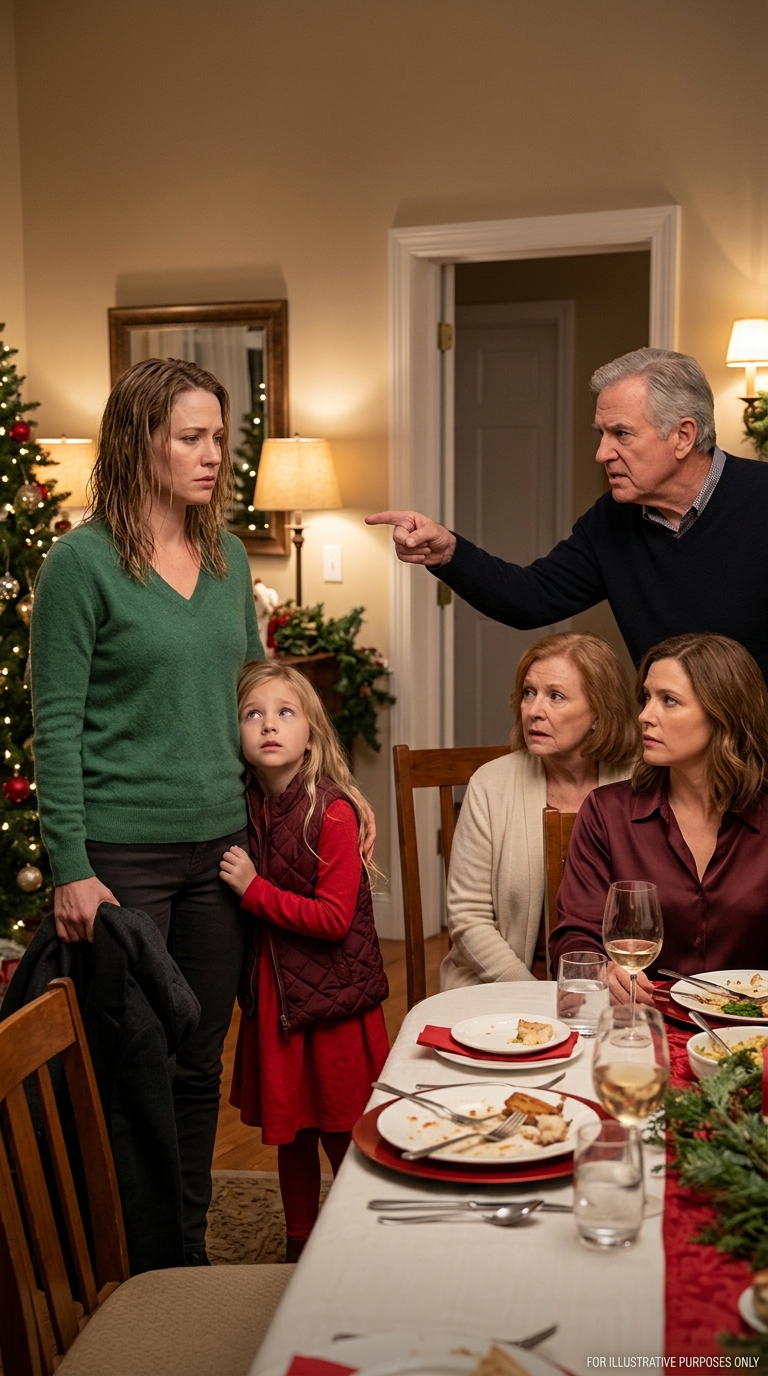
The petition had been drafted eleven days before Christmas.
Eleven days before Rosie asked about Great-Grandma Ruth’s safety net.
Eleven days before my father called a seven-year-old rude and tried to send her into a cold room to eat alone.
I looked up at Martin.
“What were they asking the court to do?”
He folded his hands on the desk.
“They wanted your father appointed as temporary guardian of Rosie’s property.”
I stared at him.
“Rosie’s property?”
“Her trust.”
My eyes returned to the papers.
The language was dense, but several phrases stood out.
Financial instability.
Questionable judgment.
Inability to protect the minor beneficiary.
Family intervention.
My mouth went dry.
“They were saying I was unfit.”
“They were preparing to.”
“Based on what?”
Martin turned another page toward me.
There were screenshots of my social media account.
One showed Rosie and me eating takeout pizza on the floor after moving into our apartment.
Another showed her sleeping beside me on the couch during a movie.
A third showed a stack of unopened moving boxes in the background.
Ordinary photographs.
But beneath each image, my father had written notes.
Unstable living arrangement.
Lack of routine.
Inadequate household structure.
I felt sick.
“They used pictures of us?”
“They intended to.”
Martin removed several printed emails.
In one, my mother wrote that Rosie had become “increasingly curious about money” and needed “stronger family supervision.”
In another, Camilla described me as emotionally reactive and financially irresponsible.
Then I saw a message from my father.
Once Emma signs the temporary authorization, we can deal with Martin directly. She doesn’t understand what Ruth set up.
I looked at Martin.
“What authorization?”

He reached for another folder.
Inside was a document titled:
FAMILY ASSET PROTECTION AGREEMENT
At first glance, it looked harmless.
It spoke about education, stability, and preserving family resources.
But Martin pointed to a paragraph near the bottom.
“If you had signed this, you would have authorized your father to act as Rosie’s financial representative.”
“For how long?”
“Until she turned twenty-five.”
The room seemed to shrink.
“He wanted control of her trust for eighteen years?”
“Yes.”
“Could he have taken the money?”
“Not directly. The trust is written to prevent that.”
Martin paused.
“But he could have created years of litigation, delayed distributions, challenged the trustee, and tried to bill the trust for legal expenses.”
I looked down at the draft agreement.
“Were they planning to ask me to sign this at Christmas dinner?”
“That appears to have been the plan.”
Suddenly, I remembered the leather folder sitting on the sideboard behind my father’s chair.
He always kept tax papers and insurance documents in it.
That evening, I had noticed it because Camilla moved it when Ava posed for photographs.
I had assumed it was nothing.
Martin opened one final email.
It had been sent by my mother to Camilla.
Keep Emma calm through dinner. Dad will raise the agreement after dessert. If she resists, remind her how much help we have provided.
The time stamp was Christmas Eve.
I pressed both palms against the edge of the desk.
“They invited us there to trap me.”
Martin did not soften the answer.
“Yes.”
“And Rosie’s question ruined it.”
“Rosie’s question told them Ruth had spoken to her.”
The humiliation had not been spontaneous.
My father had not simply lost his temper.
He had panicked.
He had needed Rosie to feel ashamed of asking about the trust before I could begin asking questions of my own.
I thought about her little face at the dinner table.
The way she had whispered, “I’m sorry.”
The way my mother told her to understand her position in the family.
They had not been correcting a child.
They had been protecting a plan.
I looked at Martin.
“What exactly did Ruth leave Rosie?”
He was quiet for a moment.
Then he reached into the thick trust folder and removed a financial summary.
“Several investment accounts. A small commercial property outside Erie. Mineral rights inherited from her father.”
He turned the page.
“And the house where your parents live.”
I blinked.
“What?”
“The house on Stanton Avenue belongs to the Rosalie Harris Trust.”
I almost laughed because the statement sounded impossible.
My father had spent my entire life calling that property his house.
He had renovated the kitchen.
He complained about the taxes.
He threatened to remove my name from his will whenever I disagreed with him.
“That house has been in my father’s name for thirty years.”
“No,” Martin said. “It was in Ruth’s name.”
“My parents bought it from her.”
“They did not.”
“They paid her.”
“They made monthly payments toward expenses. Ruth allowed them to describe those payments however they wished.”
He pulled out a recorded deed.
The county seal appeared at the top.
The transfer had been completed four years before Ruth’s death.
Grantor: Ruth Harris.
Grantee: Rosalie Harris Trust.
I read Rosie’s full legal name again.
Then I read the property address.
It was my parents’ house.
The dining room.
The den.
The polished glasses.
The place where my father had ordered Rosie to eat alone until she learned her place.
All of it belonged to a trust created for the child he had tried to humiliate.
I looked at Martin.
“Do they know?”
“They know Ruth transferred the house.”
“But do they know the trust belongs to Rosie?”
“They were provided notice.”
“Then why would they act like this?”
“Because your father believed he could pressure you into signing the agreement before you learned how much authority the trust already had.”
Martin pointed to another document.
“Your parents do not have a life estate. They have a conditional right of occupancy.”
I did not understand.
He explained.
“Ruth allowed them to remain in the house as long as they paid the expenses, maintained the property, and did not interfere with the beneficiary or trustee.”
I read the clause.
The language was direct.
Any attempt to intimidate, defraud, coerce, isolate, or improperly influence the beneficiary or her legal guardian could terminate the occupancy agreement.
My father’s voicemail demanding that Rosie return and apologize suddenly felt different.
So did Camilla’s laughing message.
So did my mother’s statement about Rosie’s position.
“Did Ruth expect this?”
“Yes.”
Martin’s answer came without hesitation.
“She expected your father to try to take control.”
“Why didn’t she tell me?”
“She did not trust that you were ready to stand against him.”
The words hurt because they were true.
A year earlier, I might have signed anything my father placed in front of me just to stop him from becoming angry.
I had spent most of my life confusing peace with obedience.
Ruth had known that.
“She told me you would call only after protecting Rosie became more important than keeping your family comfortable,” Martin said.
I stared at the documents.
“What happens now?”
“That depends partly on you.”
“Do we remove them from the house?”
“Not today.”
Relief and disappointment collided inside me.
I did not want to become cruel.
But I also did not want them sitting beneath Ruth’s roof while plotting to take Rosie’s inheritance.
Martin continued.
“First, we preserve the evidence. Then I send a formal notice directing them to stop contacting you about the trust.”
“And the petition?”
“It has not been filed yet.”
“Why not?”
“Because they needed your signature on the family agreement to strengthen their position.”
He closed the thin packet.
“They failed.”
My phone vibrated on the desk.
It was my mother.
Then my father.
Then Camilla.
I turned it face down.
Martin watched me.
“You do not have to speak with them today.”
“I know.”
It was the first time I had said those words and believed them.
Martin’s assistant scanned my documents while he prepared the notice.
He copied the voicemail in which my father demanded Rosie’s apology.
He saved Camilla’s voice message.
He took screenshots of the family photographs posted after we left.
Each cheerful image now looked like part of a performance.
Before I left, Martin handed me a sealed envelope.
“Do not open this unless you are ready.”
“What is it?”
“A letter from Ruth.”
I held it against my coat.
“When did she write it?”
“Two weeks before she died.”
“Why didn’t you give it to me sooner?”
“She instructed me to wait until you called.”
I looked at my grandmother’s handwriting across the front.
For Emma, after she chooses Rosie.
I opened it in the parking garage.
The first line made me grip the steering wheel.
My dear Emma,
If you are reading this, your father finally punished Rosie for noticing what he wanted hidden.
I continued.
You may be wondering why I did not tell you everything while I was alive.
The truth is not kind.
You spent your childhood learning how to survive your father’s anger. You became skilled at surrendering before anyone could accuse you of causing trouble. I watched you apologize for things you did not do. I watched your mother call that maturity.
It was not maturity.
It was training.
My vision blurred.
I could not place Rosie’s future in your hands until I knew you would stop offering her as payment for family peace.
I lowered the letter.
The words were severe.
But they were not wrong.
How many times had I told Rosie to hug someone who made her uncomfortable?
How many times had I explained away my father’s insults?
How many times had I asked her to be polite when what I really meant was silent?
I kept reading.
The trust is not a reward.
It is a wall.
Your father believes money proves authority. I created something he could not command.
The house is included because he has used it for years as a throne. He has made every person who enters it feel as though shelter, food, and belonging depend on pleasing him.
They do not.
That house belongs to Rosie’s trust because I wanted the smallest person at that table to possess the one thing your father always used to frighten everyone else.
Security.
At the bottom, Ruth had written one final paragraph.
Do not use the trust to punish them.
Use it to end the punishment.
I sat in the garage for nearly half an hour.
Then I drove home.
Rosie was staying with my neighbor, Mrs. Alvarez.
When I picked her up, she ran toward me holding a paper snowflake she had made.
“Did the man know Great-Grandma?”
“Yes.”
“Did she really leave something?”
I crouched so we were at eye level.
“She did.”
“What?”
“A way to make sure you are safe.”
Rosie considered that answer.
“Are Grandpa and Grandma safe too?”
The question caught me off guard.
Even after they had humiliated her, she was worried about them.
“For now,” I said.
She nodded.
Then she held out the snowflake.
“This one is for you.”
That evening, Martin sent the formal notice.
My parents were instructed not to contact Rosie about the trust, not to request signatures, and not to destroy any documents.
The notice also informed them that their attempt to interfere with the beneficiary might violate the occupancy agreement.
My father called twenty-one times.
I answered the twenty-second.
He did not say hello.
“You went to a lawyer?”
“Martin is the trust attorney.”
“You had no right.”
I almost laughed.
“No right to ask about my daughter’s trust?”
“This is family business.”
“No. This is Rosie’s business.”
His breathing became heavy.
“You have no idea what you are doing.”
“I know you prepared a guardianship petition before Christmas.”
Silence.
It lasted only two seconds, but it told me everything.
Then his voice changed.
He became calm.
That was always when he was most dangerous.
“Emma, your mother and I were trying to protect the child.”
“From me?”
“From instability.”
“What instability?”
“You move too often. You work irregular hours. You make emotional decisions.”
“I left one apartment because the landlord sold the building.”
“That is not the point.”
“It is exactly the point.”
He lowered his voice.
“Come to the house. Alone. We can resolve this.”
“No.”
“Do not make a permanent decision because of one difficult dinner.”
“You prepared legal documents eleven days before that dinner.”
Another silence.
Then he said, “Martin has always hated this family.”
“Martin didn’t order Rosie into the den.”
“She needed discipline.”
“She asked a question.”
“She asked about money at Christmas dinner.”
“She asked about something Ruth told her.”
My father’s voice sharpened.
“Ruth was confused at the end.”
“Ruth recorded the deed four years before she died.”
He stopped breathing for a moment.
That was when I understood.
He knew about the transfer, but he had convinced himself the deed could still be challenged.
Or hidden.
Or outlasted.
He had counted on my ignorance.
“What did Martin show you?” he asked.
“Enough.”
“You bring those papers here.”
“No.”
“Emma.”
“We’re finished.”
I ended the call.
Ten minutes later, Camilla arrived at my apartment.
She knocked so hard that Rosie came out of her bedroom.
I told her to stay inside, then stepped into the hallway and closed the door behind me.
Camilla held her phone in one hand.
“What have you done to Dad?”
“I told the truth.”
“He looks sick.”
“That is not my fault.”
“You are threatening to throw our parents out of their home.”
“I have not threatened anyone.”
“Martin sent a notice.”
“Because you helped prepare a petition to take control of Rosie’s trust.”
Camilla rolled her eyes.
“No one was taking anything.”
“Then why was your name on the emails?”
Her face changed.
Only slightly.
But I saw it.
“Dad asked for advice.”
“You called me emotionally unstable.”
“You are.”
The hallway became very quiet.
Camilla seemed to realize what she had said, but she did not take it back.
Instead, she folded her arms.
“You ran out of Christmas dinner because Rosie was asked to apologize.”
“She was ordered to eat alone.”
“She needs to learn that adults make the rules.”
“Not anymore.”
Camilla laughed.
“You think a few papers make you powerful?”
“No.”
I looked at the closed apartment door behind me.
“Leaving made me powerful.”
Her smile disappeared.
“You have always been jealous of Ava.”
I stared at her.
The accusation was so absurd that I almost admired it.
“This has nothing to do with Ava.”
“It has everything to do with her. Ruth always favored Rosie.”
“Ruth protected Rosie because Dad tried to control everyone else.”
Camilla stepped closer.
“You think Rosie deserves that house?”
“She is seven. She does not think she deserves anything.”
“Then sign it over.”
There it was.
Not concern.
Not fairness.
Not family.
The house.
“What did Dad promise you?” I asked.
Camilla looked away.
I understood before she answered.
“He was going to help you buy a house.”
Her jaw tightened.
“He said the Stanton property would eventually be divided between us.”
“It was never his to divide.”
“He maintained it for decades.”
“With Ruth’s permission.”
“He earned it.”
“No. He occupied it.”
Camilla’s face flushed.
“You are going to destroy this family.”
I shook my head.
“The family was already willing to destroy Rosie’s sense of safety for a property none of you owned.”
She left without another word.
The next morning, Martin called.
My father had requested an emergency meeting.
“He says he wants to settle the issue privately,” Martin said.
“I don’t trust him.”
“Neither do I.”
“Then why meet?”
“Because he has begun claiming the deed is fraudulent.”
I closed my eyes.
“Can he win?”
“No.”
Martin’s confidence steadied me.
“The deed was properly executed, notarized, and recorded. Ruth also completed a video statement with two witnesses and a physician confirming her capacity.”
“Then what does he want?”
“To frighten you before he understands how complete the evidence is.”
The meeting took place that afternoon at my parents’ house.
Martin insisted on attending.
Rosie stayed with Mrs. Alvarez.
When we arrived, the Christmas decorations were still in place.
The candles had been removed, but the polished glasses remained inside the cabinet.
The den door stood open at the end of the hallway.
I looked inside.
The folded card table was still there.
For a moment, I imagined Rosie sitting alone beneath the dim ceiling light, eating from a plate carried away from everyone else.
My anger returned.
Not wild anger.
Clear anger.
The kind that no longer needed permission.
My father waited in the dining room with my mother and Camilla.
A man I did not recognize sat beside them.
He introduced himself as their attorney.
Martin placed his briefcase on the table.
My father did not offer us chairs.
Martin pulled one out for me anyway.
“This is my house,” my father said.
Martin looked at him.
“That is the central misunderstanding.”
My father’s attorney shifted uncomfortably.
My mother spoke first.
“Before this becomes ugly, we should remember that Ruth wanted the family together.”
Martin opened his briefcase.
“Ruth left written instructions stating otherwise.”
My mother’s mouth closed.
My father pointed at me.
“She manipulated an old woman.”
“I did not know the trust existed,” I said.
“That is what she claims.”
Martin removed the recorded deed.
He placed it in the middle of the dining table.
The county stamp was clearly visible.
My father looked down.
Every trace of color vanished from his face.
Martin turned the document so the attorney could read it.
“Ruth Harris conveyed the property to the Rosalie Harris Trust four years before her death.”
My father’s attorney adjusted his glasses.
“I was told the property remained in Mr. Miller’s name.”
“It never stood in his name.”
The attorney looked at my father.
“Is that true?”
My father did not answer.
Martin continued.
“The occupants were granted a conditional license to remain in the home. That license prohibits interference with the beneficiary, coercion of her guardian, or attempts to gain unauthorized control over trust assets.”
My mother gripped the back of a chair.
“Ruth would never remove us from our home.”
Martin placed a second document beside the deed.
“This is Ruth’s signed occupancy agreement.”
Then he took out a tablet.
“And this is her recorded statement.”
My father stood abruptly.
“We are not watching that.”
His attorney looked at him.
“I think we should.”
Martin pressed play.
Great-Grandma Ruth appeared on the screen.
She sat in a blue chair beside a window.
She looked thinner than I remembered, but her eyes were clear.
“My son-in-law has referred to the Stanton Avenue property as his house for many years,” she said.
My father stared at the screen.
“That description is inaccurate.”
Camilla looked toward him.
Ruth continued.
“I allowed Robert and Diane Miller to occupy the property because Emma and Camilla were children, and I did not want housing used as a threat against them.”
My mother covered her mouth.
“Robert has repeatedly suggested that obedience earns security. I disagree.”
My father reached for the tablet.
Martin moved it out of reach.
On the screen, Ruth leaned closer to the camera.
“The house is transferred to Rosalie’s trust because she is the youngest person in the family and therefore the easiest to silence.”
No one moved.
“If Robert ever attempts to shame, isolate, intimidate, or financially control Rosie or Emma, I direct the trustee to review his right to remain in the property.”
My father finally sat down.
He looked older than he had two minutes earlier.
Ruth’s final words filled the dining room.
“A home should not belong, even symbolically, to the person most willing to make others afraid of losing it.”
The video ended.
My father’s attorney removed his glasses.
“Robert, did you know this recording existed?”
“No.”
“Did you receive the occupancy agreement?”
“I received papers.”
“Did you read them?”
My father’s face hardened.
“I paid for this house.”
Martin answered.
“You paid property expenses required by the occupancy agreement.”
“I replaced the roof.”
“The trust reimbursed half the cost.”
“I renovated the kitchen.”
“Without trustee approval.”
My father looked at me.
“You caused this.”
“No.”
For once, my voice did not shake.
“Ruth prepared for it.”
My mother began to cry.
Not loudly.
Carefully.
The way she cried when she wanted someone else to stop a conflict for her.
“Emma, please,” she said. “We are still your parents.”
“And Rosie is still my child.”
“We love her.”
“You told her to understand her position.”
“I was upset.”
“You wanted her to feel small.”
My mother looked down.
Camilla spoke from the other side of the table.
“So what happens now? You throw them into the street?”
Martin answered before I could.
“The trustee has authority to terminate the occupancy.”
My father’s face tightened.
“But Ms. Miller has requested another option.”
Everyone looked at me.
Even Martin.
We had discussed it in the car, but hearing it spoken aloud made the choice feel real.
“You can remain here for six months,” I said.
My father stared at me.
“Under conditions.”
He laughed bitterly.
“You are giving me conditions in my own dining room?”
“In Rosie’s trust property.”
His face went white again.
I continued.
“You will pay the required expenses. You will not contact Rosie directly. You will not discuss the trust with her. You will withdraw every planned petition and surrender every copy of the family agreement.”
My father leaned back.
“And after six months?”
“You move.”
My mother made a small sound.
I looked at her.
“The trust will sell the house.”
Camilla stood.
“You can’t do that.”
“The trustee can.”
“Where are they supposed to go?”
“They have savings.”
My father glared at Martin.
“You showed her the accounts?”
“No,” I said. “You told me about them every time you wanted me to feel irresponsible.”
He had spent years boasting about his retirement fund, his investments, and the condo he could buy in Florida whenever he chose.
They were not helpless.
They were losing control, not shelter.
My mother wiped her eyes.
“Why sell it?”
I thought about Ruth’s letter.
Because the house had become a throne.
Because every room carried a memory of someone being told to obey.
Because no child should inherit a weapon disguised as a home.
“The proceeds will remain in Rosie’s trust,” I said. “The trust will continue paying for her education and future needs.”
My father looked at me with pure contempt.
“You always were ungrateful.”
The old reflex rose inside me.
Explain.
Defend.
Apologize.
Then I looked toward the den.
“No,” I said. “I was trained to accept cruelty and call it gratitude.”
He said nothing.
Martin slid the settlement terms across the table.
My parents’ attorney read them carefully.
Then he turned toward my father.
“You should sign.”
My father stared at him.
“You work for me.”
“I do. That is why I am telling you to sign.”
My father looked around the room.
At my mother.
At Camilla.
At me.
For the first time in my life, no one rushed to protect him from the consequences of his own behavior.
He picked up the pen.
His hand shook.
When the papers were signed, Martin packed the originals into his briefcase.
I stood.
My mother followed me into the hallway.
“Emma.”
I stopped near the front door.
She glanced toward the dining room before lowering her voice.
“Couldn’t you have handled this quietly?”
I looked at her.
“Quietly is how it lasted this long.”
She began to cry again.
This time, I did not comfort her.
Outside, snow had begun falling.
Martin walked beside me toward the car.
“You understand they may blame you for years,” he said.
“They already blamed me.”
“For what?”
“For noticing.”
He nodded.
“That was Ruth’s answer too.”
Six months later, my parents moved into a two-bedroom condominium fifteen minutes away.
My father told relatives I had stolen his home.
Several believed him.
Others called me and said they supported me, then asked whether the trust might help Camilla with a down payment.
I stopped answering those calls.
The Stanton Avenue house sold in early autumn.
The buyer was a nonprofit organization that converted large homes into temporary housing for mothers leaving unsafe situations.
When Martin presented the offer, I read it twice.
Then I approved it.
The dining room became a shared kitchen.
The den became a children’s reading room.
The folded card table disappeared.
On the day before the sale closed, Rosie and I walked through the empty house one final time.
She ran her hand along the hallway wall.
“Did Great-Grandma live here?”
“For a little while.”
“Did she like it?”
“I think she wanted it to become something better.”
Rosie entered the den.
Sunlight poured through the window.
Without the old furniture, the room looked larger.
She stood in the center and turned slowly.
“Is this where Grandpa wanted me to eat?”
“Yes.”
“Alone?”
“Yes.”
She thought for a moment.
“Why?”
“Because he believed being older meant he could make you feel small.”
Rosie looked toward me.
“Did it?”
My throat tightened.
“For a little while.”
She nodded.
Then she walked to the window.
Outside, volunteers were unloading boxes of donated books.
“Can this room be for kids who feel small?”
I smiled.
“That is exactly what it will be.”
A brass plaque was placed beside the front entrance several weeks later.
It did not mention my father.
It did not mention the conflict.
It read:
THE RUTH HOUSE
A safe place for families beginning again.
Rosie attended the opening ceremony wearing a red coat and the same little boots she had worn at Christmas dinner.
Martin stood near the back.
Mrs. Alvarez held my phone while Rosie cut the ribbon with a pair of oversized scissors.
Afterward, a reporter asked Rosie what the building meant to her.
She looked at me before answering.
“It means nobody has to eat alone because they asked a question.”
The adults around her became silent.
Rosie did not understand why.
She simply ran inside to see the reading room.
My parents did not attend.
Camilla sent one message.
I hope you are happy.
I read it.
Then I deleted it.
Happiness was not the point.
Safety was.
Truth was.
Ending the punishment was.
That Christmas, Rosie and I ate dinner in our apartment with Mrs. Alvarez and two families from the Ruth House.
The table did not match.
The glasses were different sizes.
One napkin was folded, and the rest were not.
Rosie burned the first tray of cookies.
No one cared.
Before dessert, she raised her hand.
“I have a question.”
Every adult at the table looked toward her.
For one second, I saw the old fear cross her face.
Then I smiled.
“Ask it.”
She looked around the table.
“Can everybody come back next year?”
Mrs. Alvarez laughed.
One of the mothers reached across the table and squeezed Rosie’s hand.
“Yes,” she said. “We would love that.”
Rosie smiled.
No one told her she was rude.
No one ordered her away.
No one asked her to understand her position.
And when she climbed into bed that night, she did not apologize for anything.
Great-Grandma Ruth had called the trust a safety net.
But she had built more than that.
She had left Rosie a house no one could use against her.
She had left me evidence I could not explain away.
And she had left both of us a final lesson.
Sometimes protecting a child does not require keeping the family together.
Sometimes it requires taking the child’s hand, walking through the door, and refusing to return until the truth is allowed inside.