
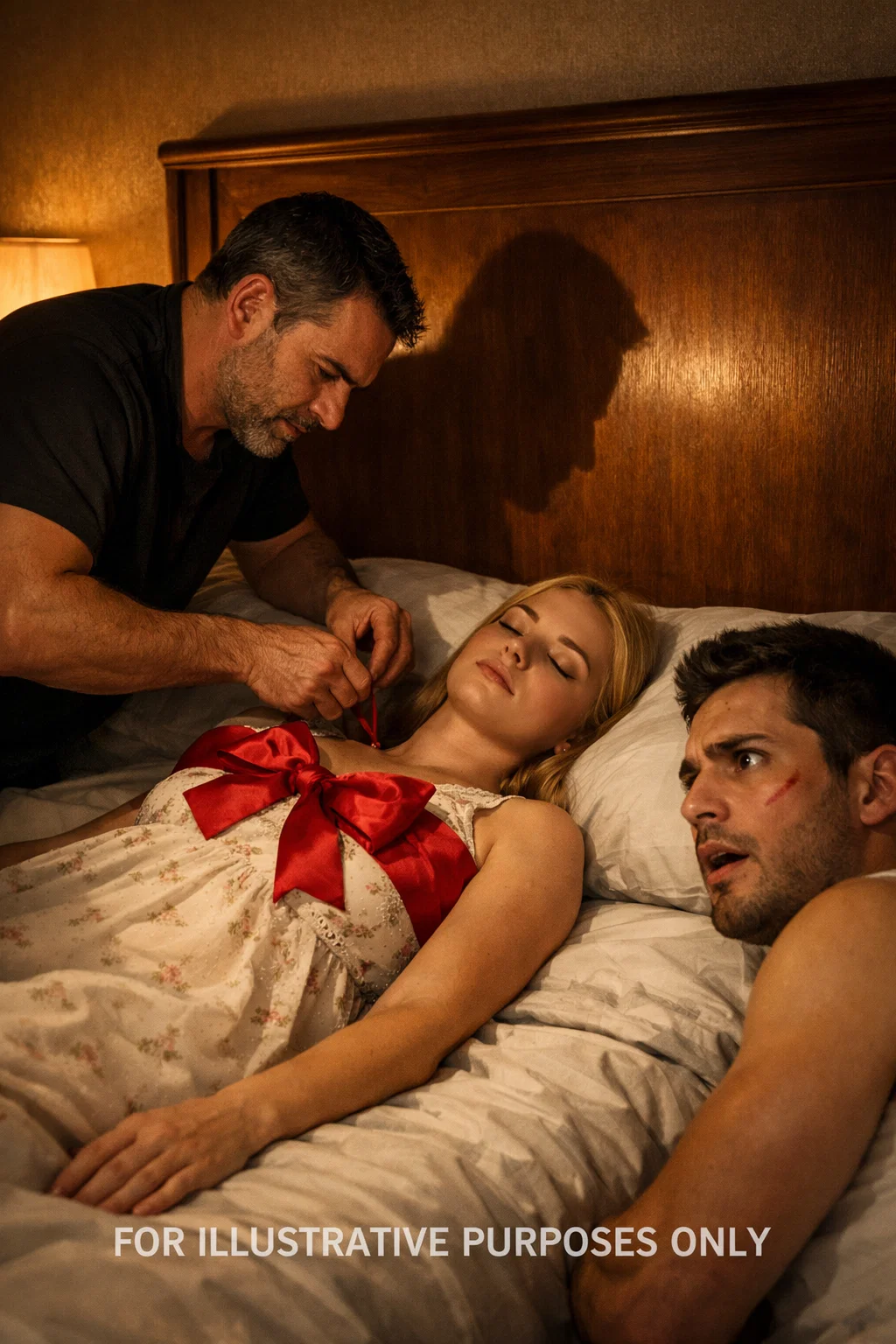
Dad, who is the man that comes into your room at night and rubs Mommy’s back with that red cloth when you are sleeping?”
My daughter Chloe asked the question with innocent curiosity while I guided the car through the pale gray light of early morning, and although her voice carried the gentle softness that usually filled me with warmth, the meaning of her words struck with such violent force that my entire body stiffened, as if the air inside the vehicle had frozen solid around my lungs. The traffic signal ahead glowed crimson, holding us in place, yet it felt as though time itself had fractured, stretching thin and unstable while my hands tightened around the steering wheel until the leather pressed painfully into my skin.

For several long seconds I could not breathe, because the question did not feel like childish imagination or playful nonsense, but instead carried the unmistakable weight of observation, the unsettling clarity of something witnessed rather than invented. I lifted my eyes toward the rearview mirror, searching desperately for the mischievous sparkle that usually betrayed Chloe’s jokes, yet her reflection revealed nothing except calm sincerity, her small face composed, her gaze steady, her expression untouched by uncertainty.
“Chloe, sweetheart, what are you talking about, and where could you possibly have heard something like that?” I asked, forcing my voice into a tone that attempted casual amusement, though the tremor beneath my words betrayed the panic already rising inside my chest. “Did someone tell you a strange story at school, or did you see something on television that frightened you?”
She shook her head slowly, her soft brown hair shifting gently against her jacket collar, while her eyes remained fixed on the passing houses outside the window.
“No, Daddy, nobody told me anything,” she replied with quiet certainty, her voice carrying the unsettling steadiness only children possess when speaking truth without fear. “I see him almost every night when I wake up and walk into the hallway for water, because he moves very quietly, like he does not want to be heard, and he always carries that steaming red cloth in his hands.”
A cold sensation crawled up my spine, spreading outward like creeping frost beneath my skin, while my heartbeat accelerated into a chaotic rhythm that drowned out the low hum of the engine.
“What man, Chloe?” I asked carefully, my throat tightening painfully as dread began shaping itself into suspicion. “Can you describe him for me?”
“He comes through the side door near the kitchen,” she explained, speaking with the same casual tone she might use to describe a stray cat wandering through the yard. “He sits beside Mommy, and then he presses the hot red cloth against her back and her legs, and sometimes Mommy looks like she is crying, but she never screams or tells you.”
Her words echoed violently inside my mind, colliding with memories of my wife Natalie’s recent exhaustion, her increasing quietness, the faint limp I had dismissed as ordinary fatigue, all those small signs I had carelessly ignored while drowning myself in endless work hours.
“And Mommy does not say anything when this happens?” I pressed, my voice growing thin beneath the rising storm of thoughts. “She never calls for help?”
Chloe’s answer came gently, yet it shattered something inside me.
“She just closes her eyes very tight,” she said softly, her brows knitting slightly as if recalling something sad. “She looks like it hurts a lot, Daddy.”
The light turned green, yet I remained frozen for a fraction too long, horns sounding impatiently behind us as I forced the car forward, my vision clouded not by tears but by spiraling dread. During the remainder of the drive I could barely register Chloe’s quiet humming, because my thoughts had already descended into a dark labyrinth of possibilities I could not escape.
I worked brutal shifts at the distribution center, followed by exhausting freelance repair jobs that consumed weekends, convincing myself that sacrifice was synonymous with love, never considering that absence might create silent fractures within a marriage. Natalie had always been patient, always supportive, always smiling despite my fatigue, yet doubt is an insidious poison, and once introduced into the bloodstream of trust, it spreads with merciless efficiency.
When Chloe stepped from the car at the school entrance, waving with cheerful innocence, I felt none of the usual morning warmth, because suspicion had already hollowed my chest into a cavern of anxiety.
The drive home felt endless, each passing streetlight blurring into meaningless streaks while my thoughts twisted violently between denial and fear. I wanted desperately to dismiss Chloe’s words as imagination, yet her calm certainty refused to fade, lingering like a persistent echo I could not silence.
Natalie stood in the kitchen when I entered the house, sunlight filtering through the curtains while illuminating her familiar silhouette, yet something inside me recoiled at the sight of her gentle smile.
“You are home earlier than usual,” she said warmly, her voice soft with mild surprise. “Did traffic improve this morning?”
I stared at her, searching for deception, for guilt, for any microscopic betrayal hidden beneath her calm exterior, yet saw only exhaustion I had foolishly ignored.
“Everything is fine,” I muttered, my voice distant, my mind clouded by accusations I dared not speak aloud.
Throughout the day, tension coiled tightly within me, growing heavier with every passing hour, until darkness finally settled over the neighborhood like a suffocating blanket. Dinner unfolded in uneasy silence, Chloe unusually quiet, Natalie visibly fatigued, and although guilt flickered faintly at the edges of my awareness, suspicion continued dominating every rational thought.
That night, once the house fell silent, I began my performance.
I lay beside Natalie, breathing slowly, deliberately deepening each exhale into an exaggerated imitation of sleep, allowing rhythmic snoring to fill the darkness while my senses remained painfully alert. My heart pounded violently against my ribs, yet I remained motionless, waiting, listening, drowning in anticipation that felt indistinguishable from terror.
Minutes passed with agonizing slowness.
Then, subtly, the atmosphere shifted.
I sensed movement, faint yet undeniable, followed by the unmistakable sound of fabric being wrung gently, water dripping softly into porcelain. A delicate hiss of steam rose into the air, carrying a scent of heated herbs I could not immediately identify.
Natalie stirred beside me.
A soft, strained sound escaped her lips, a muffled expression of pain that twisted violently within my imagination.
Rage erupted.
I surged upright with explosive force, fingers slamming against the lamp switch as light flooded the room, my voice tearing violently from my throat.
“Who are you, and what are you doing to my wife?”
The words echoed sharply against the walls, yet the scene before me shattered every monstrous assumption my mind had constructed.
Standing beside the bed, visibly startled beneath the harsh light, was Natalie’s father, George Whitman, his aging frame trembling slightly while his weathered hands clutched a steaming red flannel cloth. His expression carried neither guilt nor fear, but instead radiated weary sadness, the profound exhaustion of a man burdened by silent responsibility.
Natalie sat upright slowly, tears already pooling within her eyes.
My gaze fell upon her exposed back.
The sight obliterated every remaining fragment of anger inside me.
Her skin bore violent evidence not of betrayal but of suffering, deep crimson inflammation spreading across her spine, bruised and swollen tissue revealing agony I had never imagined.
“Daniel,” Natalie whispered, her voice fragile beneath the weight of pain. “Please, listen.”
George exhaled heavily, his shoulders sagging with quiet resignation.
“She has been enduring severe spinal inflammation for months now,” he explained gently, his voice thick with restrained emotion. “The condition worsens at night until the pain becomes nearly intolerable, and these heat compress treatments offer the only relief strong enough to let her rest.”
Confusion, horror, and guilt collided violently within my chest.
“Why was I never told about any of this?” I demanded weakly, my voice cracking beneath the crushing realization already forming.
Natalie’s tears spilled freely.
“Because you already sacrifice everything for us,” she sobbed softly, gripping my trembling hands with desperate tenderness. “You work endlessly, exhausting yourself beyond reason just to provide Chloe with opportunity and stability, and I could not bear the thought of adding my illness to the burdens you already carry.”
Each word struck with devastating clarity.
“I saw how tired you were, Daniel,” she continued through broken breaths, her voice trembling yet resolute. “I knew you would abandon your second job, lose sleep worrying about treatments, drown yourself in anxiety over bills, and I could not allow my suffering to become the thing that finally broke you.”
The red cloth Chloe had seen transformed before my eyes, no longer a symbol of betrayal but of silent devotion, of unimaginable endurance hidden behind gentle smiles.
I collapsed beside her, tears blurring my vision.
“Oh God, Natalie, I am so sorry,” I whispered hoarsely, crushed beneath shame so profound it felt physically unbearable.
George placed the cloth gently into my shaking hands.
“She needed relief, son,” he said quietly. “Nothing more.”
That night, sleep became irrelevant.
I applied the heated compress myself, pressing warmth carefully against Natalie’s trembling back while silent tears soaked the fabric, because the greatest betrayal had not been hers, but mine, my blindness not to infidelity but to suffering endured quietly beside me.
In the stillness of that dimly lit room, I understood something devastatingly simple yet profoundly humbling.
Love does not always announce itself loudly through grand gestures or dramatic declarations.
Sometimes love exists in silence, in endurance, in suffering willingly carried alone so another might rest peacefully, unaware of the storms raging inches away.
And sometimes, tragically, love is only fully seen when suspicion nearly destroys it.