
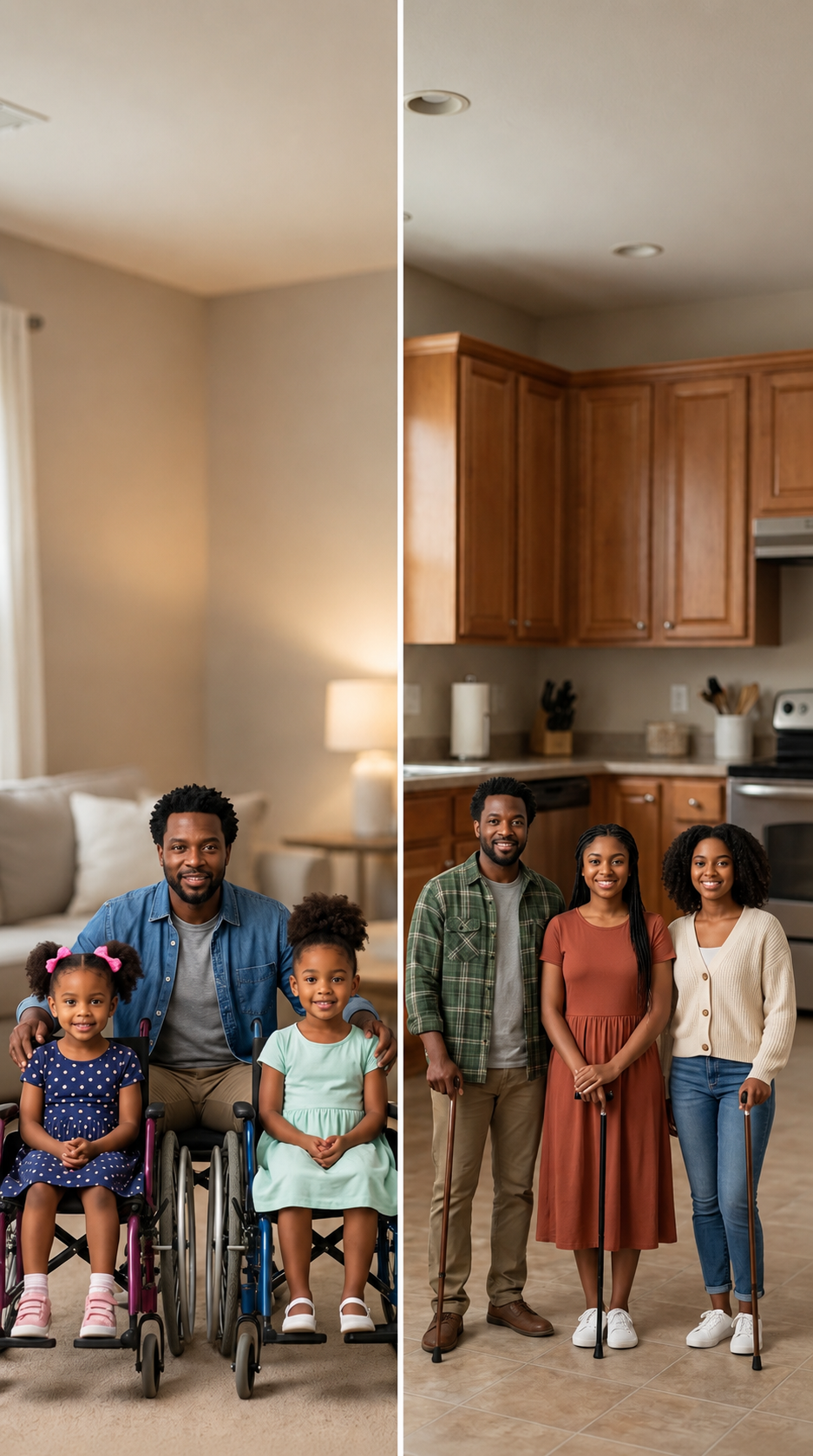
A loyal dad dedicated twelve years to fixing his girls’ world after a terrible crash. But one Sunday morning, over a plate of burnt pancakes, he discovered his daughters had secretly been trying to rescue his world too.
Burnt Pancakes
The pancakes were burning, just slightly, exactly the way they always did whenever Wren got too busy talking to pay attention to the stove. I stayed in bed, listening to the quiet sound of footsteps in the kitchen — two sets of them, moving without the whir of wheelchairs.
A dozen Father’s Days had come and gone since the crash, and this was the first one that started with my daughters moving around the apartment before I’d even opened my eyes. I lay perfectly still, because happiness had become something I learned to hold very carefully over the years, like a piece of broken glass you’re afraid will cut you if you close your fist too fast. Then Wren laughed, and the smoke detector in the hallway let out a single warning beep. I grinned into my pillow, alone in the dark, and let myself feel it.
Wren and Cleo woke up beneath bright hospital lights twelve years ago, completely numb from the waist down. The memory always returns on this particular Sunday, unlocked by nothing more than the smell of syrup and the sound of their voices. They were barely six years old, their swimsuits still soaked in the back seat, bickering over which song to play next while their mother drove them home from the pool. Another driver ran a red light.
She walked away from the wreck with nothing more than a few bruises. Wren and Cleo woke up under those hospital lights unable to feel their legs. The doctors talked in hushed voices, as if lowering the volume could somehow soften what they were telling us. Their mother left three weeks later, taping a note to the refrigerator on her way out the door.
I refuse to waste my life pushing wheelchairs. Besides, you were the one who wanted kids.
I stared at that note until my vision blurred completely.
Twelve Years in Fragments
Every single dollar I earned went toward medical care our insurance refused to cover. A dozen years passed in fragments — late-night lessons on how to braid hair from a wheelchair, stacks of medical paperwork, insurance denials, stretching charts taped above the bathroom sink. I worked two jobs, then a third. I sold the house, then the car, then my father’s watch, the only thing of his I’d ever owned. I kept the metal band from it in my pocket long after the face was gone, proof to myself that love could survive being reduced to a checklist.
I remember the exact night I sold the watch. I sat at the kitchen table long after the girls had gone to sleep, turning it over in my hands under the single working bulb over the stove, telling myself it was just an object, that my father would have understood, that a working man does what a working man has to do for his kids. I remember the pawn shop owner barely looking up from his newspaper as he counted out the bills. I remember driving home with the money folded in my shirt pocket, feeling like I’d traded away the last physical proof that I’d ever had a father of my own, so that mine could stand a chance at having one who stayed. I never told the girls what that money paid for. I never told anyone.
There were nights I sat in the hospital parking lot after their sessions, engine off, just breathing, because I couldn’t let them see my face until I’d rebuilt it into something calm enough to carry them inside. There were mornings I woke up before either of them so I could cry for exactly six minutes in the shower, where the water could take the blame for my face being red. I never counted those minutes as weakness. I counted them as the cost of admission for staying strong the other twenty-three hours and fifty-four minutes of the day.
Every minute I had went toward physical therapy, leg braces, specialists, and pain my daughters pretended not to feel so that I wouldn’t fall apart in front of them. I skipped birthday parties, weddings, ordinary dinners out, ordinary anything, and called it sacrifice for so many years that I stopped noticing the word anymore.
Then, five months ago, on an entirely unremarkable weekday afternoon, Wren took three steps on her own. Cleo managed it too, both of them gripping my fingers while their former physical therapist, Mara, stood at the entrance of the rehab center with one hand pressed over her mouth.
The word former mattered here. By that point, a different therapist had taken over their daily sessions, which meant Mara was simply the woman who had helped them reach this miracle — and the woman I had spent four years trying very hard not to think about. I pushed the thought aside as Wren shouted my name.
“Daddy?”
Cleo appeared beside her a second later, carrying a breakfast tray, her legs shaking but her face lit up with triumph. Wren steadied herself just behind her sister, grinning wider than I’d seen in months.
The Breakfast Tray
I sat up far too fast that Sunday morning, rubbing my face as if I could somehow hide twelve years of feeling behind one hand.
“We made breakfast,” Wren announced. “Some of it’s actually edible.”
“Look at you two. Serving me food now.”
“Don’t get too used to it,” Cleo said, setting the tray carefully over my legs. “This is strictly an annual event.”
The pancakes drooped at the edges, the berries were sliced into uneven, hopeful little shapes, and the coffee looked strong enough to restart a stalled heart.
“It looks absolutely perfect,” I told them, and I meant it.
They stayed standing there, their shoulders almost touching, trading one of those quick, loaded glances that used to warn me, back when they were little, that a scary doctor’s appointment was coming. I felt my stomach tighten.
“What’s going on?” I asked.
Wren grabbed my hand, her palm hot and anxious. “Daddy, please don’t be mad. We’ve been keeping something from you for a long time, and we really hope you’ll forgive us.”
The room seemed to tilt slightly. My mind raced through every possible disaster at once — a hidden injury, bad test results, money owed somewhere, a fall at school they’d kept quiet so I wouldn’t panic.
I looked at Wren. Wren looked at Cleo. Cleo glanced toward the hallway like the front door itself might attack her.
“Just tell me,” I said.
“It’s a good thing,” Cleo jumped in, already tearing up. “We promise, Dad.”
The Knock at the Door
Right before Wren could explain any further, the doorbell rang. All three of us froze at once, as if the sound had walked in carrying a weapon.
“Who’s out there?” I asked.
Nobody answered right away. In that silence, twelve years of missing my ex-wife sharpened into something bladed and immediate. She’d found them, I assumed instantly. She’d tracked them down through a text, a social media profile, some hidden regret I’d never witnessed her have, and she’d chosen this exact Sunday, of all Sundays, to show up on our doorstep.
I stood up so fast the tray slipped sideways, orange juice spilling across the blanket without anyone bothering to notice.
“Did your mother contact you?” My voice came out flat and strange.
“Daddy,” Wren murmured.
“Did she?”
“It’s not her,” Cleo said softly.
But I was already moving into the hallway, my fingers trembling the exact same way they used to outside operating rooms twelve years earlier.
“Stay in here,” I said, already walking.
“Dad, wait—”
I kept going, rehearsing the sentence I’d been holding onto for over a decade: You don’t get to come back. You don’t get to ask for them. They’re mine. They’ve always been mine.
I unlatched the door and yanked it open.
It wasn’t their mother.
Mara at the Door
Standing there was Mara, wearing a light yellow sundress, gripping a small red gift box tightly against her chest like a shield, her eyes already welling with tears.
“Hi,” she said quietly.
My legs nearly gave out from under me. I grabbed the doorframe with one hand to steady myself. Behind me came the familiar drag of Cleo’s old wheelchair being pushed out of the way from pure muscle memory, followed by the soft, uneven patter of two sets of feet walking on their own for the first time into this particular moment.
“Oh, my sweet girls,” I said quietly, without turning around. “Why would you do this?”
Wren’s voice broke behind me.
I stood frozen between wanting and fear, unable to tell which one to protect myself against first.
“Daddy, come on.”
Mara lowered the box slightly, as if she’d just realized how much a gift could look like a threat when held out that way. “I can leave,” she said quickly. “If this feels wrong, I’ll go.”
“Don’t,” Cleo shouted. “Please, just hear us out.”
Five Months
Mara stepped inside only after I moved backward to let her by. We sat down in the living room while the smell of burnt pancakes still drifted in from the kitchen, and the small red gift box sat on the coffee table like something that hadn’t finished deciding whether it was going to explode. My daughters sat on either side of me, close enough to catch me if I fell apart.
I closed my eyes, because the truth of what was coming had already settled in my chest. I had never once had the courage to delete her number from my phone.
“Since when?” I asked.
Wren answered first. “Five months.”
“Five whole months?” My laugh came out strange, hollow. Cleo wiped her cheeks with the back of her hand.
“We found her number in your phone. You never deleted it.”
“You used to talk about Mara constantly during our sessions,” Cleo added. “Mara thinks we should try this. Mara says our balance is getting better. Then, once we started walking, you just stopped saying her name at all.”
I closed my eyes again, simply because it was true. I had never had the courage to delete her contact, but I’d also spent four years pretending I never thought about calling it.
“You did that because you needed my full attention,” I said, trying to defend myself.
“We needed you to actually live,” Wren replied, gripping my arm tightly, her fingers shaking against mine. “You sold Grandpa’s watch. You sold the car. You worked three jobs. You skipped your own birthdays. You gave away every small piece of yourself until there was nothing left except the two of us.”
“That’s my job,” I said.
“Then let us do ours,” she said. “Let us take care of you, just for one afternoon.”
What I Missed
I looked over at Mara. Four years of early clinic visits came rushing back all at once — her steady hands on my daughters’ hips as she taught them balance, her voice counting out their steps down the hallway, her laugh echoing after another exhausting appointment neither of us wanted to admit had gone well.
I had missed her, quietly, during still moments I always scolded myself for even imagining. The strict rule I’d built inside myself flared up hard and fast: You are not allowed to want this. Not now. Not while the girls still need muscle therapy, updated leg braces, better insurance, and you staying unbroken for them.
I used to invent excuses to walk past her office on clinic days, just to hear her voice through the door telling some other family the same kind, patient things she used to tell us. I never once let myself linger long enough for her to notice. I told myself I was protecting the girls’ therapy from becoming complicated, that mixing anything personal into their treatment would somehow poison it. The truth, standing in my own living room twelve years later, was simpler and far less noble. I was protecting myself from wanting something I didn’t believe I’d earned the right to want.
I stood up.
“I need some air.”
“Daddy, please don’t,” Wren pleaded.
“Just give me a second.”
Mara reached toward her purse. “I’ll go,” she said.
“It was never your fault, Mara. I promise you that.”
I grabbed my keys off the hook by the door, fumbled them twice, and stepped outside before anyone could forgive me out loud. The hallway outside our apartment was empty and harshly lit by a single fluorescent bulb.
For twelve years I had assumed I was the one holding my daughters up. I had completely missed how gently they’d been holding me up too, the entire time, without me ever noticing.
The Watch Band
I made it to the stairwell before my legs finally gave out, and I sat down on the bench outside the building, my father’s watch band tangled between my fingers. I’d sold the actual watch face years earlier but kept the band, the way some men keep prayer beads in their pocket. I always told myself it proved my loyalty to my girls. Sitting there that morning, it looked more like plain evidence of everything I’d been too afraid to let myself have.
They had seen every bit of it — the empty birthday plates I never explained, the collars fraying on my old shirts, the way I flinched whenever Mara smiled at me because wanting anything for myself had started to feel like theft. And through all of it, they never once turned on me. They had simply been taking care of me from the other side of a wall I kept locked shut myself.
I stood up slowly, wiped my face, and walked back up the stairs. Inside, the living room carried that particular hush of a space right after a hard conversation. Mara sat between my daughters, all three of them with red, puffy eyes. The gift box sat closed on the coffee table. I knelt down in front of Wren and Cleo, because an apology should never stand tall over someone you’ve hurt.
“I owe both of you a huge apology,” I said. “I made you carry my grief quietly for years. That wasn’t fair to either of you.”
Cleo patted the fabric of my sleeve. “We just wanted you to be happy, Dad.”
“I know that now. And I mixed up protecting you with disappearing completely into you. You are not my unfinished project. You are my finished blessing.”
“I Am Not Angry”
I turned to face Mara. She was still holding herself carefully, as if one wrong breath from me might send me running again.
“So you’re not angry?” she asked.
“I feel the exact opposite of angry. I feel terrified, and grateful, and awkward, and unbelievably hungry, all at the same time.”
A laugh escaped Cleo, damp and surprised. Even Mara smiled at the sound of it, and something anxious loosened in my chest right along with her.
“I can’t promise you forever,” I admitted, looking at Mara. “I don’t even know how to begin something like this again. But I can say yes to a cup of coffee, if you still want that.”
Relief crashed into me so hard I laughed, a real laugh this time. Wren made an exaggerated, annoyed sound from the couch.
Mara let out a shaky laugh of her own. “Coffee sounds perfect.”
Then she picked up the little red gift box and passed it over to me. My stomach knotted right back up. I opened it slowly, half expecting a ring and half terrified of one. Inside sat a small metal key resting on a folded piece of paper. For a long moment, nobody said a word. Then Mara went suddenly, deeply red.
“This is definitely not a marriage proposal,” she said quickly. “The girls insisted I bring something meaningful. It’s a spare key to my apartment building, not my actual unit. It’s an invitation to stop by sometime — with boundaries, and coffee first.”
“We told you he’d freak out,” Wren said to Cleo.
Cleo sucked in a sharp breath. “We also told you not to pick something wrapped in soft fabric. Too romantic, we said.”
“It felt festive,” Mara said, laughing through her own tears.
I closed the box and held it against my chest, not because it fixed twelve years of loss, but because it asked for nothing more than a small, honest start. That was about all I had to offer that particular morning, and Mara seemed to understand that without needing to be told.
Back to the Kitchen
The pancakes had gone cold by then, chewy and burnt at the edges, but Cleo declared she was reheating them anyway. Wren stood up, steadier now than she’d been earlier that morning, and held out her hand to her sister. They walked toward the kitchen side by side, arm in arm, neither perfectly nor quickly, but entirely on their own two legs.
I watched until my vision blurred again. For twelve years I had prayed for the day they’d stand on their own. I had never once imagined the particular sting of realizing that they also wanted me to stand on my own, without carrying every ounce of the weight alone forever.
“I was scared,” I admitted to Mara, sitting beside her while the girls argued cheerfully over syrup in the next room. “Scared that wanting a life of my own meant I loved them less.”
Mara glanced toward the kitchen, where the twins were bickering over sauce and laughing quietly at something only the two of them found funny.
“Love doesn’t shrink just because you let someone else sit next to it,” she said.
I wanted very badly to believe her. Maybe that was enough for one fresh morning.
The Smoke Detector, Judging Us
“Daddy, your pancakes are getting worse by the second!” Wren shouted from the kitchen.
“Mara, you’re welcome to join us too,” Cleo called out, “unless you care about your dental health.”
Mara glanced at me for approval before answering. I nodded, and something old and locked tight inside me finally clicked open a little further.
We ate together in the kitchen, the smoke detector still blinking down at us judgmentally from the ceiling. The pancakes tasted like sweetness and burnt edges and pure, unbelievable luck all at once. Wren and Cleo kept bumping each other under the table, thoroughly pleased with themselves over their terrible, wonderful scheme.
Mara laughed once, soft and careful, and I found I couldn’t look away from her when she did. My father’s watch band felt warm in my pocket, no longer proof of everything I’d sacrificed, but a quiet reminder that I was still here to receive something back for it.
Twelve Father’s Days had taught me how to survive. This one — full of smoke, and awkward silences, and far too much sweetness — taught me how to slowly start living again.