
I should have checked the license plate. That was the detail that stuck with me, the one that made the whole thing both absurd and inevitable. I should have looked at the license plate number before getting in.
But my eyes burned with exhaustion, and my mind was elsewhere. I’d worked two shifts straight at the bar, studied for three exams, and slept only four hours in two days. I was now on autopilot, kept afloat by willpower and a cheap coffee.
When I saw the black car parked in front of the library at 11:00 PM, I thought it was my Uber. It was black. It was waiting for me. I was too tired to ask any more questions.
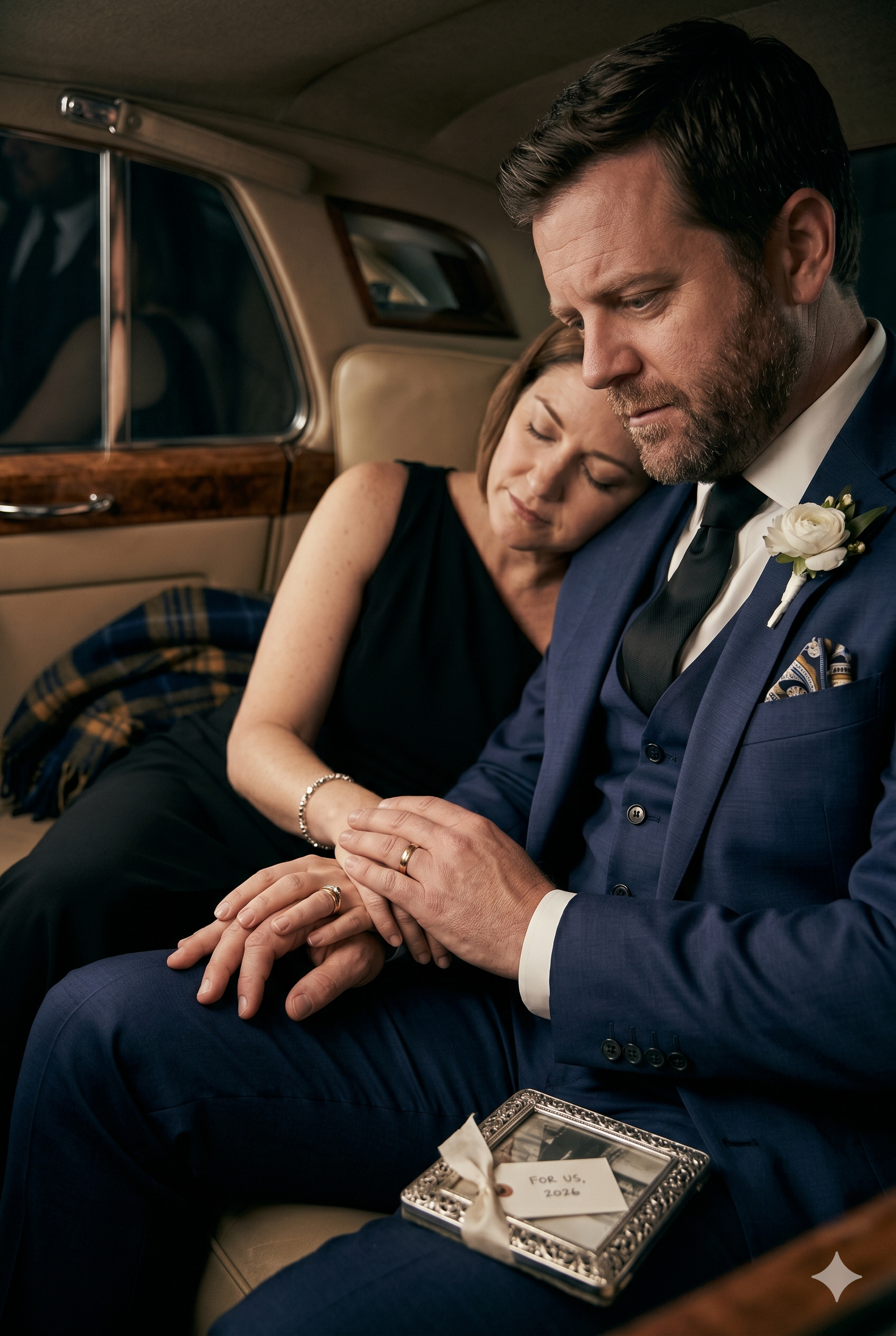
I opened the back door and slipped in as if I were going home. The seat was incredibly comfortable, too comfortable for an Uber, but my exhausted mind didn’t register any warning signs. I sank into the soft leather, closed my eyes for what must have been only a second, and let the darkness envelop me.
It was the best sleep I’d had in weeks. Deep, dreamless, and worry-free, the kind that only comes when fatigue gets the better of me.
Then a deep, clearly amused male voice broke into my consciousness.
“Do you always break into other people’s cars, or am I a special case?”
My eyes widened. Panic gripped me when I realized I wasn’t alone.
A man was sitting next to me, close enough to feel his warmth and smell the expensive aftershave that probably cost more than my rent. He wore a dark, tailored suit that made him look like he stepped straight out of a luxury magazine. His hair was styled to perfection, but with that studied messiness that wealthy men seem to master effortlessly. His face was almost offensively handsome, with a well-defined jaw, dark eyes that regarded me with curiosity and amusement, and a wry smile that made me feel simultaneously annoyed and strangely good.
My voice was hoarse from sleep.
“I’m sorry. I thought it was my Uber. I wasn’t trying to break into his car.”
He tilted his head, smile still on his face.
“Technically, that’s exactly what you did. And you snored for 20 minutes.”
A warm feeling rose from my neck to my cheeks. I wanted to sink into the leather seat.
“I don’t snore.”
“Yes, you do. Gently. It was actually quite adorable.”
It was then that I really looked around. The interior of the car wasn’t just luxurious. It was obscene. There was a built-in minibar, touchscreens, polished wood trim that probably came from some rare exotic forest, and a quiet comfort superior to any other car I’d ever been in.
No Uber had a minibar.
The reality of the situation hit me hard.
“You are not an Uber driver.”
“Absolutely not.” He leaned back, completely at ease, while I panicked. “My name is Noah Priestley, and this is my car, which you stole while you were taking a nap.”
The name didn’t mean anything to me at the time, but the way he said it made me realize it should have. From his car, his clothes, and the aura of power he exuded, it was clear this wasn’t just any man. He was important. Rich. The kind of person who would probably report me for trespassing before breakfast.
“I’m so sorry,” I said quickly. “Really so. I worked all day, studied all night, and was just waiting for my Uber.”
I stopped, took a breath, and tried to regain some dignity.
“I’m leaving. I apologize for the inconvenience.”
I reached for the doorknob, but his voice stopped me.
It’s 11:30 PM. What part of town are you in?
“It’s none of your business.”
My response came out more bluntly than I’d anticipated. Fatigue made me sarcastic. It was an automatic defense mechanism.
He laughed, a low, genuine laugh that gave me a strange feeling in my stomach.
“Right. But since you slept in my car, I think I can be minimally concerned about your safety. Let me drive you home.”
“I don’t need charity.”
“It’s not charity.” Noah leaned forward a little further, and suddenly the space in the car felt smaller and warmer. “It’s common sense. It’s late. It’s dangerous. And technically, you’re already in the car, even if it’s the wrong one.”
I should have refused. I should have gotten out and called another Uber. But the truth is, I was exhausted and scared to walk alone at that hour. Something in his voice, and the way he looked at me, made my survival instincts relax just enough.
“Okay,” I said. “But if you’re a serial killer, it’s really going to bother me.”
“Taken note.”
His smile widened as he tapped on the glass separating us from the driver.
“James, we can go.”
The car moved off with a smoothness no shared Uber could ever match. I gave James my address and tried to ignore Noah’s staring gaze.
“So,” he said after a silence that had become almost comfortable, “why are you so exhausted?”
Normally, I wouldn’t have shared my life story with a stranger, but there was something about the way he asked. He seemed genuinely curious, not condescending.
“Full-time college. Two jobs. I sleep about four or five hours a night, if I’m lucky.”
“This situation is unsustainable.”
There was no judgment in his voice, just observation.
“Wealth must be beautiful,” I said. “Some of us need to work to survive.”
To my surprise, he laughed again.
“Touché. But you’re killing yourself. Literally.”
“And you?” I turned to him, meeting his dark gaze fixed on me. “I bet you work 80 hours a week and sleep even less than me.”
“Maybe.” A reluctant smile curled his lips. “But at least I have a choice.”
The truth in those words hit me harder than it should have. I looked away and watched the streets pass by outside the window.
We were approaching my neighborhood. I noticed the change in his expression as he looked around. Old buildings. Dimly lit streets. Graffiti on the walls. It wasn’t the worst place in the world, but it certainly wasn’t the kind of place someone like Noah Priestley would live.
The car stopped in front of my building. I was just about to grab the handle when he spoke again.
“I need a personal assistant. It’s a well-paid job with flexible hours.”
I stood still, my hand still on the door. Slowly, I turned toward him.
“What?”
“You heard me.”
He took a card from his inside jacket pocket and held it out.
“I need someone to organize my schedule, answer emails, and take care of the house when I’m traveling. You clearly need money and a job that doesn’t exhaust you.”
“I don’t need charity.”
The words were the same, but this time they sounded weaker.
“It’s not charity, Angeline.”
The use of my name surprised me until I remembered that he had probably seen it on the Uber app.
“It’s a fair deal. I really need help, and you really need a better job. Nothing else.”
I took the paper. The paper, in my fingers, felt precious.
“I don’t promise I’ll call.”
“I’m not asking for promises.” He leaned back, regaining control. “Think about it for a moment.”
I got out in silence and watched the car drive away. Then I climbed the three flights of stairs to my tiny apartment, dropped my bag on the floor, and looked again at the card in my hand.
Noah Priestley. CEO. Phone number and business address emblazoned in gold.
My roommate and best friend, Christy, came out of her room with her hair in a messy bun.
“Are you okay? You’re late.”
“I took the wrong Uber.” I tossed the card on the coffee table and collapsed onto the old couch. “And the owner of the car offered me a job.”
“What?”
Christy grabbed the paper. Her eyes widened.
“Wait. Noah Priestley? Billionaire Noah Priestley?”
“Is he a billionaire?”
I closed my eyes, tiredness overwhelming me.
“Angel, he’s one of the richest CEOs in the city. And you slept in his car.”
Christy burst out laughing, that loud laugh that always made me laugh too.
“Only you.”
For the next three days, I tried to ignore the note. I went to work, to class, studied, and survived. But the rent was in arrears, my manager at the bar was cutting hours, and I was so tired I almost fainted during an exam.
Christy found the note still on the coffee table.
“You’d be an idiot if you didn’t call him.”
“It’s charity,” I protested weakly.
“It’s a job. One that pays better and doesn’t kill you.” He stared at me with that expression that brooked no argument. “Will your pride pay the rent?”
It wasn’t like that, and she knew it.
The next day I called the number, my fingers shaking slightly as I dialed.
He answered on the third ring, his voice unmistakable.
“Priestley.”
“It’s Angeline Torres,” I said. “The girl who broke into your car.”
I tried to sound confident, but I probably failed.
There was a pause. Then I heard that soft laugh I remembered.
“I didn’t think you’d call.”
“Me neither. But apparently I need money more than pride.”
Brutal honesty was sometimes easier.
“When can you start?”
“Tomorrow,” I said, hoping it wasn’t too soon.
“Perfect. I’ll send you the address. We start at 9:00.”
The next day, his car came to pick me up. Noah wasn’t inside. Only James, the driver, greeted me politely and took me to a villa that made me question every life choice that had led me there.
The house was obscene. Three floors of pure ostentation, perfectly manicured gardens, and a fountain in front that had probably cost more than my entire college education. I felt completely out of place as I approached the front door.
A woman in her sixties greeted me with a warm smile. Her gray hair was pulled back in an elegant bun, and her kind eyes quickly scanned me.
“You must be Angeline. I’m Mrs. Dawson, the housekeeper.” She opened the door wider. “Come in, dear. Mr. Priestley is in his office.”
The interior of the house was even more impressive. Soaring ceilings. Artwork probably worth a fortune. Marble floors so polished I could see myself in them. I followed Mrs. Dawson down the halls to a pair of mahogany double doors. She knocked lightly.
“Mr. Priestley, Miss Torres has arrived.”
“Come in.”
His voice came from the other end and I got a strange feeling in my stomach.
Noah was sitting behind a large desk, his fingers on the keyboard of his laptop. He looked up when I walked in. He was wearing a white shirt with the sleeves rolled up to the elbows, revealing his forearms, which was, unfortunately, distracting. A wry smile spread across his face when he saw me, but there was something else in his eyes, something akin to satisfaction.
“You didn’t run away,” he said, standing up.
“I need money.”
“Honestly. I like it.”
He moved closer to the desk, too close to make me comfortable.
“Should we discuss terms?”
We spent the next hour going over responsibilities. I was supposed to organize his chaotic schedule, answer non-urgent emails, coordinate with Mrs. Dawson on household matters, and manage travel. The salary he was offering me was three times what I earned at my two jobs combined.
“That’s too generous,” I said before I could stop myself.
“It’s fair for the work you’ve done.” Noah looked me straight in the eye. “And I want to make one thing clear, Angeline. This is a job, not a favor. You’ll work. You’ll earn your salary. Nothing else.”
Something in my chest relaxed.
“Understood.”
“Great.”
He held out his hand.
“Welcome to the team.”
When our palms touched, an electric shock ran down my arm. From his eyes, I knew he’d felt it too. We pretended nothing had happened, even though our hands separated perhaps a second later than professionalism would have required.
This was work. Just work.
I repeated this to myself as Mrs. Dawson showed me the office that would be mine, as Noah explained his chaotic organizational system, and as our eyes met casually several times throughout the day.
Just work.
Even though an inner voice whispered to me that sleeping in the wrong car had changed everything.
The first few weeks of working with Noah Priestley made me realize how exhausting organized chaos could be. His schedule was a nightmare of overlapping meetings, double-booked appointments, and meaningless reminders. A note like “Noah, call M about that” wasn’t exactly specific, but I quickly realized that M was Marcus, his lawyer, and that the matter at hand was a multimillion-dollar merger.
I devoted myself to my work with the same intensity I devoted to everything else in my life. I completely reorganized her calendar, creating a color-coded system so simple even a child could follow it. I answered non-urgent emails with a professionalism I didn’t know I possessed, separating the important from the unnecessary. With Mrs. Dawson’s help, the house began to run like clockwork.
Noah was impressed. I could tell by the slight raise of his eyebrow before he nodded in silent approval. But that impression didn’t translate into intimacy. He maintained an almost military distance, working 16-hour days, leaving early and returning late, barely interacting with me, limiting himself to brief, direct instructions.
“Cancel the 3:00 PM meeting.”
“Reschedule the call from Tokyo.”
“I need the financial statements by tomorrow.”
Orders were given as he moved along the corridors, never looking back, always moving, as if stopping meant admitting that he was human and not a tireless corporate machine.
I should have been grateful for the distance. It made it easier for me to ignore the tightness in my stomach when I heard him coming home late at night. It allowed me to pretend I didn’t hear his footsteps upstairs, or the creak of his office chair when he finally sat down to work a little longer before bed.
But there were small, fleeting moments that were impossible to ignore.