
I Believed The Cafeteria Worker Was Too Old To Keep Up, Then I Discovered What She Carried Inside A Brown Paper Bag
The lunch tray crashed against the floor with such force that every voice in the cafeteria disappeared.
Green beans rolled across the tiles. A plastic cup spun beneath a nearby table. Maribel Crowe, the 62-year-old cafeteria worker known throughout Westfield Middle School for her gentle voice and long gray braid, stood frozen beside the mess.
Both hands were pressed against her apron.
For a moment, she looked as though she had forgotten how to move.
Several students laughed.
The mother standing next to me lowered her voice and murmured, “Poor thing. Maybe she’s getting too old for this.”
I wish I could say I disagreed with her.
But the same thought had already crossed my mind.
I was waiting near the gym entrance with a group of parents for an after-school fundraiser meeting. I had driven there directly from work, still wearing my office shirt and carrying every bit of frustration the day had piled onto me.
My son had already sent three messages asking when I was coming.
I was exhausted.
I hadn’t eaten.
My patience was gone.
And in my mind, Maribel was making everything worse.
She had confused two students’ lunch slips. She gave one child milk instead of the water he had requested. Half the trays went out without bread rolls. Then the green beans fell, and she began apologizing as though the entire delay were her fault.
“I’m sorry, sweetheart,” she said again and again. “I’m so sorry.”
There was something weak and strained in her voice.
I checked the large clock above the cafeteria doors and released an irritated sigh, making sure the woman beside me heard it.
Maribel lowered herself toward the floor with a cleaning cloth. She moved carefully, favoring one stiff knee, while one of her hands shook.
A student walked around her without offering to help, almost as if she were part of the furniture.
For a brief moment, that bothered me.
Then my impatience returned.
The meeting had been scheduled for 5:30.
It was now 5:42.
The principal still hadn’t arrived. The students were becoming louder, and the food line continued growing because Maribel seemed unable to keep up.
I remember the exact thought that entered my head.
If you can’t handle the work anymore, maybe you shouldn’t be doing it.
Later, I would feel ashamed of myself.
At that moment, I convinced myself I was simply being realistic.
A few minutes passed before I noticed Maribel carrying napkins toward a table near the far windows.
A small sixth-grade boy sat there by himself.
I didn’t know who he was then.
He wore an old hoodie whose sleeves no longer reached his wrists. A section of hair stood up behind his head, and he kept his face lowered, almost as though he were trying to disappear into the chair.
There was nothing on his tray except a carton of milk.
Maribel paused beside him and spoke quietly.
I couldn’t hear the words.
The boy shook his head.
She bent closer and said something else.
This time, he shook his head more firmly.
It was the kind of refusal children make when dignity is the last thing they still own.
Maribel glanced around the cafeteria.
There was nothing sneaky about the way she did it.
It was gentle.
Protective.
Like a grandmother making sure no one witnessed a child’s humiliation.
Then she slipped one hand inside her apron pocket.
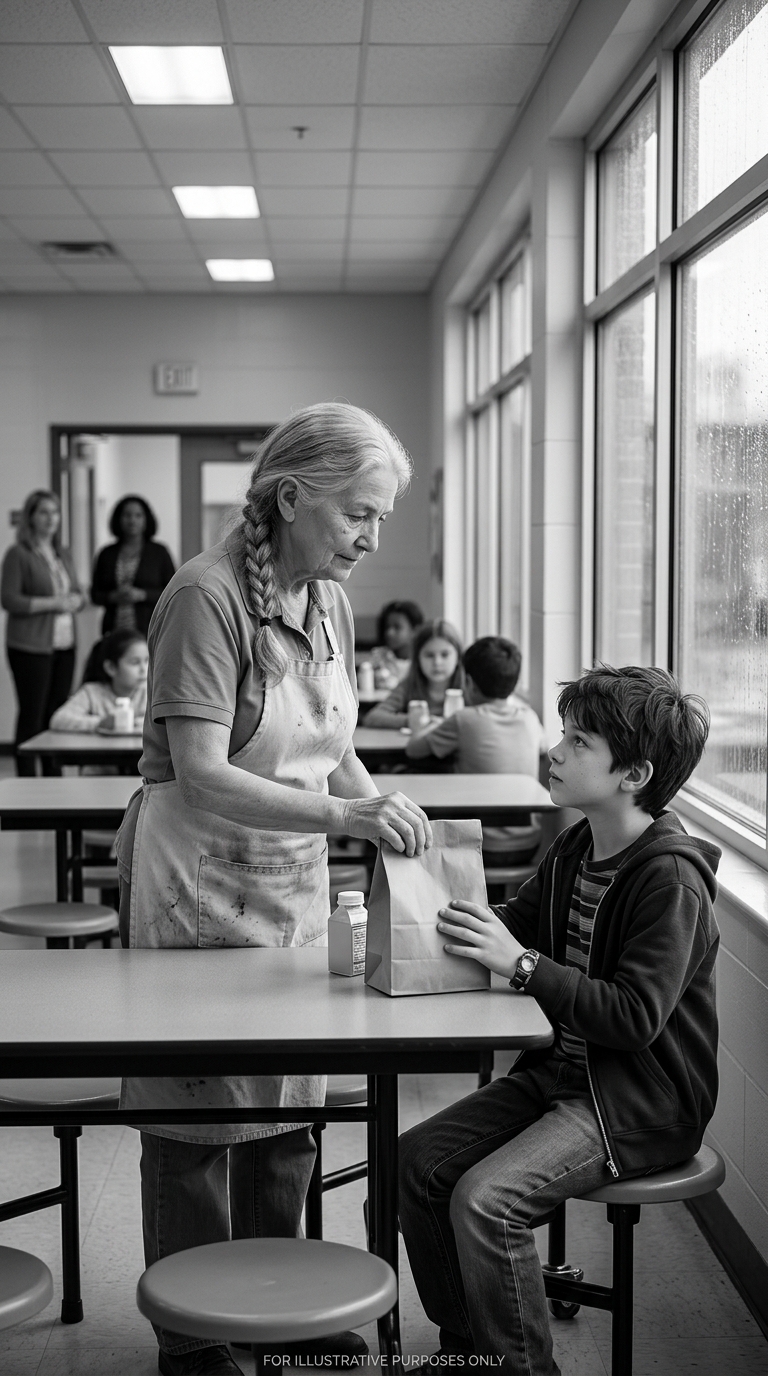
She removed a brown paper bag with the top folded over twice and placed it beside the boy’s milk.
Her fingers tapped the bag softly.
The child stared down at it.
Maribel smiled at him.
It wasn’t the tired, polite expression she had offered the impatient parents and noisy students.
This smile was genuine.
Exhausted, but genuine.
The boy slowly opened the bag and looked inside.
The expression that appeared on his face has never left my memory.
It wasn’t happiness.
Not exactly.
It was the look of someone whose fear had suddenly eased.
Inside the bag sat half a sandwich, a small apple, and two crackers wrapped carefully in a napkin.
I immediately turned my eyes away.
Watching them suddenly felt too personal, as though I had accidentally witnessed something holy.
A moment later, Principal Ellery entered through the side door with a folder tucked beneath her arm.
She noticed me standing rigidly near the gym and must have recognized the impatience written across my face.
“I’m sorry about the delay,” she said.
I gestured toward the serving area.
“Things not going well in the kitchen today?”
Mrs. Ellery followed my gaze toward Maribel.
Her face softened.
“She buried her husband three days ago,” she said in a low voice.
I had no response.
The cafeteria was still filled with chatter, scraping chairs, and children calling to one another, yet inside my head everything suddenly became quiet.
Mrs. Ellery lowered her voice even further.
“We asked her to stay home for the entire week. She wouldn’t do it. She said some of these students depend on the breakfast and evening meal programs more than they depend on almost anything else.”
I looked at Maribel again.
She was cleaning a table with one hand while supporting her lower back with the other.
A little girl spoke to her.
Maribel laughed as though the child had just handed her something precious.
“She was married for forty-one years,” Mrs. Ellery continued. “Her husband picked her up from work every evening in the same old blue truck. He always waited in the parking spot beside the cafeteria entrance.”
I looked through the glass doors.
Rain streamed down the windows.
The space closest to the entrance was empty.
“This is the first week no one has been waiting there for her,” Mrs. Ellery whispered.
My throat tightened.
In that instant, everything I had witnessed took on a different meaning.
The dropped food.
The confused tickets.
The shaking fingers.
Maribel wasn’t incompetent.
She was mourning while wearing an apron.
She was standing beneath harsh cafeteria lights, placing pizza squares and canned fruit onto children’s trays, while knowing the man who had driven her home for forty-one years would never pull into that parking spot again.
And I had been criticizing how slowly she moved.
I thought about my wife.
Every morning, even after an argument, she places my coffee mug beside the machine before I wake up.
I thought about how easily the little routines of a life begin to feel unimportant.
Then I thought about how unbearable those same routines must become once they are gone.
A lunch made the wrong way.
An old truck waiting outside.
A familiar voice asking, “Are you ready to head home?”
The fundraiser meeting began about ten minutes later.
I barely remember the discussion.
I remember the fundraising envelopes spread across the table.
I remember parents debating raffle prizes and gift baskets.
I remember someone complaining that people didn’t donate the way they used to.
But mostly, I remember Maribel across the room, sweeping beneath the tables long after everyone else had finished eating.
There was no applause for her.
No one stood up to praise her.
No one gave a speech.
And no one noticed when she wrapped two leftover rolls in a napkin and quietly handed them to the boy in the worn hoodie before he left through the side hallway.
No one except me.
When the meeting ended, I approached Mrs. Ellery at the front table.
“How much money is owed on student lunches?” I asked.
She looked confused.
“You mean the entire school balance?”
“Yes,” I said. “Every unpaid account.”
She paused before opening the folder in her hands.
The total was higher than I had imagined.
It wasn’t beyond what I could manage.
It was simply uncomfortable.
Only a week earlier, I would have found a dozen reasons not to do it.
There were household bills.
Fuel.
Groceries.
My son needed braces.
Money always had somewhere else to go.
But I couldn’t stop thinking about that small brown bag.
Before I could change my mind, I filled out a check.
Mrs. Ellery stared at the amount, then looked up at me.
“You really don’t need to do this.”
“I know,” I replied.
For once, saying those words made me feel lighter.
I asked her to keep my identity private.
I didn’t want public thanks.
I didn’t want a social media post.
I didn’t want anyone believing I had entered that cafeteria as some unusually kind or generous man.
Because that wasn’t true.
I had arrived judgmental and irritated.
Maribel had changed something in me without even realizing it.
Before leaving, I picked up an empty card from the fundraiser supplies and wrote a single sentence.
For every child you notice, and for the husband who surely loved that part of you.
I placed the card near the register.
Maribel discovered it just as I reached the glass exit doors.
I turned around only once.
She held the card between both hands.
Her shoulders trembled as she cried.
Mrs. Ellery stood beside her with an arm wrapped around her.
The boy in the faded hoodie remained near the hallway, watching in silence while holding the brown paper bag tightly against his chest.
Outside, the rain had become lighter.
Most of the parking lot was empty.
For one brief second, I pictured an aging blue pickup turning into the space beside the cafeteria doors.
I imagined headlights shining through the rain.
I imagined a patient husband sitting behind the wheel, waiting to drive his wife home.
But the parking space remained vacant.
I climbed into my car and sat there alone.
Then I cried harder than I had in years.
When I finally arrived home, my son complained that we were eating dinner too late.
My first instinct was to snap at him.
But I stopped myself.
I looked at my child properly.
Not quickly.
Not distractedly.
I thought about all the students who hide their hunger because they are ashamed.
I thought about workers who come to their jobs carrying grief no one can see.
I thought about older people we become impatient with simply because their bodies can no longer move as fast as our plans.
I rested my hand on my son’s shoulder.
“Come on,” I said. “Let’s cook something together.”
He stared at me with surprise.
Maybe he had every reason to.
Later that night, I told him about Maribel.
I didn’t present it as a tragedy.
I told it as something he needed to understand.
I explained that some people carry suffering so silently that others mistake it for weakness.
I told him someone can drop a lunch tray and still be the person keeping an entire community from falling apart.
I told him kindness should not depend on hearing someone’s private explanation first.
We should offer it because most people will never tell us what they are carrying.
I never found out whether Maribel learned who cleared the unpaid lunch accounts.
I hope she never did.
Some acts of kindness should remain quiet.
Even now, whenever I stand in a slow checkout line, or an employee makes a mistake, or an older worker needs more time, my mind returns to that rainy afternoon in the school cafeteria.
I see the vacant parking space.
I see the small brown bag.
And I remember the woman I was ready to judge before I understood anything about her.
The people who continue feeding others while their own hearts are shattered are often the very people keeping the world from coming apart.