
Part 1
The first time my aunt joked that my baby belonged to another man, everyone laughed.
By the time my daughter turned one, nobody was laughing anymore.
My name is Claire Bennett, and I used to believe family cruelty announced itself loudly. I thought it came as screaming matches, slammed doors, insults sharp enough for everyone to recognize. I did not understand then that some cruelty arrives smiling, carrying a casserole, calling itself humor.
My daughter Lily was born with a wild crown of red hair.
Not strawberry blond. Not copper in certain light. Red. Bright, undeniable, storybook red that stood up in soft little curls no matter how carefully I brushed it down. I was blond. My husband Daniel had dark brown hair, nearly black when wet. But my grandmother had been redheaded as a girl, and Daniel’s grandfather, according to an old family photo, had hair the color of autumn leaves.
The pediatrician smiled when we asked about it.
“Recessive genes,” she said. “Completely normal. Genetics likes surprises.”
Everyone understood that.
Everyone except my aunt Beverly.
Beverly was my mother’s younger sister, a woman who treated every room like a stage and every vulnerable person like material. She had three divorces, two adult children who barely returned her calls, and a talent for making insults sound like jokes until you reacted. Then she would throw up her hands and ask why everyone was so sensitive these days.
At Lily’s first family gathering, when my baby was only three weeks old, Beverly leaned over the carrier, looked at Lily’s red hair, and grinned.
“Well,” she said loudly, “we know what happened here.”
The room gave an uneasy chuckle.
I looked at her. “What does that mean?”
Beverly winked at Daniel. “Red hair doesn’t come from nowhere. Maybe Claire has some explaining to do.”
Daniel’s face tightened. My mother immediately said, “Beverly, stop being ridiculous.”
“Oh, relax,” Beverly said, laughing. “It’s a joke.”
But it did not stop.
At my nephew’s birthday party, she asked Daniel if he wanted a paternity test for Christmas. At Easter, she told my cousin Lily looked “just like the mailman.” At a Fourth of July barbecue, she asked me in front of fifteen relatives if I wanted to make a confession before the fireworks started.
Each time, she laughed.
Each time, everyone looked uncomfortable.
Each time, no one did enough.
Daniel stopped coming to my family events after the third joke. He said he could not sit there while people laughed at our daughter like she was evidence in a trial. I told him I understood, but secretly I was ashamed. Not of him. Of myself. I kept telling him Beverly was just terrible, that nobody believed her, that if we ignored her, she would get bored.
She did not get bored.
She got louder.
Soon Daniel’s mother, Kayla, heard the rumors from a cousin. She never accused me directly, but she started calling Daniel with careful questions. Had he noticed Lily’s features? Had we considered testing, just for peace of mind? Daniel’s brother Christopher began making comments too, subtle at first. Lily didn’t have Daniel’s nose. Lily was tall for her age. Lily’s hair was awfully unusual.
I watched doubt creep into my husband like poison through a crack in the wall.
He never accused me.

That almost made it worse.
He would stare at Lily while feeding her, searching her face, then hate himself for searching. One night, I caught him looking up DNA testing labs on his phone. He said he was curious about ancestry, but both of us knew that was a lie.
Then came Lily’s first birthday.
We kept the guest list small. Close family only. Beverly was not invited. I told my mother clearly: if Beverly came, she would not be allowed inside.
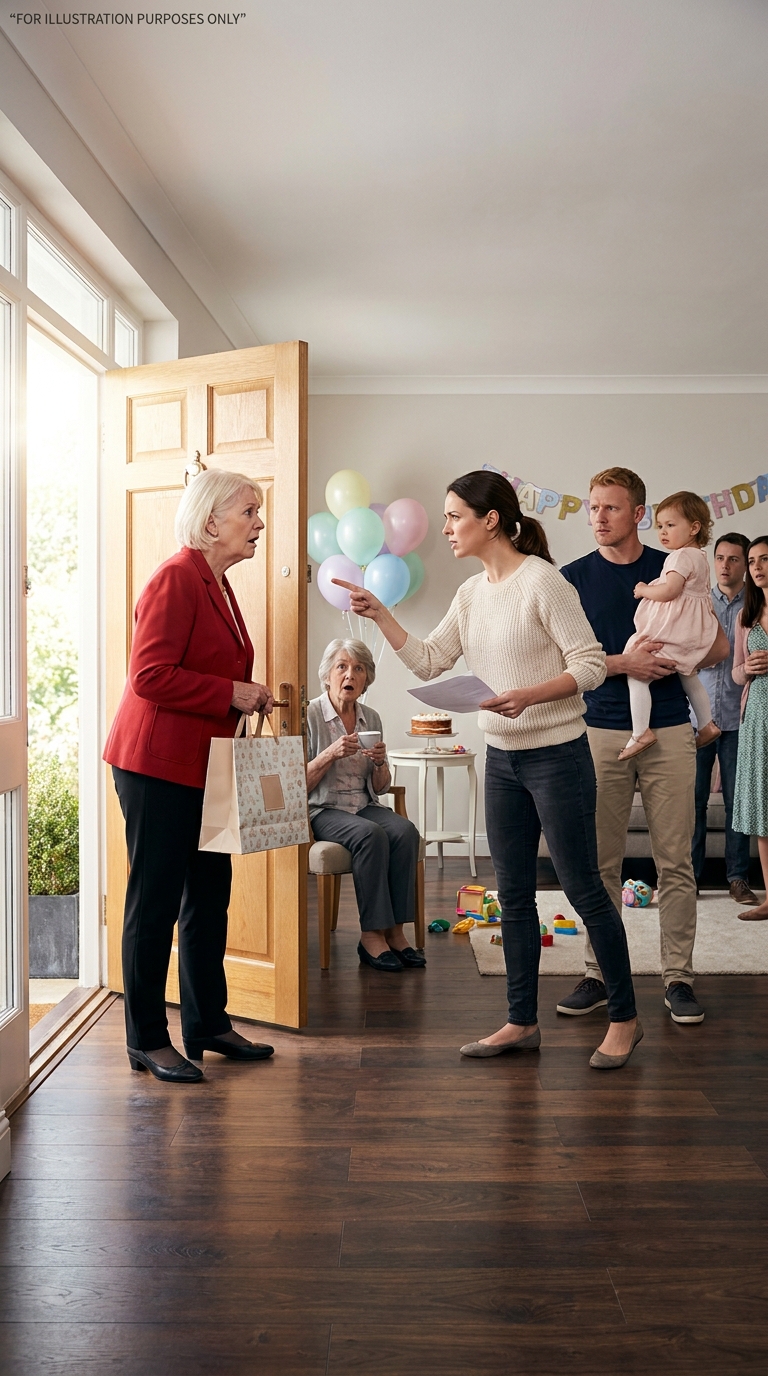
But Beverly came anyway.
She walked through my front door carrying a gift wrapped in pink paper and acting as if she had not spent a year carving cracks into my marriage.
Before I could stop her, Lily tore open the package in front of everyone.
Inside was a white onesie with black letters across the chest.
Daddy’s Maybe.
The room went silent.
Daniel stood, picked up Lily, and carried her down the hall to our bedroom. I heard the door lock.
Beverly laughed.
“Oh, come on. It’s a gag gift.”
Something in me went cold.
I turned to her and said, “You miserable woman. You have been trying to destroy my marriage for entertainment.”
She rolled her eyes. “If your marriage is that weak, maybe it deserves to be destroyed.”
My mother gasped.
Beverly moved toward the door, still smirking.
I followed her.
“If you ever mention my daughter’s hair again,” I said, loud enough for the whole room to hear, “I’ll tell everyone what you did with Grandma’s missing money.”
Beverly’s face went white.
And for the first time in my life, Aunt Beverly had no joke ready.
Part 2
For a moment, nobody breathed.
Beverly’s hand gripped the doorframe so hard her knuckles blanched against the wood. She opened her mouth, closed it, then forced out the same high, brittle laugh she had used for years after cutting someone down.
But this time it cracked.
“Claire,” she said, waving one hand as if I were being silly, “you’re embarrassing yourself.”
“No,” I said. “I’m remembering.”
Behind me, I felt my relatives leaning into the silence. My mother was near the fireplace. My father stood frozen beside the cake table. Cousins who had laughed nervously at Beverly’s jokes for a year now stared at her as if they were seeing the machinery behind the performance.
I stepped onto the porch after her.
“Do you want to talk about Grandma’s missing fifteen thousand dollars right here?” I asked. “Or should we discuss how her signature appeared on checks during the last six months of her life, when she couldn’t even hold a pen steady enough to sign a birthday card?”
Beverly’s face flushed red.
“You lying little—”
“I have copies,” I said.
The words stopped her.
“Every check. Every forged signature. Every bank statement.”
Her eyes darted toward the living room, toward all those people who had always let her dominate every gathering because resisting Beverly required more courage than most of them wanted to spend on a Saturday.
“You’re making this up,” she whispered.
“No,” I said. “I kept quiet because Grandma had just died and I didn’t want to tear the family apart over money. But you spent the last year trying to tear apart my home for sport. So here we are.”
Beverly backed down the steps, fumbling in her purse for her keys. She dropped them once. Then again. When she finally got into her car, her tires squealed as she backed out of our driveway.
I stood on the porch until her taillights vanished.
When I turned around, my mother was standing behind me.
“What money?” she asked.
Her voice was barely a whisper.
I looked past her into the living room. Guests stood among half-deflated balloons and plates of uneaten cake. Lily’s birthday banner hung crooked over the window. The onesie Beverly had brought lay on the floor like evidence.
“Kitchen,” I said.
My mother followed me.
I told her the truth I had carried for two years.
After my grandmother died, I had helped clean out her house. In the bottom drawer of her desk, beneath expired coupons and old church bulletins, I found a folder of bank statements. At first, I thought they were ordinary bills. Then I noticed the checks.
They were written to Beverly.
Five hundred here. Twelve hundred there. Three thousand near the end.
Fifteen thousand total.
All during the last six months of Grandma’s life, when Parkinson’s had made her hands shake so badly she could barely hold a spoon. I remembered helping her sign a birthday card for Lily before Lily was born, before my grandmother passed. Her name had come out in trembling loops, hardly legible.
The signatures on the checks were smooth.
Too smooth.
I copied everything and locked the copies in my safe deposit box.
“Why didn’t you tell us?” Mom asked, hand over her mouth.
“Because Grandma had just died,” I said. “Everyone was grieving. You and Dad were already fighting with Beverly about funeral expenses. I thought exposing it would destroy whatever was left.”
Mom’s eyes filled.
“And you carried that alone?”
I laughed once, though nothing was funny.
“I’ve carried a lot alone.”
She flinched because she knew what I meant.
When we returned to the living room, people had started leaving. Suddenly everyone had early mornings, long drives, children who needed baths, dogs to let out. Nobody wanted to meet my eyes. Nobody wanted to admit they had watched Beverly torment us and called it awkward instead of cruel.
My cousin Scarlet was one of the last to go.
She hugged me tightly at the door.
“It was about time someone stood up to her,” she whispered. “I’m sorry I didn’t say more.”
I held on to her.
“What did you know?”
Scarlet pulled back, shame flickering across her face.
“Beverly was betting people,” she said. “About when Daniel would leave.”
My stomach turned.
“How many?”
She hesitated.
“I know of at least five.”
After everyone left, the house felt ruined.
Cake dried on paper plates. Gift bags leaned against the couch. Pink streamers fluttered under the air-conditioning vent.
I walked down the hall and knocked softly on our bedroom door.
“Daniel,” I said. “They’re gone.”
The lock clicked.
He opened the door slowly.
Lily slept on his shoulder, her red curls sticking up in every direction, her tiny hand pressed against his neck. Daniel’s eyes were swollen and wet. He looked ashamed, exhausted, and utterly broken.
I stepped inside.
For a long moment, neither of us spoke.
Then Daniel whispered, “I made an appointment.”
My throat tightened.
“For what?”
He looked down at our sleeping daughter.
“A DNA test.”
Part 3
The room seemed to tilt beneath me.
I looked at Lily first, not Daniel. She was asleep against him, trusting him with the complete, unconscious peace of a child who had never wondered whether she belonged. Her red curls brushed his jaw. One of her socks had slipped halfway off.
Daniel could not meet my eyes.
“It’s next week,” he said. “At a lab downtown.”
I sat on the edge of the bed, careful because my knees suddenly felt unreliable.
“You were going to go without telling me?”
His face crumpled.
“I know how that sounds.”
“How does it sound?”
“Like betrayal.”
The honesty took some of my anger away and left grief in its place.
Daniel lowered himself beside me, still holding Lily. “I hate myself for it. Every time the thought came into my head, I hated myself. But Beverly kept saying it. Then my mom started asking questions. Christopher made comments. Your relatives looked at me like they were waiting for me to realize something obvious.”
His voice broke.
“I’d be feeding Lily at two in the morning, looking at her hair, and suddenly I’d hear Beverly’s voice. I knew better. I did. But knowing better didn’t stop the question from showing up.”
For months, I had been angry that Daniel did not defend me enough.
That night, I saw the damage in him too.
Beverly had not only attacked me. She had attacked his sense of fatherhood, his peace, his ability to look at his daughter without shame. She had turned love into something he felt guilty for trusting.
“I don’t want to be the kind of husband who needs proof,” he whispered. “I don’t want to be the kind of father who questions his own baby.”
I reached for his hand.
“You are not the one who planted the poison.”
“No,” he said. “But I let it grow.”
We sat in silence.
Then I said the hardest thing I had ever said in my marriage.
“If taking the test kills the doubt Beverly planted, then we do it together.”
Daniel looked at me then, tears sliding down his face.
“I don’t deserve that.”
“I’m not doing it because you deserve it. I’m doing it because Lily deserves parents who don’t let Beverly live in their heads forever.”
We ordered a home paternity test that night with rush processing. It felt humiliating and relieving at the same time. Daniel paid extra for overnight shipping, his hands shaking as he entered his card number.
The next morning, my mother called before I finished my coffee.
“Beverly is telling everyone you made up the estate story,” she said. Her voice was tight. “She says you’re trying to destroy her because of the joke.”
“The joke?” I repeated.
Mom went quiet.
Then she said, “I need to ask you directly. Is it true?”
“Yes.”
“And you have proof?”
“Copies of the checks. Statements. Everything.”
An hour later, my father called. He did not say hello.
“Why didn’t you tell me?”
His voice sounded rough in a way I had never heard.
“Because Grandma had just died.”
“You should have told me.”
“I know.”
“No,” he said, and his voice softened slightly. “You were trying to protect the family. Beverly used that silence to hurt yours. That ends now.”
By noon, Dad had contacted the estate attorney. By evening, Beverly was banned from any family gathering hosted by my parents. By the next day, my mother-in-law Kayla called.
I nearly did not answer.
When I did, her voice was small.
“Claire,” she said, “I owe you an apology.”
I leaned against the kitchen counter and closed my eyes.
She admitted she had let Beverly’s gossip get into her head. She said she had questioned Daniel when she should have trusted him. She said she was ashamed for adding weight to a rumor instead of protecting her son and granddaughter from it.
“I never should have made him feel like he had to prove anything,” she said.
I wanted to be harder than I was.
But she sounded genuinely broken.
“Thank you for saying that.”
Christopher texted Daniel later, apologizing for every comment about Lily’s face, nose, height, hair, everything. He said he had repeated gossip because it was easier than admitting how ugly it was.
Daniel showed me the message without speaking.
The test kit arrived two days after the party.
We swabbed Daniel’s cheek first at the kitchen table. Then Lily’s, which took three attempts because she kept trying to bite the cotton swab and laughed like the whole thing was a game.
We sealed the tubes.
We walked to the post office together and sent the envelope overnight.
On the way back to the car, Daniel took my hand.
Neither of us said what we were both thinking.
We knew what the result would say.
But knowing did not make waiting painless.
On the fourth morning, while Lily sat in her high chair smashing banana into her tray, Daniel walked into the kitchen holding a white envelope.
His face was pale.
“It came,” he said.
Part 4
Daniel opened the envelope like it might explode.
I stood beside the sink, one hand still wet from rinsing Lily’s spoon. She babbled happily in her high chair, unaware that the entire year of whispered cruelty was folded inside that paper.
Daniel read silently.
His shoulders dropped first.
Then his face changed.
He turned the paper toward me.
Most of it was technical language, numbers, lab identification, terms that blurred at the edges because my eyes had already found the bold line in the center.
Probability of Paternity: 99.99%.
I covered my mouth.
Daniel started crying before I did.
Not relieved crying. Not exactly. It was grief leaving his body. Shame. Anger. Love that had been forced to defend itself against a lie.
He crossed the kitchen and pulled me into him so tightly I could barely breathe.
“I’m sorry,” he said into my hair. “I am so sorry.”
Lily banged her spoon on the tray and squealed, demanding attention from both her emotionally destroyed parents.
We laughed through tears.
That afternoon, Daniel bought a simple black frame.
When he slid the results inside it, I stared at him.
“What are you doing?”
“I want to hang it in Lily’s nursery.”
“That feels strange.”
“I know.” He looked embarrassed but steady. “But I need to remember. Not that she’s mine. I know she’s mine. I need to remember how close I came to letting someone else’s poison change how I looked at my own child.”
We hung it beside her growth chart, surrounded by stuffed animals, soft blankets, and pastel animal prints. It looked absurd there, an official paternity document in a baby’s room.
It also looked like survival.
Two days later, my parents hosted Sunday dinner.
Beverly was not invited.
When we arrived with Lily, the house felt cautious, like everyone inside had rehearsed normal behavior and forgotten the lines. My father stood as soon as he saw us. He hugged me hard, then Daniel, then kissed Lily’s red curls.
After everyone sat down, Dad cleared his throat.
“I need to say something before dinner.”
The room went quiet.
He announced that he had filed a formal complaint regarding forged checks from my grandmother’s estate. The amount, he said, was not fifteen thousand after all. The estate attorney had found additional electronic transfers and bank records.
Beverly had taken closer to twenty-two thousand dollars.
Several relatives gasped. My aunt Sarah began crying. Scarlet reached under the table and squeezed my hand.
Dad’s voice shook, but he kept going.
“This is not gossip. This is not a misunderstanding. We have bank records, forged signatures, and proof that money was taken while my mother was too ill to consent. The police are investigating.”
For once, nobody defended Beverly.
That silence felt different from the silence that had protected her for years.
This one buried her.
The next afternoon, Beverly’s daughter called me from an unknown number. She was crying so hard I could barely understand her.
“Please,” she said. “Drop the charges. My mom made a mistake, but she doesn’t deserve jail.”
I sat on the couch, suddenly exhausted.
“I’m not the one pressing charges. My father is.”
“You started it.”
“No,” I said. “Beverly started it when she stole from Grandma. Then she kept going when she attacked my daughter.”
“She has problems.”
“I know.”
“She’s still my mom.”
I closed my eyes. “And Lily is still my daughter.”
She hung up on me.
That night, after Lily fell asleep, Daniel muted the television.
“I think we need counseling,” he said.
My stomach dropped.
He noticed and immediately reached for my hand.
“Not because I want to leave. Because I don’t. But the DNA test proves biology. It doesn’t fix what happened between us.”
I swallowed.
“You mean the doubt.”
“And the silence,” he said. “Mine. Yours. All of it.”
Our first counseling session was awkward and painful.
The therapist, Dr. Elaine Porter, asked why we were there. Daniel admitted he felt ashamed for doubting Lily’s paternity. I admitted I resented him for not defending me sooner, for leaving me alone at family gatherings while Beverly performed cruelty for applause.
Daniel cried.
So did I.
Dr. Porter told us something I still remember.
“A sustained campaign of humiliation can damage a marriage even when both people love each other. The goal now is not pretending the damage did not happen. The goal is repairing it honestly.”
For the first time in months, I felt something like hope.
Meanwhile, Beverly got worse before consequences caught her.
She emailed me ten paragraphs calling me vindictive, cruel, jealous, unstable, and desperate for attention. She claimed the estate money was a misunderstanding. She said I had destroyed the family because I could not take a joke.
I did not answer.
I forwarded it to my father.
He replied five minutes later.
Block her. The lawyer has it now.
So I did.
For years, Beverly had controlled rooms by making people afraid of her next sentence.
Now her words were evidence.
Part 5
Consequences arrived slowly, then all at once.
Three weeks after Lily’s birthday party, Beverly was formally charged with theft and forgery connected to my grandmother’s estate. The prosecutor did not treat it like family drama. Bank records are not family drama. Forged signatures are not family drama. A dying woman’s account being drained while someone pretends to help with bills is not family drama.
My father sounded older when he called to tell me.
“She took money from Mom while bringing her groceries,” he said. “She sat by her bed and stole from her.”
I did not know how to comfort him.
So I listened.
That was all either of us could do.
Some relatives who had joined Beverly’s betting pool began sending apologies. One cousin said she thought it was harmless. Another claimed she did not realize how seriously Daniel was taking the jokes. An aunt wrote that she was ashamed but hoped we could move forward.
I read the messages but answered almost none.
There is a special kind of betrayal in learning people did not merely tolerate your pain. They made a game of it. They placed money on whether your marriage would fail and called it teasing.
Scarlet became one of the few people I trusted completely.
She called every week, sometimes just to ask if I had eaten lunch. We started meeting at a sandwich shop near her office. One day, she told me watching everything with Beverly had made her rethink her own family.
“My uncle makes awful comments at every gathering,” she said. “Everyone laughs because it’s easier. I used to laugh too.”
“Used to?”
She smiled a little.
“I called him out last Sunday.”
“How did that go?”
“Terrible,” she said. “But necessary.”
We both laughed, and it felt good.
At home, Daniel and I worked through counseling the way people rebuild after a storm: one board, one nail, one honest sentence at a time. He began leaving notes around the house. On the coffee maker. In my coat pocket. Taped to the bathroom mirror.
I love how fiercely you protect Lily.
Thank you for fighting when I was drowning.
You deserved a husband who spoke sooner. I am becoming him.
I started telling him when I was hurt instead of carrying it until it hardened. When something reminded me of Beverly’s jokes, I said so. When I felt angry at Daniel again, I told him before resentment could build walls.
Dr. Porter called it rebuilding trust through small consistent actions.
It was not romantic at first.
It was work.
Then slowly, it became tenderness.
Daniel’s family asked us to dinner. Kayla apologized again, this time in front of everyone. Christopher stood and admitted he had repeated gossip instead of supporting his brother. Daniel’s father, a quiet man who had always avoided conflict, said he was ashamed he had let rumors take root in his home.
The dinner was uncomfortable for three straight hours.
It was also necessary.
On the drive home, Daniel said, “That hurt.”
“Yes.”
“But I needed to hear them say it.”
“I know.”
A month later, Beverly took a plea deal. She received probation, restitution, community service, and a permanent criminal record. My father said he wished she had gotten worse. My mother cried because Beverly was still her sister, but even she did not say it was unfair.
“She did this,” Mom said quietly. “All of it.”
Beverly’s name stopped appearing on family invitations.
And without her, gatherings changed.
At my cousin’s September wedding, Daniel came with me for the first time in over a year. Lily wore a tiny dress with embroidered flowers and clapped at the music. Nobody joked about her hair. Nobody whispered. Nobody watched Daniel for signs of doubt.
Halfway through the reception, Daniel asked me to dance.
As we moved slowly beneath soft lights, Lily toddled near my mother, her red curls bouncing. Daniel watched her with a smile so open it almost hurt.
“That’s our girl,” he said.
No tension.
No question.
Just love.
Later that fall, Lily took her first real steps across my parents’ living room. My mother had been visiting every Tuesday since the confrontation, bringing groceries, folding laundry, playing blocks with Lily while I showered or simply sat down for ten minutes.
She was trying.
Not perfectly. Not dramatically. But steadily.
When Lily let go of the coffee table and walked five wobbly steps into my mother’s arms, Mom burst into tears.
“She did it,” Mom cried. “Claire, she did it.”
Daniel got home twenty minutes later, and Mom made Lily perform the miracle again. Daniel lifted her into the air and spun her around, laughing as Lily shrieked with delight.
I watched his face.
There was no shadow left.
That was when I truly understood how much Beverly had stolen from us. Not only peace. Not only trust. She had stolen ordinary moments by making them feel like tests.
Now we were taking them back.
One Tuesday afternoon, Scarlet sent me a photo from a family picnic I had missed because of work. Lily sat in the grass with Scarlet’s kids, sunlight turning her red hair into a halo.
The caption read:
Look at this beautiful redheaded angel.
I stared at those words until my eyes filled.
A year earlier, Lily’s hair had been treated like an accusation.
Now it was being loved as part of her.
That night, I rocked my daughter in her nursery beneath the framed DNA results and the growth chart. Her curls stuck to her forehead as she fought sleep with heroic determination.
I kissed her warm cheek.
“You were never the problem,” I whispered. “Not for one second.”
Part 6
By the time we planned Lily’s second birthday party, Daniel and I had learned the difference between family and access.
Family was not everyone who shared a last name. It was not everyone who expected an invitation because history said they deserved one. Family was the people who protected peace after seeing how hard it had been to earn.
So the guest list was smaller.
My parents came. Kayla came. Christopher brought his girlfriend. Scarlet came with her children. A few relatives who had stood beside us came too.
No one from Beverly’s betting pool was invited unless they had apologized, changed, and respected silence when we needed it. Beverly was not invited. Her daughter called once asking if her children could know Lily, and I told her maybe someday, but not yet.
For once, I did not confuse guilt with obligation.
The morning of the party, Daniel helped me hang streamers while Lily scattered napkins across the floor like confetti. I made a cake with red frosting because my daughter’s hair was beautiful and nobody in my home would ever treat it like evidence again.
When guests arrived, the house filled with warmth instead of tension.
People brought gifts and food and ordinary conversation. Kayla sat on the floor building block towers with Lily. My mother carried a tray of sandwiches into the kitchen. My father stood near Daniel, discussing some home repair project neither of them would actually complete.
It was normal.
After the year we had survived, normal felt holy.
About an hour into the party, Daniel tapped his glass with a fork.
Everyone turned.
He cleared his throat, holding Lily on his hip. She had frosting already smeared on one sleeve though we had not cut the cake yet.
“I just want to say thank you,” Daniel said. “To everyone here. This past year was hard for our family. Harder than most people know. Some of you helped us get through it. Some of you apologized when you were wrong. Some of you gave us space when space was what we needed.”
His voice thickened.
“I’m grateful Lily gets to grow up surrounded by people who understand that love means protecting each other, not laughing while someone gets hurt.”
My mother wiped her eyes.
Kayla pressed a hand to her chest.
Daniel looked at me.
“And Claire,” he said softly, “thank you for fighting for us before I remembered how.”
The room blurred.
Then Lily slapped both hands against his cheeks and shouted, “Cake!”
Everyone laughed.
That laugh healed something in the walls.
When we brought out the red-frosted cake, Lily studied it solemnly for two seconds before plunging both hands into the middle. Frosting went everywhere. Her face. Her dress. Daniel’s shirt. A red streak landed across one eyebrow, making her look like a tiny warrior.
Daniel laughed harder than anyone.
I watched him watching her.
There was my victory.
Not Beverly’s probation. Not the estate records. Not the framed test. Not even the apologies.
This.
My husband looking at our daughter covered in red frosting and seeing only joy.
Months later, Beverly moved out of state to live near her daughter. My father told me over the phone, his voice calm but sad. He had not spoken to her since the plea deal. He said maybe distance was best for everyone.
“Family gatherings are easier now,” he admitted. “People breathe differently.”
I knew exactly what he meant.
Some people do not leave a room when they exit. Their absence does.
Daniel and I kept going to counseling until Dr. Porter told us we had built the tools we came for. Not perfection. Tools. There is a difference. We knew how to speak before silence hardened. We knew how to name hurt without making it a weapon. We knew how to stand together when family pressure rose around us.
On our anniversary, Daniel cooked dinner at home after Lily fell asleep. He gave me a necklace with Lily’s birthstone on a thin gold chain.
“This year taught me you’re the strongest person I know,” he said.
I touched the stone with my fingertips.
“It taught me I don’t want to be strong alone anymore.”
“You won’t be,” he said.
The next weekend, we drove to the cemetery where my grandmother was buried. The sky was gray, the grass damp beneath our shoes. Daniel carried Lily until we reached the headstone, then set her down carefully.
I knelt in front of the stone.
“Grandma,” I said, “this is Lily. She has your hair.”
Lily reached out and touched the cold granite with her little hand.
Daniel stood beside me, holding my shoulder. For years, Beverly had twisted my grandmother’s memory into a secret weapon. Standing there with my daughter, I felt that secret loosen its grip.
My grandmother’s red hair had skipped generations and returned as a child with bright eyes, sticky fingers, and a laugh that filled our whole house.
It was not scandal.
It was inheritance.
It was proof that love and blood both travel in ways people like Beverly will never understand.
On the walk back to the car, Lily held one of my hands and one of Daniel’s, jumping over puddles with complete confidence that we would not let her fall.
And we did not.
One evening not long after, Daniel and I sat together on the couch while Lily slept upstairs. The house was quiet. Not the brittle quiet after a fight. The soft kind. The safe kind.
Daniel looked toward the hallway.
“Do you ever think about taking down the frame in her room?”
“The DNA test?”
He nodded.
I thought about it.
“Not yet,” I said. “Maybe someday.”
He smiled faintly. “It’s a strange decoration.”
“It is.”
“But it means something.”
I leaned against him.
“It means we survived the kind of lie that was meant to destroy us.”
Daniel kissed the top of my head.
“And it didn’t.”
No, it did not.
Beverly tried to make my daughter’s red hair a question mark.
Instead, it became an exclamation point.
A bright, beautiful, impossible-to-ignore reminder that our family belonged to itself, not to gossip, not to cruelty, not to anyone standing outside our home with a joke sharpened like a knife.
The end