
Part 2
Patricia sighed softly.
It was the kind of sigh that had ruined whole dinners.
Not loud.
Not dramatic enough to be called dramatic.
Just a small, wounded breath, released carefully into the air so everyone nearby could understand that she was the victim and I was the woman making a scene.
“I only picked up a few things,” she murmured.
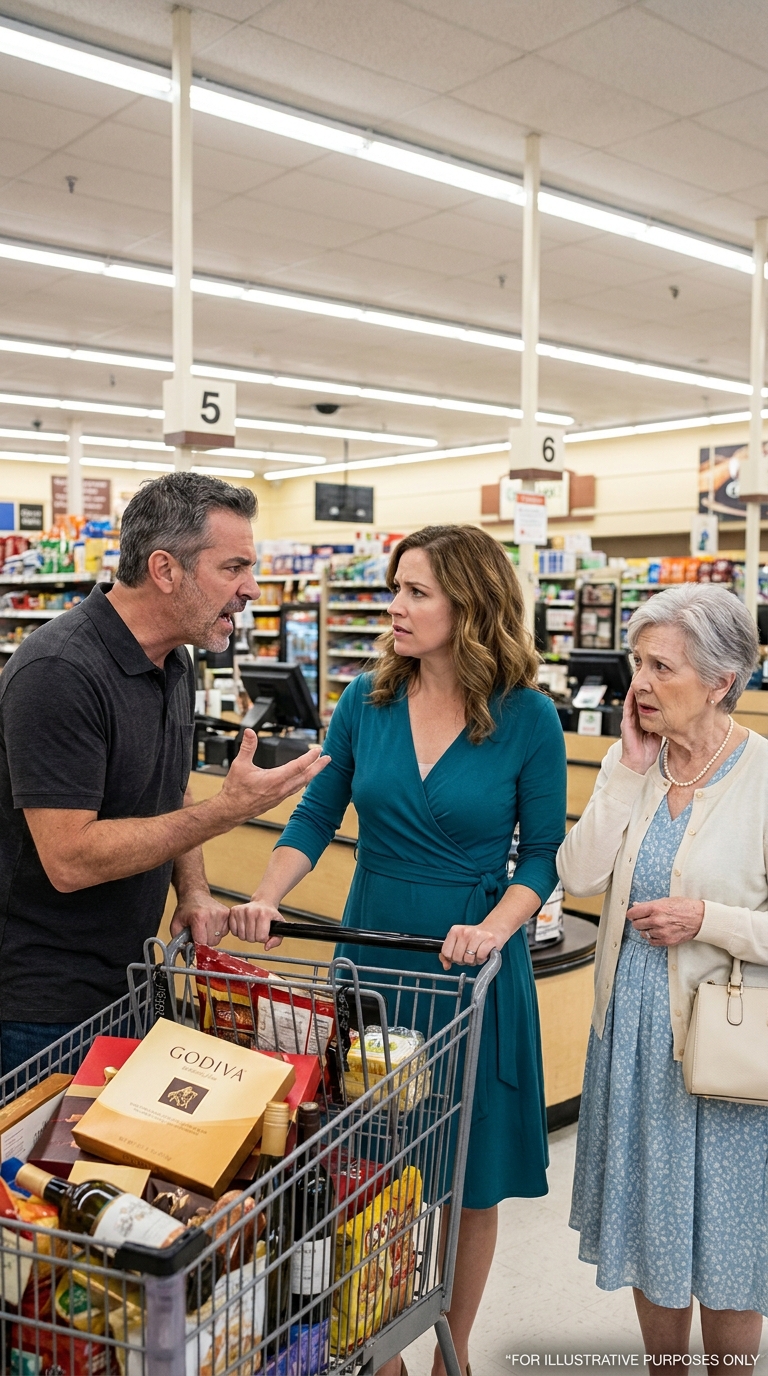
I looked at the cart.
A few things.
One thousand twelve dollars and forty-six cents of “a few things.”
The cashier’s fingers hovered over the register like she wished the machine would swallow her whole.
Daniel stepped closer to me and lowered his voice, but not enough.
“Claire, pay for it. We’ll talk at home.”
That sentence used to work on me.
For years, it had worked.
We’ll talk at home meant I was supposed to swallow my embarrassment in public, pay whatever needed paying, smile politely, and wait until we got behind closed doors so Daniel could tell me I had made things uncomfortable.
Not Patricia.
Me.
Always me.
But this time, I looked at him and said, “No.”
The word was small.
It still landed like a dropped glass.
Daniel blinked.
“What did you say?”
“I said no.”
Patricia’s lips parted. “Claire, dear, this is really unnecessary.”
“So was the caviar.”
The woman behind us made a tiny sound, something between a cough and a laugh, then immediately stared harder at her phone.
Daniel’s face went darker.
“You’re humiliating my mother.”
“No,” I said. “Your mother chose what she wanted. I’m asking her to pay for it. That is not humiliation. That is shopping.”
The cashier finally spoke.
“I can, um, separate the order.”
Her voice trembled.
I turned to her and gave her the gentlest smile I could manage.
“Please do.”
Daniel snapped his head toward her. “Don’t.”
The cashier froze.
That was the moment the store manager appeared at the end of the lane.
He was a short man with gray hair, a name tag that read Howard, and the expression of someone who had been called to handle too many checkout lane battles in one lifetime.
“Everything all right here?”
“No,” Daniel said at once. “My wife is creating a problem.”
I almost laughed.
My wife.
Not Claire.
Not she.

My wife.
A title he only remembered when he needed ownership.
I reached into the cart and lifted the chicken thighs, the coffee, the onions, the yogurt, the sweet potatoes, and my coworker’s birthday card.
“These are mine,” I told Howard. “The rest belongs to my mother-in-law. I would like to pay for my items separately.”
Howard looked from me to Daniel to Patricia.
Then, with the tired wisdom of a man who knew exactly when a husband was not the safe person in the conversation, he nodded.
“Of course.”
Daniel’s mouth opened.
Howard turned to the cashier. “Separate transaction.”
The cashier moved fast after that.
My items came to $118.73.
I paid.
The machine beeped.
Receipt printed.
I picked up my two paper bags and put them in the cart’s child seat.
Then I stepped aside.
Patricia’s things remained on the belt.
Smoked salmon.
French cheese.
Olive oil.
Balsamic vinegar.
Truffles.
Caviar.
“Your turn,” I said.
Patricia looked at Daniel.
Daniel looked at me.
For the first time all evening, neither of them seemed to know the script.
Finally, Daniel reached for his wallet.
I watched him pull out the black card he kept behind his driver’s license. The one he said was for emergencies.
Patricia touched his arm.
“No, sweetheart. I can pay.”
But she said it too late.
The card was already in his hand.
I saw it.
The cashier saw it.
Howard saw it.
And most importantly, Patricia knew I saw it.
Daniel paid the $893.73 without another word.
When the receipt printed, he snatched it so hard the paper tore crooked.
We walked out of the store in silence.
The automatic doors opened into the warm evening air. The sky had turned orange over the parking lot, and cars moved slowly between the rows. Somewhere, a cart rattled against a curb.
Daniel loaded the bags into the trunk like each one had personally betrayed him.
Patricia stood beside the passenger door, clutching her purse.
“Claire,” she said softly, “I hope you understand how hurtful this was.”
I looked at her.
For six years, I had apologized to that face.
For birthdays she ruined because the restaurant was “too loud.”
For holidays where she arrived early and rearranged my kitchen.
For dinners where she corrected my cooking, my clothes, my tone, my spending, my family, my grief, my plans.
I had apologized when she insulted me.
I had apologized when Daniel defended her.
I had apologized because it was easier than fighting two people who always agreed I was the problem.
Not tonight.
“I understand more than you think,” I said.
Then I got into the back seat.
Daniel drove.
Patricia sat in front, silent and stiff.
For the first ten minutes, nobody spoke.
Then Daniel said, “You embarrassed me.”
I watched the road lights slide across the window.
“No, Daniel. I embarrassed your arrangement.”
His eyes flicked to the rearview mirror.
“What does that mean?”
“It means I know.”
The car went quiet again.
Patricia turned her head slightly.
Daniel’s hands tightened on the steering wheel.
“What exactly do you think you know?”
There it was.
Not What are you talking about?
Not Claire, are you okay?
What exactly do you think you know?
A guilty man’s question.
I leaned back against the seat.
“I know about the bottom drawer.”
The car drifted slightly before Daniel corrected it.
Patricia whispered, “Daniel.”
One word.
But it told me everything.
She knew too.
My stomach should have twisted.
It didn’t.
The twisting had happened three nights earlier, when I went into the office looking for printer paper.
The top drawer had been empty.
The second drawer had old tax folders.
The bottom drawer had been locked.
It had never been locked before.
I almost walked away.
Then I noticed the tiny silver key on Daniel’s key ring hanging from the hook beside the door.
That was how little he feared me.
He had hidden everything in our house, behind a cheap lock, and trusted that I would never question him.
Inside the drawer were three folders.
One labeled Home Repairs.
One labeled Mom Medical.
One with no label at all.
The first folder had bank statements.
The second had wire transfers.
The third had copies of my signature.
My signature, again and again, on documents I had never seen.
A home equity line of credit.
A private loan agreement.
A transfer authorization.
A notarized paper with a stamp from a man I had never met.
And beside those papers, clipped together neatly, were emails between Daniel and Patricia.
I had read them sitting on the office floor, while the house hummed around me like nothing had changed.
Patricia had written:
Claire never checks the accounts. Use the joint line before she asks questions.
Daniel had replied:
She’ll complain, but she always calms down.
Another message from Patricia:
Once the condo sells, I’ll pay it back. Until then, don’t let her interfere. She doesn’t understand family duty.
The condo had not sold.
The condo had never even been listed.
Patricia had borrowed against my house, through my husband, using my forged signature, so she could keep living like money was something other people made for her.
And Daniel had helped her.
No.
Worse.
Daniel had protected her.
That was why the grocery store did not break me.
I had already broken.
This was just where they noticed.
“Claire,” Daniel said carefully, “you need to calm down.”
I almost smiled again.
“Don’t worry. I’m very calm.”
Patricia turned fully in her seat now.
Her face had lost its soft, injured look.
“What have you done?”
I met her eyes in the rearview mirror.
“I called an attorney.”
Daniel cursed under his breath.
“I made copies of everything,” I continued. “I sent them to my father. I sent them to my attorney. And tomorrow morning, the bank is freezing the home equity line until the signatures are reviewed.”
Daniel pulled into our driveway too fast.
The tires bumped the curb.
He slammed the car into park.
Patricia opened her mouth, but no sound came out.
The porch light was on.
Our house looked normal.
White trim.
Blue door.
Geraniums in the pots I had planted myself.
A small house I had loved because I believed it belonged to us.
Now I knew it had been treated like a wallet.
Daniel turned around in his seat.
“Do you understand what you’re doing?”
“Yes,” I said. “For the first time in years.”
“You’re going to destroy this family over paperwork?”
“No. You destroyed it with the paperwork.”
His face twisted.
“I did what I had to do. Mom needed help.”
“Your mother needed caviar?”
Patricia flinched.
Good.
Daniel jabbed a finger toward the house.
“You don’t know what it’s like to have a parent depend on you.”
I laughed once.
It came out cold.
“My father had a stroke two years ago. I took leave from work, drove him to therapy, paid for his medication when insurance delayed approval, and still managed not to forge your name.”
Daniel looked away.
He always looked away when facts were inconvenient.
Patricia’s voice sharpened.
“You always resented me.”
“No, Patricia. I tried very hard to love you.”
She stared at me like that was more insulting than hatred.
“I invited you into my home,” I said. “I hosted every holiday. I bought your birthday gifts when Daniel forgot. I drove you to appointments. I listened when you cried about being lonely. I ignored every little insult because I thought peace mattered.”
My voice shook then, just once.
“But peace without respect is just silence. And I am done being silent.”
Daniel got out of the car and slammed the door.
Patricia followed.
I stayed inside for a moment, looking at the dark windows of the house.
Then I opened my door and stepped out.
Daniel was already unlocking the front door.
“You’re not taking anything,” he said.
I walked past him.
“I already did.”
He stopped.
“What?”
I went to the hall closet, pulled out my overnight bag, and set it by the door.
A second bag waited behind it.
Then another.
Daniel looked from the bags to me.
His anger faltered.
“You packed?”
“Three days ago.”
Patricia gripped the back of the sofa.
“You planned this?”
I looked at her.
“No. You did. I just finally responded.”
Daniel followed me into the kitchen as I picked up my laptop bag.
“Where are you going?”
“My father’s.”
“Claire, don’t be ridiculous.”
That word.
Ridiculous.
It had followed me through six years of marriage.
Ridiculous when I asked why his mother had a key.
Ridiculous when I said I wanted our bank passwords changed.
Ridiculous when I asked why Patricia’s “temporary help” came out of my paycheck too.
Ridiculous when I cried after she told Daniel he could have married someone “warmer.”
Ridiculous had been his favorite cage.
I turned around.
“I am not ridiculous. I am not dramatic. I am not selfish. And I am not paying for one more thing your mother chooses.”
Daniel stared at me.
Then his face changed.
His anger lowered into something softer.
More dangerous.
“Claire,” he said, “we can fix this.”
I felt the old reflex rise in me.
The urge to listen.
The urge to hope.
The urge to believe that the man I married was still somewhere inside the man standing in front of me.
Then Patricia spoke from the living room.
“Daniel, don’t beg.”
And just like that, the reflex died.
He did not turn toward her.
He did not tell her to stop.
He did not say, Mom, this is my marriage.
He stood there, silent.
That silence answered every question I had ever been afraid to ask.
I lifted my bags.
Daniel reached for one.
I stepped back.
“No.”
His hand dropped.
“Claire.”
“I’ll send you my attorney’s information tomorrow.”
“You’re really leaving?”
“Yes.”
“Over money?”
I looked at him for a long moment.
“No, Daniel. Over theft. Over lies. Over your mother having more rights in my marriage than I did.”
His mouth tightened.
“You’ll regret this.”
Maybe he meant it as a warning.
Maybe he meant it as a plea.
Either way, it was the wrong thing to say.
I walked out.
The night air touched my face.
For the first time in days, I could breathe.
My father was waiting in his truck at the end of the driveway.
He was seventy-two, broad-chested, stubborn, and still recovering from the stroke that had left his left hand weaker than his right. When he saw me, he climbed out anyway.
I crossed the lawn toward him.
Behind me, Daniel came onto the porch.
“Claire!”
I did not turn around.
My father opened the passenger door.
“You got everything?”
“Enough.”
He looked past me at Daniel.
For one second, the two men stared at each other.
Then my father said, calm as winter, “Son, you should go back inside.”
Daniel did.
The porch door closed.
I got into the truck.
My father started the engine.
Neither of us spoke until we reached the end of the street.
Then he said, “You okay?”
I looked out at the dark road.
“No.”
He nodded.
“That’s fair.”
The first tear came then.
Not the loud kind.
Not the collapsing kind.
Just one tear slipping down my cheek, followed by another.
My father reached over and placed his rough hand over mine.
“You don’t have to be okay tonight,” he said.
So I wasn’t.
For one night, I let myself fall apart.
By morning, I was ready.
At 8:05, my attorney called.
At 8:40, the bank called.
At 9:10, Daniel called twelve times.
I did not answer.
At 10:30, Patricia left a voicemail.
Her voice was no longer soft.
“You have no idea what you’ve done. Daniel was only trying to help his mother. A decent wife would understand that.”
I saved it.
My attorney loved voicemails.
By noon, the bank confirmed what I already suspected.
Two signatures were under review.
One notary stamp looked questionable.
The home equity withdrawal had been approved six months earlier.
The amount was not small.
Eighty-four thousand dollars.
I had to sit down when I heard the number.
Eighty-four thousand dollars.
While I had clipped coupons.
While I had delayed replacing my car tires.
While I had told myself we were tightening our budget because life was expensive.
Patricia had been spending borrowed money from my house.
And Daniel had let me feel guilty for buying coffee out twice a week.
That afternoon, I met my attorney in her office.
Her name was Maribel Santos, and she had the calmest eyes I had ever seen.
She reviewed the copies again.
Then she looked at me and said, “Claire, this is not just a divorce issue.”
I folded my hands in my lap.
“I know.”
“Are you prepared for where this could go?”
I thought of Daniel in the grocery store, red-faced and furious because I would not pay for caviar.
I thought of Patricia’s sigh.
I thought of six years of making myself smaller so they could call it peace.
“Yes,” I said. “I’m prepared.”
Maribel nodded.
“Then we start today.”
The next week moved like a storm.
Daniel changed his tone three times.
First, he was angry.
Then he was sorry.
Then he was afraid.
He sent flowers to my father’s house.
I left them on the porch.
He texted:
I made a mistake. Please don’t ruin my life.
I stared at the message for a long time.
Then I typed back:
You were comfortable ruining mine.
After that, I stopped replying.
Patricia tried a different route.
She called my sister.
She called my coworker Renata.
She even called my father’s church office and asked the secretary to pass along a message about “family forgiveness.”
My father answered that one himself.
Whatever he said, Patricia did not call the church again.
Two weeks later, Daniel asked to meet.
My attorney advised against it unless she was present.
So we met in a conference room with glass walls, a long table, and a box of tissues nobody touched.
Daniel looked thinner.
Patricia came with him.
Of course she did.
She wore pearls.
Maribel sat beside me with a yellow legal pad.
Daniel’s attorney sat across from us, already looking tired.
Patricia began before anyone else could speak.
“This has gone far enough.”
Maribel looked at Daniel’s attorney.
“Is your client’s mother a party to this meeting?”
The attorney adjusted his glasses.
“Mrs. Whitmore is here for emotional support.”
Maribel smiled politely.
“Then she can support silently.”
Patricia’s mouth shut.
I nearly laughed.
Daniel leaned forward.
“Claire, I don’t want this to get ugly.”
“It already is,” I said.
“I can explain.”
“You had six months.”
He swallowed.
“Mom’s expenses got out of control.”
Patricia stiffened.
Daniel kept going, which surprised me.
“She was behind on condo fees. There were credit cards. Some medical bills.”
“Daniel,” Patricia warned.
He glanced at her, then back at me.
“I thought I could fix it before you found out.”
“You thought you could use my name before I found out.”
He looked down.
That was the closest thing to honesty I had gotten from him in years.
“Did you forge my signature?”
His attorney sat up quickly.
“Daniel, don’t answer that.”
Daniel closed his eyes.
Patricia’s face went pale.
Maribel wrote something down.
I had my answer.
The settlement took months.
Not because the truth was unclear.
Because Daniel and Patricia fought every inch of it.
They tried to claim I had known.
Then they tried to claim I had benefited.
Then Patricia produced a handwritten note saying I had “verbally agreed” to help her.
Maribel read it once and said, “This looks like it was written yesterday.”
It was.
In the end, the bank reversed part of the debt pending investigation. Daniel had to assume responsibility for the remaining amount connected to the withdrawals. Patricia had to sign a repayment agreement after her condo finally went on the market.
The divorce was granted in early spring.
I kept the house.
Not because Daniel wanted me to.
Because my name had been on the original down payment, my inheritance had paid for the renovation, and his attorney knew what would happen if we took the forged documents before a judge in full.
The day Daniel came to collect his things, Patricia waited in the car.
She did not come inside.
I stood in the kitchen while Daniel carried boxes from the hallway.
The house was quiet.
No shouting.
No performance.
Just the sound of tape ripping and cardboard shifting.
At the door, Daniel paused.
“I did love you,” he said.
I believed him.
That was the saddest part.
“I know,” I said.
His eyes filled.
“Then why does it feel like you hate me?”
“Because you thought love meant I would keep taking damage quietly.”
He looked at me for a long moment.
Then he nodded.
Maybe he understood.
Maybe he didn’t.
It no longer mattered.
He left.
I closed the door.
For the first time, the house belonged to me in more than paperwork.
That summer, I changed the locks.
I painted the office a warm green.
I replaced Daniel’s heavy leather chair with a small reading chair by the window.
I planted tomatoes in the backyard.
I bought the good coffee without guilt.
On my birthday, Renata took me to dinner.
When the waiter brought the dessert menu, she leaned across the table and said, “Order the expensive one.”
I laughed.
“Why?”
“Because you’re paying for yourself now. Might as well enjoy it.”
So I did.
A month later, I saw Patricia at the same grocery store.
She was standing in front of the cheese case, holding a small wedge in her hand.
For a moment, we just looked at each other.
She had changed.
Not much.
Women like Patricia rarely changed in ways they could not control.
But there was something smaller about her now.
Less polished.
Less certain that the world would rearrange itself around her comfort.
Her cart held eggs, bananas, soup, and a store-brand loaf of bread.
No caviar.
No truffles.
No smoked salmon.
She looked at me and lifted her chin.
I waited for the sigh.
The injury.
The old performance.
Instead, she looked away.
That was the closest thing to an apology I was ever going to get.
I walked past her and picked up my coffee.
At checkout, my total was $63.18.
I paid for it myself.
The cashier handed me the receipt.
I walked into the sunlight with two bags in my hands and no one beside me demanding that I carry what they had chosen.
And for the first time in a long time, my life felt light.