
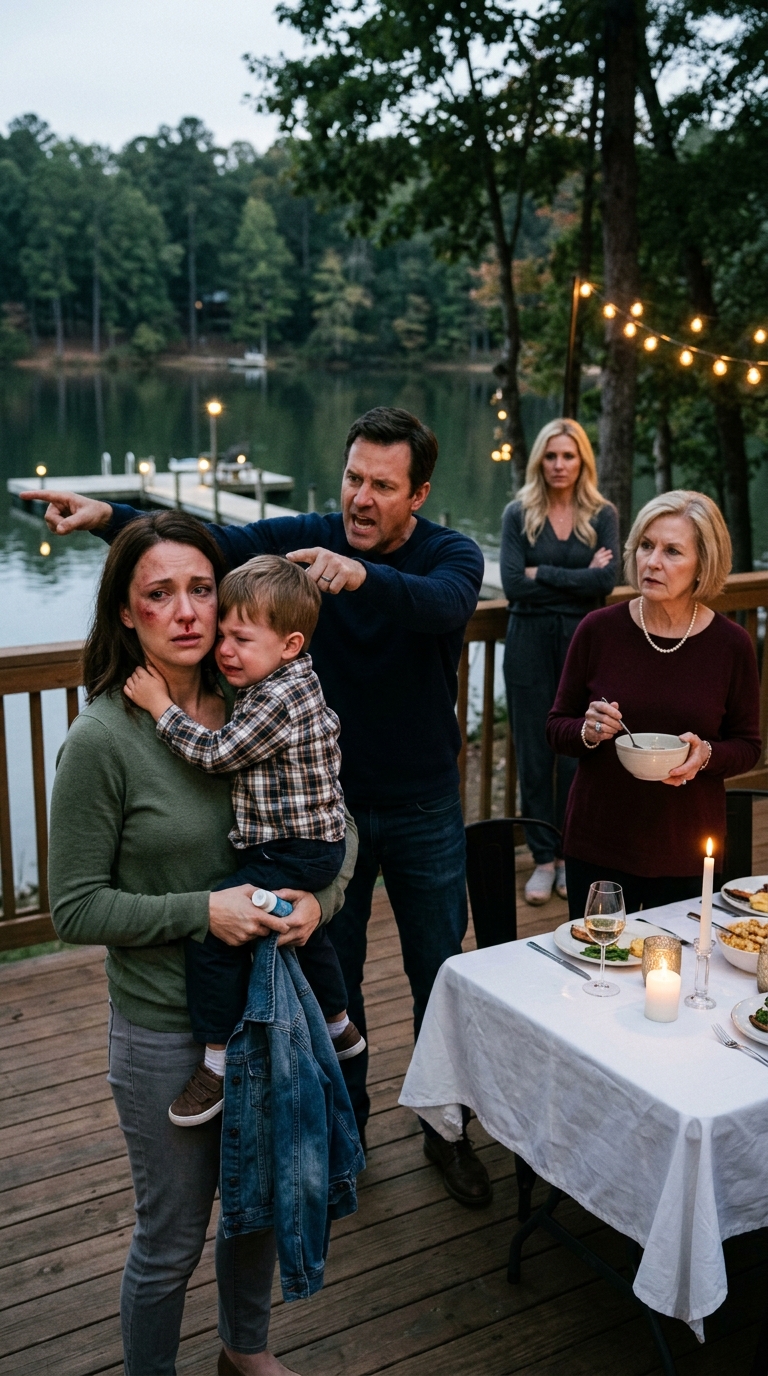
By the time Nathan’s family learned we had left the country, it was too late to bully me back into silence.
And they went pale when they realized I had not left empty-handed.
I had left with proof.
Part 3
For two days, Nathan did not call.
That silence scared me more than the shouting had.
Nathan was not a quiet man when he felt wronged. He believed every disagreement could be won if he spoke loudly enough, stood close enough, and made the other person feel unreasonable enough.
But now there was evidence.
Now there was a hospital report.
Now there was a video.
Now there was a court order with his name on it.
And suddenly, the man who had told me to apologize or leave had nothing to say.
My mother’s house in Toronto looked exactly the way it had when I was a child. The same blue curtains in the kitchen. The same little brass lamp by the couch. The same smell of laundry soap, tea, and lemon cleaner.
For the first time in years, I slept in a house where nobody made me feel like I had to earn space.
Leo adjusted faster than I did.
Children are strange like that. Their world can crack open, and if someone safe is there with warm socks, dinosaur pancakes, and bedtime stories, they will still find a way to laugh.
But every time he coughed, my whole body froze.
Every time he scratched his neck, I reached for the EpiPen.
Every time my phone buzzed, I expected war.
On the third morning, war arrived.
Not from Nathan.
From his mother.
Patricia Whitaker sent one email.
Subject: You Will Regret This
Elena,
You have no idea what you have done. You have torn apart a family because you cannot handle being corrected. Leo is my grandson. Nathan is my son. You are not going to poison him against us.
You always wanted to isolate Nathan. You always acted superior because you are a nurse. But everyone saw the truth that night. You wanted attention. You wanted to make me look dangerous.
You should be ashamed.
Bring him back before things get worse.
Patricia
I read it once.
Then again.
Then I forwarded it to Marissa.
Her reply came six minutes later.
Do not respond. Save everything.
So I saved it.
That became my new job.
Not defending myself.
Documenting.
The messages.
The missed calls.
The threats disguised as concern.
The posts that appeared and disappeared.
The family members suddenly writing long, cruel comments under old photos of mine.
“She always seemed unstable.”
“Poor Nathan.”
“That child belongs with his father.”
I wanted to answer every single one.
I wanted to write, He belongs where people do not put poison in his food to prove a point.
But Marissa had warned me.
“People like this want you emotional,” she said. “They want screenshots where you sound angry. Don’t give them weapons.”
So I gave them silence.
Silence made them louder.
And the louder they got, the clearer they became.
A week after I arrived in Toronto, Nathan finally called from a number I did not recognize.
I answered because Marissa told me recorded calls could matter, and because some part of me still needed to hear whether my husband cared more about being exposed or about what happened to our son.
“Elena,” he said.
His voice sounded rough.
Tired.
Almost human.
“What do you want, Nathan?”
“I want to see my son.”
“You can speak to him on video call through the temporary schedule Marissa sent.”
“That’s not the same.”
“No. It isn’t.”
He breathed into the phone.
For a moment, I heard the man I used to love. The one who brought me soup when I worked double shifts. The one who cried the first time Leo wrapped his whole tiny hand around his finger. The one who once told me he would never let anyone make me feel alone again.
Then he said, “My mother is devastated.”
And just like that, he was gone.
I closed my eyes.
“Your son was in the hospital.”
“I know.”
“Do you?”
His voice sharpened.
“Don’t do that.”
“Do what?”
“Act like I don’t love him.”
I stood in my mother’s kitchen, looking out at the frozen backyard where Leo was chasing bubbles in a puffy coat.
“Love is not the question, Nathan.”
“Then what is?”
“Safety.”
He said nothing.
So I continued.
“Your mother deliberately exposed him to peanuts after I warned her. Your sister blamed me. Your family demanded an apology. And you stood there and told me to leave.”
“I was angry.”
“You were angry at me.”
He went quiet again.
That silence answered too much.
Then he said, lower, “The video doesn’t show everything.”
My stomach turned cold.
“There it is.”
“Elena, listen to me.”
“No. You listen. That video shows your mother dipping Leo’s food into peanut sauce after I stopped him from eating it. It shows me asking what was in the sauce. It shows Brooke laughing. It shows your mother giving him that plate anyway.”
“She thought you were exaggerating.”
“That does not make it better.”
“She didn’t know it would be that bad.”
“She knew enough to hide it from me.”
His breathing changed.
He knew.
He had watched the video.
He knew.
But knowing and admitting were different things in the Whitaker family.
“Nathan,” I said quietly, “what would it take for you to protect Leo from them?”
He did not answer.
I felt something inside me settle.
Not break.
Settle.
“Thank you,” I said.
“For what?”
“For finally making it clear.”
I hung up.
That evening, Leo asked if Daddy was mad.
I froze with a spoon halfway to his bowl.
My mother looked at me from across the kitchen.
Leo was sitting in his booster seat, swinging his little legs, looking down at his pasta like the answer might be hidden between the noodles.
“No, baby,” I said carefully. “Daddy loves you.”
“Grandma Pat mad?”
I swallowed.
“Grandma Pat made a very unsafe choice, and the grown-ups are dealing with it.”
He frowned.
“She said peanuts make me strong.”
My spoon slipped from my hand and clattered onto the table.
My mother’s face went white.
I knelt beside Leo.
“When did she say that?”
He shrugged, tiny and careless, not knowing he had just cracked the world open wider.
“At the party. She said don’t tell Mommy because Mommy gets scared.”
I could not breathe.
My mother stood slowly.
“Did she give you food before dinner?”
Leo nodded.
“Chicken.”
My hand found the edge of the table.
Before the plate.
Before the sauce.
Before I asked.
Patricia had tested him.
Not once.
Twice.
I took Leo into my arms so quickly he squeaked in surprise.
“I’m sorry, baby,” I whispered.
He patted my cheek with his little hand.
“I’m okay, Mommy.”
But he wasn’t.
Not fully.
And neither was I.
That night, I called Marissa.
When I told her what Leo said, her voice changed.
“Write it down exactly. Date, time, setting, his words. Do not coach him. Do not ask leading questions. We will request a child specialist interview.”
“Do you think they’ll believe him?”
“Combined with the video?” she said. “Yes.”
I sat on the bathroom floor after that call and cried into a towel so Leo would not hear me.
Not because I was weak.
Because the truth kept getting worse.
The next hearing was held remotely because we were in Canada and Nathan was in Illinois.
I sat at Marissa’s office in Toronto with Leo’s dinosaur tucked in my purse for luck.
On the screen, Nathan sat beside his lawyer.
Patricia was not supposed to be there.
But I saw her reflection in the glass cabinet behind him.
Standing just out of frame.
Still trying to control the room without being seen.
The judge reviewed the emergency motion.
Hospital records.
Travel consent.
Video footage.
Threatening messages.
Patricia’s email.
Then Marissa raised the new concern.
“Your Honor, since the initial filing, the child disclosed that the paternal grandmother may have intentionally exposed him to peanut-containing food before the recorded incident, telling him not to tell his mother.”
Nathan’s head snapped up.
His lawyer touched his sleeve, warning him to stay quiet.
The judge looked at Nathan.
“Mr. Whitaker, are you aware of this allegation?”
Nathan opened his mouth.
Closed it.
Then looked down.
That was the moment I knew.
He had not known.
Not before.
Not until right then.
And it hit him.
I watched it happen.
The anger drained first.
Then the pride.
Then the excuses.
His face changed into something stripped and pale and terrified.
Not because of court.
Because for one second, maybe the first second in his life, Nathan saw his mother clearly.
The judge ordered that Leo remain in my care until further review.
Nathan was granted supervised virtual contact.
Patricia and Brooke were barred from contact with Leo pending investigation.
The words landed like stones.
Barred from contact.
Patricia’s reflection moved behind Nathan.
Then disappeared.
Nathan did not look at the camera again.
After the hearing, I expected him to call angry.
He did not.
He called that night.
I answered from my mother’s porch, wrapped in a blanket, watching snow fall under the streetlight.
For a long moment, he said nothing.
Then his voice broke.
“Did he really say that?”
I looked toward the window. Leo was inside, asleep on the couch with my mother beside him.
“Yes.”
Nathan inhaled sharply.
“I didn’t know.”
“I believe you.”
He cried then.
Not loudly.
Not theatrically.
Just one broken sound he tried and failed to swallow.
“She told me you were making it up,” he said. “She said you humiliated her. She said you scared Leo so badly he reacted worse.”
I closed my eyes.
“Did you believe her?”
The silence hurt.
“Yes,” he whispered.
There it was.
At least it was honest.
“She’s my mother,” he said.
“I was your wife.”
Another silence.
“And Leo is your son,” I added.
“I know.”
“No, Nathan. You didn’t. Not when it mattered.”
He did not defend himself.
That was new.
Maybe that was the first crack where light could enter.
“I don’t know how to fix this,” he said.
“You don’t fix it by asking me to come back.”
“I know.”
“You don’t fix it by protecting Patricia.”
“I know.”
“You don’t fix it by saying she meant well.”
His voice came out quiet.
“She didn’t.”
I opened my eyes.
For a moment, the falling snow seemed to stop.
“What did you say?”
“She didn’t mean well,” he said. “Not if she told him not to tell you.”
The words were simple.
But from Nathan, they were almost impossible.
I sat down slowly on the porch chair.
“What are you going to do?”
He let out a shaking breath.
“I’m going to give a statement.”
Part 4
The Whitaker family did not forgive Nathan for that.
They could forgive him for almost anything else.
A bad temper.
A missed birthday.
A careless word.
Even telling his wife to leave.
But telling the truth about Patricia was unforgivable.
Two days later, Brooke sent him a message he later forwarded to his lawyer.
You’re choosing her lies over your own blood.
Nathan replied with one sentence.
My son is my blood.
For the first time since I had known him, he did not add an apology.
Patricia went quiet after that.
Too quiet.
Marissa warned me again.
“Silence from someone controlling often means they are planning a different route.”
She was right.
The route came through my nursing license.
An anonymous complaint was filed with my hospital in Chicago, claiming I had “emotionally unstable behavior,” had “abducted a child,” and had “misused medication in a public setting.”
When my former supervisor called me, my legs went weak.
“Elena,” she said gently, “I know this is retaliation.”
I sat down on my mother’s stairs.
“You do?”
“You documented Leo’s allergy with us when you needed shift flexibility for appointments. You also trained half this unit on emergency response. No one here believes you misused an EpiPen.”
My eyes filled.
“We still have to process the complaint,” she added. “But I wanted you to hear from me that you are not alone.”
You are not alone.
Those words became the rope I held onto.
Because Patricia did not stop there.
A wellness check was called to my mother’s house.
Then another.
Then a Canadian social worker arrived with a tired expression and a file already thick with nonsense.
She apologized before she even sat down.
“We have to follow up,” she said.
“I understand.”
She looked around the house.
Leo was on the floor building a tower. My mother was making tea. His allergy medication was clearly labeled on the counter, his EpiPen case hanging by the door.
The social worker watched him for five minutes.
Then she looked at me and said quietly, “You’d be surprised how often safe parents are reported by unsafe people.”
I almost cried from relief.
Her report helped.
So did Nathan’s statement.
So did the video.
So did Patricia’s email.
Piece by piece, the story Patricia tried to build collapsed under the weight of what she had actually done.
But the hardest part was not court.
It was the memory of love.
Because I had loved Nathan.
I had not married a monster.
That would have been easier.
I married a man who could be kind when kindness cost him nothing. A man who loved our son but had been raised to think his mother’s feelings were more fragile than anyone else’s safety. A man who thought peace meant asking me to bend because I was the one less likely to break things.
That kind of betrayal is difficult to explain.
It does not always come with shouting.
Sometimes it looks like your husband rubbing his forehead while you hold your child after an ambulance ride.
Sometimes it sounds like, Mom didn’t mean any harm.
Sometimes it is a man choosing comfort over courage until the truth becomes too large to ignore.
Nathan began therapy.
I knew because the court required proof.
At first, I rolled my eyes when Marissa told me.
“Therapy won’t undo what happened,” I said.
“No,” she replied. “But the court cares whether he understands why it happened.”
That was fair.
I hated that it was fair.
Weeks passed.
Then months.
Virtual calls with Leo became supervised in person, but only in Toronto.
Nathan flew in every other weekend.
The first time Leo saw him, he hid behind my leg.
Nathan’s face crumpled.
He knelt at a distance.
“Hey, buddy.”
Leo clutched my jeans.
Nathan did not reach for him.
That mattered.
The old Nathan would have scooped him up and insisted everything was fine.
This Nathan stayed still.
“I’m sorry I didn’t keep you safe,” he said.
Leo peeked out.
“I had to go hospital.”
“I know.”
“Grandma Pat gave me bad chicken.”
Nathan closed his eyes.
“Yes.”
“You mad at Mommy?”
Nathan looked up at me.
Then back at Leo.
“No,” he said. “Mommy protected you.”
Leo thought about that.
Then he walked forward and handed Nathan his dinosaur.
Not a hug.
Not forgiveness.
But a beginning.
I turned away because I did not want Nathan to see me cry.
During those visits, Nathan and I barely spoke except about Leo.
Food.
Nap time.
Allergy medicine.
Preschool.
Court schedules.
It was the strangest version of marriage, two people tied together by a child and separated by everything that had been ignored too long.
One afternoon after a supervised visit, Nathan asked if we could talk outside.
My mother watched from the window like a guard dog in slippers.
I stepped onto the porch.
Nathan stood at the bottom of the steps, hands in his coat pockets.
“I filed for temporary separation,” he said.
The words hit me strangely.
Not like pain.
Like a door opening in a hallway I had been avoiding.
“Okay.”
“I also changed the locks at our house.”
I stared at him.
“What?”
“My mother had a key. Brooke had one too. I didn’t realize how often they came in when we weren’t there until I checked the camera logs.”
A chill went through me.
“How often?”
He looked sick.
“More than I want to admit.”
I thought of Leo’s snacks.
His cups.
His little plates.
The times Patricia had said, “I dropped by to help.”
My hand gripped the railing.
Nathan’s voice lowered.
“I found something else.”
“What?”
He pulled out his phone, then hesitated.
“I don’t want to show you, but you need to know.”
He turned the screen toward me.
It was a photo from our kitchen pantry.
A small jar of peanut butter tucked behind the cereal boxes.
We did not keep peanut butter in our house.
Ever.
Not once after Leo’s diagnosis.
My knees almost gave out.
“When did you find it?”
“After I changed the locks. It wasn’t there before the lake house weekend. I know it wasn’t, because I cleaned that shelf the week before.”
“Patricia?”
“I can’t prove it yet.”
Yet.
That word shook me.
“What did you do?”
“I gave it to my lawyer. He’s checking whether it can be tested, but I don’t know if anything will come of it.”
I covered my mouth.
For months, I had wondered whether I was being too harsh.
Whether fear had made me see evil where there was only arrogance.
But a hidden jar in my child’s kitchen was not arrogance.
It was a threat.
Nathan’s eyes filled.
“I’m sorry,” he said. “I’m sorry it took this much for me to see it.”
I looked at him for a long time.
The man standing in front of me was not asking me to comfort him.
That was new too.
“Sorry is not the end,” I said.
“I know.”
“It’s barely the start.”
“I know.”
A month later, Patricia was interviewed.
She denied everything.
The video, she said, was misunderstood.
Leo, she said, was confused.
I, she said, had always been unstable.
The peanut butter, she said, could have belonged to anyone.
But her mistake was believing everyone feared her as much as her family did.
The investigator did not.
The judge did not.
Marissa definitely did not.
And Nathan, finally, did not.
At the next hearing, Patricia appeared perfectly dressed in a cream blazer, pearl necklace, and the wounded expression of a woman who had practiced being the victim longer than I had been alive.
She cried when she spoke about family.
She cried when she spoke about her grandson.
She cried when she described me as “controlling.”
Then Marissa played the deck video.
The courtroom watched Patricia look me in the eye, smile, and place Leo’s chicken into the sauce.
Patricia’s tears stopped.
Marissa paused the video.
Then she played the audio from a phone call Nathan had recorded after the hearing, in a state where his attorney had advised him it was legal under the circumstances.
Patricia’s voice filled the courtroom.
“She had to be taught a lesson, Nathan. That woman uses that allergy to control everyone.”
A silence fell so hard it felt physical.
The judge looked at Patricia.
For the first time, she had no tears ready.
Nathan sat with his head bowed.
Brooke stared straight ahead, face frozen.
I held Leo’s dinosaur in my lap and gripped it with both hands.
The judge barred Patricia from unsupervised contact indefinitely.
Brooke was also restricted due to harassment and false public accusations.
Nathan’s parenting time remained supervised, with a clear path to unsupervised visits only if he continued therapy, allergy training, and maintained no contact between Leo and Patricia.
And me?
I was granted primary custody.
In Canada.
The word primary echoed in my ears until I almost did not hear the rest.
After the hearing, Patricia waited in the hallway.
I tried to walk past her.
She stepped into my path.
Her face was pale, but her eyes were sharp.
“You think you won,” she whispered.
I looked at her.
Behind me, Marissa stopped.
Nathan froze near the elevator.
Patricia leaned closer.
“One day Leo will know you took him from his family.”
I smiled then.
Not because it was funny.
Because I finally understood something that had once terrified me.
Patricia had power only where people protected her.
And I did not.
“No,” I said. “One day Leo will know exactly who made him unsafe, and exactly who saved him.”
Her mouth opened.
No words came.
I walked away.
Part 5
Two years later, Leo started kindergarten in Toronto.
He wore a red backpack almost as big as his whole body and insisted he did not need me to walk him to the classroom door.
Then he held my hand the entire way.
His allergy plan was filed with the school. His teachers were trained. His EpiPen was labeled. Every parent in his class received a clear note about food safety.
No one rolled their eyes.
No one called it modern nonsense.
No one told him to build tolerance by risking his life.
That morning, after I dropped him off, I sat in my car and cried.
Not from sadness.
From release.
I had spent so long fighting to prove danger was real that peace felt unfamiliar.
Nathan moved to Toronto six months later.
Not into my house.
Not back into my life the way he wanted at first.
He moved into a small apartment twenty minutes away and took a job that paid less but gave him more time with Leo.
He completed allergy training.
He kept therapy appointments.
He sent me photos of every restaurant menu before taking Leo anywhere.
He carried two EpiPens.
He learned to read labels like a man decoding a bomb.
And slowly, carefully, Leo began to trust him again.
One Sunday, Nathan brought Leo home after a visit.
Leo ran inside to show my mother a toy truck.
Nathan stayed on the porch.
“There’s something I need to say,” he told me.
I leaned against the doorframe.
He looked older now.
Not ruined.
Just humbled.
“I spent years making you stand between my family and our son while I called it compromise.”
I said nothing.
“You were not difficult,” he said. “You were right.”
The words struck a place in me I thought had gone numb.
“I should have protected you both,” he continued. “And I didn’t. I don’t expect you to forgive me.”
“Good,” I said softly.
A small, sad smile crossed his face.
“But I’m going to keep being better anyway.”
I nodded.
“That’s what Leo needs.”
His eyes flicked to mine.
“And you?”
I looked inside, where Leo was laughing with my mother in the kitchen.
“I need peace.”
Nathan accepted that.
Maybe that was the greatest proof he had changed.
He did not argue.
Patricia never apologized.
People like Patricia rarely do.
She sent birthday cards that went unopened. She tried through relatives. She tried through old family friends. She posted vague things online about grandparents’ rights and cruel daughters-in-law.
But she never touched my son again.
And eventually, the noise faded.
Not because she became kinder.
Because we stopped living close enough to hear her.
On Leo’s sixth birthday, we held a small party in my mother’s backyard.
No peanut products.
No drama.
No relatives whispering that I was overprotective.
Just balloons, cupcakes, a dinosaur cake, and a little boy with frosting on his nose who blew out his candles with his father on one side and me on the other.
Nathan and I were not back together.
Maybe we never would be.
Some love stories survive.
Some become co-parenting schedules, careful respect, and quiet grief for what could have been.
But that day, Leo was safe.
And that was enough.
After the cake, he ran across the yard with his friends, laughing so hard he nearly fell over.
My mother came to stand beside me.
“You did the right thing,” she said.
I watched my son.
The boy I had carried through an airport before dawn.
The boy they said I had stolen.
The boy I had simply refused to surrender to people who confused pride with love.
“I know,” I said.
And I did.
For years, Nathan’s family had called me dramatic.
Difficult.
Controlling.
Too sensitive.
Too protective.
But when my son could not breathe, none of their opinions mattered.
Not their tears.
Not their reputation.
Not their last name.
Not their version of family.
Because motherhood had taught me one thing with brutal clarity.
The world will always have people who tell you to be polite while danger sits at the table.
They will tell you to calm down.
They will tell you to apologize.
They will tell you not to embarrass anyone.
But when your child’s life is on the line, you do not owe peace to the people who created the threat.
You owe your child protection.
So when Nathan told me to apologize or get out, I chose the door.
I chose the airport.
I chose the lawyer.
I chose the evidence.
I chose the country where my son could sleep without someone testing whether his body would survive their pride.
And if anyone still wanted to call that running away, let them.
Because I knew the truth.
I did not run from my family.
I ran toward my son’s future.
And I carried him there in my arms.