
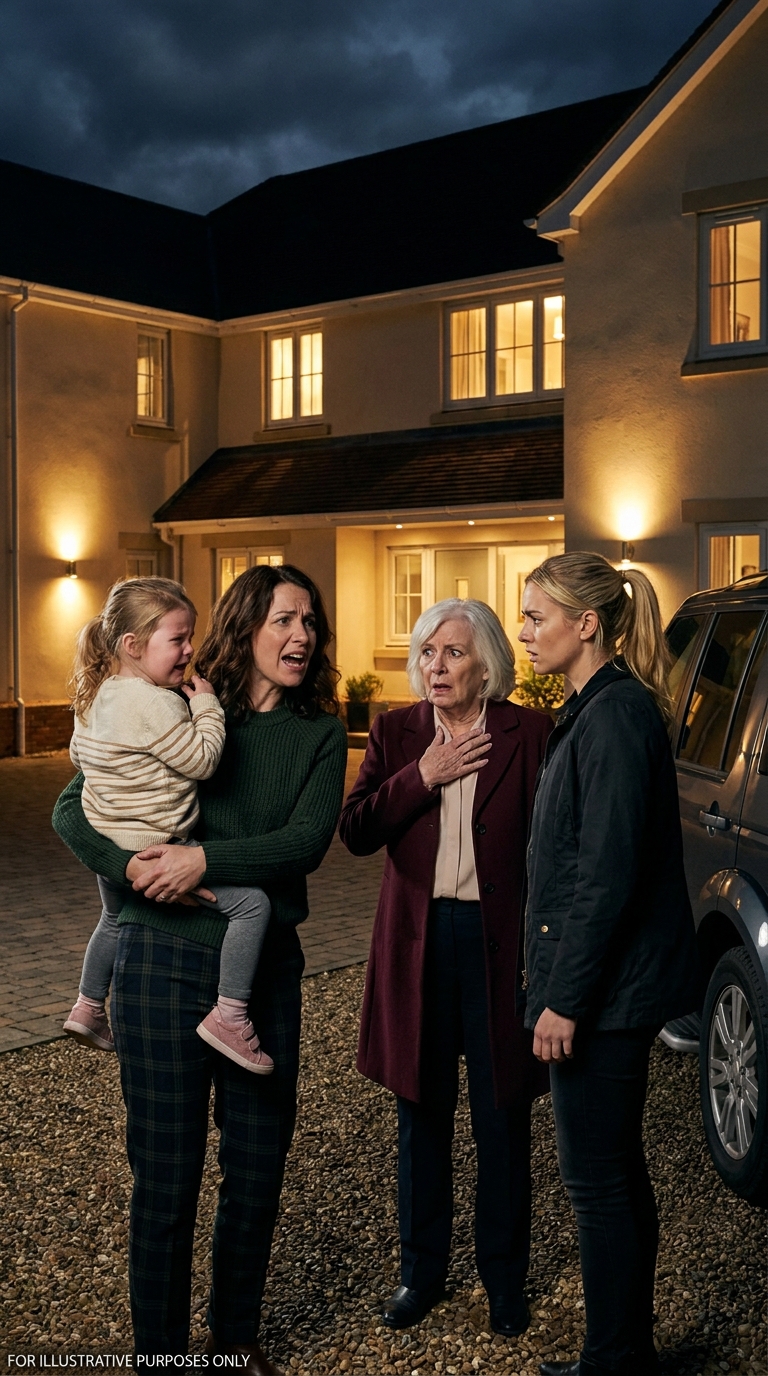
“Give me the child, Harper,” my mother said.
Her voice was flat.
Not panicked.
Not sorry.
Not even afraid enough.
That scared me more than her laughter had.
I pulled Mia tighter against my chest. Her whole body was shaking inside my jacket, her small fingers twisted in the front of my shirt.
“No,” I said.
My mother took one step across the sand.
“Do not make this worse.”
Behind her, my father climbed out of the SUV slowly. Chloe stayed near the passenger door, one hand pressed against her mouth. She looked sick.
Good.
She should have looked sick.
“You left my daughter here,” I said. “You left a six-year-old child alone on a dark beach.”
Mom’s face twitched.
“She wandered off.”
Mia made a tiny sound against my chest.
I felt it more than heard it.
My hand moved over the back of her head.
“Don’t,” I whispered. “You don’t have to say anything.”
My mother’s eyes dropped to Mia’s wrists.
For one second, the mask slipped.
Not guilt.
Annoyance.
Like the marks were inconvenient.
Like bruises on a child were something that had ruined her evening.
Then she looked back at me.
“You need to calm down before you say something you can’t take back.”
I lifted my phone.
“I already called 911.”
That was the first time she looked afraid.
Chloe let out a broken whisper.
“Mom.”
My mother snapped her head toward her.
“Be quiet.”
The command was sharp enough to cut through the wind.
For my whole life, Chloe had obeyed that voice.
So had I.
But not anymore.
The dispatcher was still on the line. I had hit emergency call the moment Mia said Victor’s name. My phone was tucked between my shoulder and cheek, open, recording every word.
“Stay where you are,” the dispatcher said in my ear. “Officers are on the way.”
My mother heard the faint voice through the speaker.
Her face hardened.
“You stupid girl.”
Something cold moved through me.
Not fear.
Recognition.
There she was.
The mother behind the mother.
The woman I had spent years trying not to see.
My father stepped forward at last.
“Elaine,” he said quietly. “Enough.”
Mom turned on him so fast it made Chloe flinch.
“Do not start.”
“No,” he said, and his voice shook. “This has gone too far.”
My mother laughed once.
This time, it sounded ugly.
“Too far? Now you decide that?”
My father looked at Mia.
His face collapsed.
He looked old suddenly, older than he had looked that morning, older than he had looked when I last hugged him at Christmas.
“I’m sorry,” he whispered.
I stared at him.
“Sorry for what?”
He opened his mouth, but no words came.
Mia’s fingers tightened in my shirt.
“Grandpa saw,” she whispered.
My father covered his face with one hand.
That was my answer.
The sirens came from far away at first, faint and thin beneath the sound of the ocean. Then they grew louder.
My mother heard them too.
Her eyes darted toward the service road.
I followed her gaze.
A dark pickup was parked beyond the snack shack, half hidden near the dunes. Its headlights were off.
My stomach dropped.
“Is he still here?” I asked.
Nobody answered.
I stepped backward, carrying Mia as best as I could.
She was getting too big for me to hold for long, but I would have carried her across the whole state if I had to.
My mother moved again.
“You are not taking this family down because a child got frightened.”
I looked at her.
“A child got taken.”
“She misunderstood.”
Mia buried her face in my neck.
That was when Chloe broke.
“She didn’t misunderstand,” she said.
The words came out so softly I almost missed them.
My mother turned toward her.
“Chloe.”
But my sister’s eyes were on me now, wide and wet and terrified.
“I saw him take her hand,” Chloe whispered. “I thought he was just walking her to the car. Mom said it was fine. She said Victor only wanted to see her.”
The beach seemed to tilt beneath me.
I looked at my mother.
“You let him near my daughter.”
My mother’s chin lifted.
“He is my brother.”
“He is the reason I moved twice.”
“You were always dramatic about that too.”
A sound came out of me that I did not recognize.
Not a cry.
Not a scream.
Something lower.
Mia whimpered.
I forced myself to breathe.
For her.
Only for her.
The first police car swung into the parking lot, lights flashing blue and red across the sand. A second followed close behind. The colors washed over my mother’s face, then my father’s, then Chloe’s.
My mother straightened her blouse.
Even then.
Even with police arriving and my child shaking in my arms, she was still preparing to perform.
Two officers came across the sand. One was a woman with dark hair pulled tight at the back of her neck. The other was older, heavyset, with a flashlight in his hand.
“I’m the caller,” I said before my mother could speak. “My daughter was taken from my mother’s care. She has bruises on both wrists. The man who took her may still be near the service road.”
The female officer’s eyes went straight to Mia.
Her expression changed.
Not shock.
Focus.
“What’s your daughter’s name?”
“Mia.”
She softened her voice. “Hi, Mia. I’m Officer Ramirez. You’re safe now.”
Mia did not answer.
Officer Ramirez did not push.
She looked at me. “Do you consent to medical evaluation?”
“Yes.”
My mother stepped forward.
“That is unnecessary. She is tired and scared because Harper is frightening her.”
Officer Ramirez turned slightly.
“Ma’am, step back.”
My mother froze.
For once, someone had spoken to her like she was not in charge of the room.
The older officer moved toward the service road, one hand near his radio.
My father said, “He’s there.”
Everyone turned.
My father’s hand was shaking as he pointed toward the dark pickup.
“Victor. He’s there.”
My mother hissed, “Richard.”
My father did not look at her.
“He put her behind the snack stand. He said he just wanted to talk to her. Elaine told us to get in the car. She said Harper would overreact.”
Chloe started crying then.
A thin, helpless sound.
“I wanted to go back,” she said. “I swear, Harper, I wanted to.”

I could barely look at her.
“You left her.”
Chloe flinched like I had slapped her.
Maybe I had.
Maybe the truth should hurt.
The older officer raised his radio and spoke quickly. Another set of lights turned into the service road from the far end of the lot.
The pickup engine started.
For one breath, nobody moved.
Then the truck lurched backward, tires spitting sand and gravel.
The officer shouted.
The pickup swung toward the exit, but the second patrol car cut across the road and blocked it.
The truck stopped hard.
Doors opened.
Commands rang out.
My mother whispered, “No.”
Not because of Mia.
Not because of what had happened.
Because Victor had been caught.
I looked at her and felt something inside me close forever.
Paramedics arrived minutes later. They checked Mia while she sat in my lap on the back of the ambulance, still wrapped in my jacket. She answered only a few questions, mostly with nods.
No one rushed her.
No one called her dramatic.
No one told her she misunderstood.
The paramedic wrapped a small blanket around her shoulders and gave her a stuffed bear from a plastic bin.
Mia held it with both hands.
When Officer Ramirez asked if she could take photos of Mia’s wrists, I said yes, though every camera flash felt like a blade under my ribs.
My mother tried to speak to the officers three times.
Each time, they told her to wait.
That alone felt like justice.
Victor was placed in the back of a patrol car.
I saw only a glimpse of him.
Gray hair.
Thick neck.
Same heavy face from the old family photo I had once found in my mother’s drawer, before she snatched it away and told me never to dig through things that did not belong to me.
He stared at me through the window.
I stared back.
I was not nineteen anymore.
I was not the frightened girl who had tried to tell her mother something was wrong and been told to stop making accusations.
I was Mia’s mother now.
And I was done being quiet.
At the station, the night stretched into something unreal.
Fluorescent lights.
Paper cups of water.
A child advocate with a soft sweater and gentle voice.
Officer Ramirez stayed close, explaining each step before it happened.
Mia was not questioned by a room full of strangers. She spoke with the advocate while I sat nearby where she could see me. She did not have to repeat everything again and again.
What she said was enough.
Victor had told her Grandma said it was okay.
He had grabbed her when she said she wanted Aunt Chloe.
He had held her wrists too tightly when she tried to pull away.
He told her she was “a rude little thing just like her mother.”
Then, when headlights came down the road, he dragged her behind the snack shack and told her to stay hidden unless she wanted her mama to be in trouble.
My hands shook so badly I had to put them under my legs.
Not in front of Mia.
Not while she could see.
But inside, I was breaking.
My father gave a statement.
Chloe gave one too.
My mother refused.
That did not surprise me.
What surprised me was that my father did not sit beside her.
He sat across the room from her, elbows on his knees, his face in his hands.
At three in the morning, Officer Ramirez told me Victor had been arrested.
So had my mother.
Child endangerment.
Interference.
False statements.
More charges might come later.
I looked through the glass wall at my mother, seated in a hard plastic chair with her purse clutched in her lap.
She saw me watching.
For one strange second, I wanted her to look sorry.
Not for me.
For Mia.
For the little girl who had trusted her enough to wave goodbye that morning in a purple swimsuit.
But my mother’s face twisted with rage.
She mouthed one word through the glass.
Ungrateful.
That was the last word my mother ever gave me as my mother.
After that, she was just Elaine.
I took Mia home to my apartment just before sunrise.
She fell asleep in my bed with the stuffed bear under her chin. I sat beside her until the room turned pale with morning light.
Every few minutes, she twitched.
Every time, I touched her hair and whispered, “I’m here.”
At seven, my phone started ringing.
Relatives.
Unknown numbers.
My cousin Bethany texted first.
Your mom says there’s been a misunderstanding. Call me.
Then Aunt Denise.
Your mother would never hurt a child. Be careful before you destroy the family.
Then my mother’s neighbor.
Elaine is devastated. Shame on you.
I read each message while Mia slept.
Then I opened a new text thread and sent one message to all of them.
Mia was found alone after dark with bruises on both wrists. Police are involved. Do not contact me again unless you are asking how my daughter is.
The replies slowed after that.
Not stopped.
People like my mother always had loyal witnesses, people who did not want facts to ruin their favorite version of a person.
But they slowed.
By afternoon, my father came to the apartment.
I almost did not let him in.
He stood outside my door holding Mia’s purple beach shoes in one hand. His eyes were red.
“I found these in the SUV,” he said.
I took them from him.
Neither of us spoke.
Then he said, “Can I see her?”
“No.”
He nodded, as if he had expected that.
“I understand.”
I gripped the shoes so hard the rubber bent.
“Do you?”
His face crumpled.
“I froze.”
“That is not an answer.”
“I know.”
“You heard her. You saw him. You got in the car.”
His mouth opened.
Nothing came out.
I stepped into the hallway and closed the door behind me so Mia would not hear.
“You were her grandfather,” I said. “She trusted you.”
“I know.”
“You let her think no one was coming back.”
A tear slipped down his cheek.
I had seen my father cry only once before, at my grandmother’s funeral.
It did not soften me.
Not enough.
“Elaine said Victor only wanted a minute,” he whispered. “She said if we made a scene, he would get angry. She said Mia was safe. Then when Mia cried, Elaine told us to leave before beach security came over.”
I stared at him.
“And you listened.”
His shoulders shook.
“I have listened to her for forty years.”
That was the saddest excuse I had ever heard.
It was also the most honest thing he had ever said.
“I’m sorry,” he said. “I know it isn’t enough. I know I don’t deserve forgiveness. But I will tell the police everything. I will testify.”
I looked down at the tiny sandals in my hand.
Purple straps.
Little shells on the sides.
Mia had picked them herself because they made her “feet look like mermaid feet.”
My voice went quiet.
“You don’t get access to her because you’re sorry.”
“I know.”
“You don’t get to call yourself Grandpa until she decides you are safe.”
His face tightened, but he nodded.
“Yes.”
“And if you protect Mom even once, you never see us again.”
“I won’t.”
I wanted to believe him.
I didn’t.
Not yet.
Maybe not ever.
But he came back the next day with a written statement. Then he went to the prosecutor. Then he gave them the old family address where Victor had been staying, the one my mother had sworn she did not know.
Three days later, Chloe came.
She looked like she had not slept.
I opened the door only halfway.
She started crying before she spoke.
“I’m sorry.”
I said nothing.
“I should have stopped it.”
“Yes,” I said.
She flinched.
“I know.”
There was no comfort in me to offer her.
Not then.
Maybe that made me cruel.
Or maybe it made me honest.
Chloe wiped her cheeks with shaking hands.
“Mom told me if I said anything, I’d ruin Dad. She said Victor would blame him. She said you’d take Mia away from everyone.”
“I am taking Mia away from everyone who failed her.”
Chloe nodded.
“You should.”
That surprised me.
She looked past my shoulder toward the hallway.
“Is she okay?”
“No.”
Her lips trembled.
“Will she be?”
I thought of Mia waking up twice before dawn. Of her refusing to wear long sleeves because fabric touched her wrists. Of her asking if Grandma knew where we lived.
“I’m going to make sure she has every chance to be,” I said.
Chloe closed her eyes.
“I gave my statement.”
“Good.”
“I told them everything. Even the things Mom told me not to say.”
For the first time, I felt something other than anger when I looked at her.
Not forgiveness.
Not trust.
But maybe the first inch of a road that could someday lead somewhere less broken.
“Thank you,” I said.
She nodded, crying silently.
Then she left.
The case moved slowly.
Too slowly.
There were hearings and interviews and paperwork. There were days when I felt like the legal system moved through mud while my life stood on fire.
But Mia began therapy with a child trauma counselor named Dr. Voss, who had a room full of soft toys, sand trays, and paints. Mia liked the blue turtle best.
At first, she barely spoke.
Then she drew.
A beach.
A trash bin.
A black truck.
A woman with a big red mouth.
When Dr. Voss asked who the woman was, Mia said, “Grandma when she lies.”
I went home and cried in the shower where Mia could not hear.
Weeks passed.
Then months.
The bruises faded before the fear did.
That felt unfair.
Her skin healed faster than her sleep.
For a long time, she would not go near sand. She would not let anyone besides me buckle her into a car seat. She asked if bad people could hide in drawers because of “the picture in Grandma’s drawer.”
I answered every question the best way I could.
No lies.
No ugly details.
Just truth she could carry.
“You are safe now.”
“What happened was not your fault.”
“Adults are responsible for protecting children.”
“You told the truth, and I believe you.”
I said those four things so often they became the walls of our new life.
My mother tried to reach me from jail once.
I did not take the call.
Later, her attorney sent a message asking if I would write a statement saying she had been a loving grandmother who “made a terrible mistake.”
I wrote back one sentence.
A mistake is forgetting sunscreen, not leaving a child with a dangerous man.
The prosecutor used my father’s testimony, Chloe’s statement, the dispatcher recording, and Mia’s forensic interview. Victor’s past came back into the light too. Old complaints. Old whispers. Old women who had been girls when no one believed them.
This time, people listened.
My mother pleaded out before trial.
Not because she was sorry.
Because she was afraid of what a jury would hear.
Victor fought longer.
Men like him always do.
But he was convicted.
When the sentence came down, Mia was not in court. She was at school, making a paper butterfly with purple wings.
I was there.
So was Chloe.
So was my father.
My mother did not look at us.
Victor did.
He looked angry until the end.
I let him have his anger.
It was all he had left.
That evening, I picked Mia up from school. She ran toward me with her backpack bouncing and the paper butterfly clutched in one hand.
“Look, Mama,” she said. “It’s for our window.”
It was crooked.
Too much glue.
One wing bigger than the other.
The most beautiful thing I had ever seen.
We taped it to the living room window where the sunset could shine through the purple paper.
Mia stood beside me, staring at it.
“Can butterflies go to the beach?” she asked.
My heart squeezed.
“They can go anywhere,” I said. “But only when they’re ready.”
She thought about that.
Then she slipped her hand into mine.
“Maybe not yet.”
“That’s okay.”
“Maybe someday.”
I kissed the top of her head.
“Someday is allowed.”
A year later, someday came.
Not the same beach.
Never that one.
A smaller beach up north, quiet and bright, with soft dunes and clear shallow water. Chloe came too, but only after months of supervised visits, therapy, apologies, and patience. My father came for one hour, stayed near the picnic table, and asked Mia before he moved closer.
She said yes.
Not because anyone told her to.
Because she wanted to.
I watched her run toward the water in a purple swimsuit she had chosen herself.
For a second, fear rose in my throat so fast I almost called her back.
Then Mia turned around, laughing.
“Mama, look!”
She lifted both arms in the sunlight.
No bruises.
No hiding.
No flinching.
Just my little girl, standing where the waves touched her feet, alive and bright and free.
I waved back.
And this time, when she ran toward me, she did not stop.
She crashed into my arms, warm from the sun and smelling like salt and sunscreen.
I held her close.
Not because I was afraid she would disappear.
Because she was here.
Because I had found her.
Because I had believed her.
Because the people who called it drama, misunderstanding, and family business had finally learned what I knew the second I saw those marks on her wrists.
It was never forgetfulness.
It was a crime.
And I was never going to let them bury the truth again.