
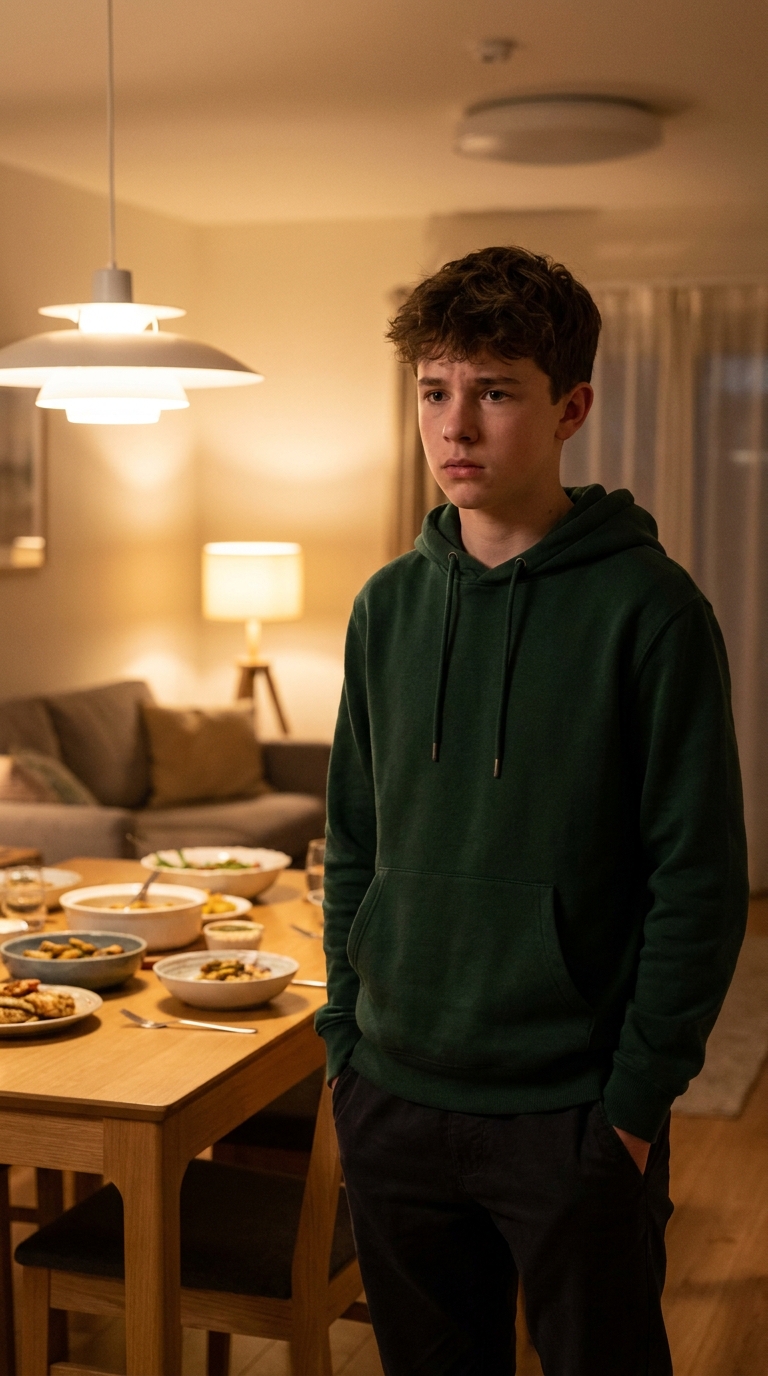
I thought my teenage son was hiding something terrible. Then two police cars pulled up during our family cookout, and the truth that came out had nothing to do with him.
By the time the police walked through our side gate, I had already ruined the evening in my own head ten different ways.
That is the thing nobody tells you about motherhood.
Sometimes the worst part is not what happens. It is what you think might happen in the 30 seconds before the truth lands.
Our annual Fourth of July dinner had started the same way it always did. My husband, Greg, had been outside at the grill acting like char marks were a sacred science. My younger daughter, Ava, kept stealing pickle slices from the tray and swearing she had not touched anything.
My mother-in-law had brought the same baked beans she brings every year and still waited for praise like she had invented the recipe.
There were kids running through the yard with glow sticks, my brother-in-law arguing with someone about baseball, and enough smoke in the air from fireworks and grilled burgers to make the whole block smell like summer and bad decisions.
Normal. Loud. Messy. Ours.
Except for Daniel.
He is sixteen, all elbows and silence lately, tall enough now that when he stood next to me, I still had these little shocks of not remembering when that happened. Usually, even when he was moody, he still tossed in a joke or rolled his eyes hard enough to make a point. But that evening, he was too still. Too careful.
“Are you okay?” I asked him the first time when he only picked at his food.
“I’m fine, Mom.”
I watched him for another ten minutes.

“You don’t look fine.”
He gave me a tight smile. “I said I’m okay.”
Then later, right before sunset, while everybody else drifted toward the front yard to watch the neighbors start their illegal fireworks early, Daniel touched my arm.
“Mom. Come here.”
There was something in his face that made my stomach drop. He led me halfway down the side of the house, where the voices from the yard turned muffled. His hands were shaking.
“What happened?” I asked.
He swallowed. “Please don’t tell Dad about what happened today.”
I felt cold all over.
“What happened?”
He looked back toward the yard like he was afraid somebody would hear. “I’ll explain after dinner.”
“Daniel.”
“Please.”
Then the sirens started.
I still remember how wrong it sounded against laughter and fireworks. Two police cars rolled slowly up to the curb in front of our house, lights washing red and blue over our windows, over the kids’ faces, over the paper flags in the flowerpots. My neighbor, Mrs. Hargrove, was already out in her driveway pointing toward our backyard like she had been waiting all year for a moment like this.
Everyone went quiet.
Greg muttered, “This has to be about the fireworks.”
I wanted that to be true so badly it almost hurt.
But all I could hear was Daniel in my ear: “Please don’t tell Dad.”
One of the officers came through the gate. He scanned the yard, took in the long table, the startled faces, the little American flag tablecloth, and then his eyes landed on my son.
“Are you Daniel?” he asked.
Daniel stood up so slowly it made my chest ache. “Yes, sir.”
The officer looked at him for a long second, and I swear I stopped breathing.
“We need to speak with you.”
I stepped forward before Daniel could move. “He’s a minor. I’m his mother. What is this about?”
The officer’s face softened.
“Ma’am, your son is not in trouble.”
That should have relieved me. Instead, it confused me so fast I nearly cried.
He glanced at Daniel, then back at me. “There was an elderly woman near Route 8 this afternoon. She was disoriented, dehydrated, and wandered close to traffic. Your son found her and stayed with her until paramedics arrived.”
I looked at Daniel. “What?”
His face crumpled with guilt. “Mom, I was going to tell you.”
The officer nodded. “She was scared and confused. She kept trying to walk away. Your son got her to sit in the shade behind a closed gas station, gave her water, and called it in. But she panicked whenever anyone talked about contacting family.”
Greg frowned. “Wait. He was gone for hours.”
Daniel flinched at his father’s voice.
“I know,” the officer said. “And that probably worried you. But if he had walked away, she might have gone back toward the highway. We believe he prevented a serious accident, maybe worse.”
Nobody said anything for a second.
The fireworks kept popping somewhere down the block. A burger hissed on the grill. My daughter whispered, “What’s happening?” to nobody in particular.
I turned to Daniel. “Why didn’t you tell us?”
He stared at the grass. “Because Dad was already mad I left my phone on the charger. I knew he’d lose it when he found out I disappeared half the day.”
Greg opened his mouth, then shut it again.
The officer gave Daniel a small smile. “The woman said he kept talking to her. Asked about her garden. Her favorite pie. Her hometown. Anything to keep her calm.”
That sounded exactly like Daniel and also nothing like the picture I had built in my panicked mind. My knees felt weak.
Then the officer reached into his breast pocket.
“There is one more thing,” he said.
He looked at Greg. “The woman asked us to give this to your husband.”
The whole yard went still again.
He handed Greg a folded piece of paper, worn soft at the edges, like it had been opened and closed too many times. Before Greg even unfolded it, I saw his hands start to shake.
“Who is she?” he asked.
The officer hesitated. “She gave her name as Eleanor.”
The name hit Greg like a blow.
Not dramatic, not loud. Worse. Quiet. Like somebody had reached inside him and pulled one piece loose.
My husband sat down hard in his chair.
“Greg?” I said.
He did not answer. He opened the note, and whatever color had been left in his face disappeared.
“What is it?” I asked.
He looked up at me, then at the officer, then back down at the paper. “She’s… she’s from my hometown.”
The officer cleared his throat. “She insisted that if we found Daniel’s family, we were to make sure this got to you. She said she has been trying to reach you for months.”
“Trying to reach me about what?”
“She would only say that it was personal. Urgent. And long overdue.”
My mother-in-law, Ruth, who had been silent until then, stood up so fast her chair scraped the patio.
“What did you say her name was?”
“Eleanor.”
Ruth’s face changed in a way I had never seen before. Not confusion. Not annoyance. Fear.
“Oh, God,” she whispered.
Greg looked at her. “Mom?”
She pressed one hand to her chest. “That’s not possible.”
I looked between them. “Can somebody please tell me what is going on?”
Nobody answered me.
The officer broke the silence. “Mrs. Elenor was taken to County General. She asked that Mr. Greg come as soon as possible. But I should tell you, she was in and out by the time we left. The paramedics were concerned about her heart.”
Greg stood up so fast he knocked his drink over. “I’m going.”
“I’m coming with you,” I said.
He looked at me, really looked at me, like he had just remembered I existed in this moment too. “Claire-“
“I’m coming.”
Daniel spoke quietly. “Mom… I’m sorry.”
I grabbed his face with both hands and kissed his forehead. “You do not apologize for saving someone.”
His eyes filled immediately. “I thought you’d be mad.”
“Never for that.”
Greg and I left the family in the yard with half-eaten plates and too many questions. My sister took over watching the kids. Ruth refused to meet my eyes. She just sat there staring at the spilled drink spreading across the tablecloth.
The drive to the hospital was only 15 minutes, but it felt like an hour. Fireworks were going off all over town, bright bursts over rooftops, red and white and blue reflected in the windshield. Greg drove too fast. I held the note in my lap because his hands were too unsteady to keep it.
I finally unfolded it.
Gregory,
“I am sorry to do this through your son, but I have run out of time and courage at the same rate.
You deserve the truth about the baby.
Ask your father what happened in August 1981.
Ask him whose child was buried under your mother’s name.
Ask why they told me never to come back.
I should have spoken sooner.”
Eleanor.”
I read it twice before the words even made sense.
“The baby?” I whispered.
Greg had both hands locked on the wheel. “I don’t know.”
“You know her.”
He nodded once. “She lived next door when I was little.”
“And this means what?”
His voice came out thin. “I have no idea.”
At the hospital, we were too late for answers.
Eleanor had gone into cardiac distress not long after arriving. A nurse told us she was alive but sedated and being transferred to intensive care.
“She was asking for Gregory before she lost consciousness,” the nurse said. “That’s all I know.”
Greg sat in one of those ugly waiting room chairs and stared at the floor like the world had split open under him. I sat beside him, the note trembling in my hand.
After a long time, I said, “Start talking.”
He rubbed both palms over his face. “When I was eight, my parents told me our next-door neighbors moved away after some kind of scandal. I remember Eleanor. I remember her husband. And I remember…”
He stopped.
“What?”
“I remember there was a baby.”
I turned toward him fully. “What baby?”
“I don’t know. I just remember hearing my parents fighting about a baby one night. Then it all stopped. A week later, Eleanor was gone. My father told me not to ask questions.”
That was the moment I realized this was no random message from a confused old woman. This was a fuse burning through decades.
When we got home, the party was over. The yard looked wrecked in that sad post-holiday way, paper plates curled at the edges, sparklers burned down to wire, folding chairs tipped in the grass.
Daniel was on the back steps waiting for me.
He stood up the second he saw my face. “Is she okay?”
“I don’t know yet.”
He nodded, then looked miserable. “I really didn’t mean for all this to happen.”
I sat beside him. “You found a woman in trouble and stayed. That part is good.”
He was quiet for a second. Then he said, “Was Dad mad?”
I laughed once, tired and sharp. “Your father has moved on to a whole new category of upset.”
That got the smallest smile out of him.
Then he looked down. “She kept saying Dad’s last name. Mercer. That’s why I stayed after I called. She got scared every time I tried to step away, but when I told her my name, she grabbed my arm and said, ‘Gregory’s boy?'”
I turned to him. “You didn’t say that before.”
He shrugged helplessly. “I didn’t know if it mattered.”
It mattered.
The next morning, Greg went to see his parents. I went with him because after 22 years of marriage, there are moments when “I need some space” no longer applies. His father, Walter, opened the door and looked annoyed until he saw our faces.
His expression changed immediately.
We had barely made it into the living room before Greg took out the note and said, “Tell me about August 1981.”
Walter went pale. Ruth, sitting on the sofa with a cup of tea, made a soft sound in her throat like she had been expecting this knock for decades.
“No,” she said to Walter. “No more lies.”
Walter glared at her. “This is not the time.”
“It should have been the time 45 years ago,” she snapped.
I had never heard my mother-in-law speak to him that way.
Greg’s voice shook. “What baby?”
Walter sat down slowly, like his bones had turned old all at once.
Then the truth came out in pieces.
Before Greg was born, his parents had another son. A baby boy named Thomas. He lived only three days. That was the story Greg had been told his whole life.
It was not the truth.
The real story was that Thomas had died, yes, but not from the illness Walter always claimed. He died after Walter, drunk and furious after an argument, dropped him. Eleanor had heard the screaming from next door. She ran over. She saw too much. Ruth wanted to call the police.
Walter refused.
At the time, Eleanor had recently lost an infant daughter of her own during delivery. She was not thinking clearly. Walter convinced her and the local doctor, who was a family friend, to keep quiet.
In return, Walter arranged the burial records so that Eleanor’s stillborn daughter was buried under Ruth’s paperwork, and Thomas was buried privately under another name outside county lines. Ruth was threatened into silence. Eleanor and her husband were paid to leave town.
I felt sick listening to it.
Greg looked like he might throw up.
“You let me grow up thinking I had some tragic little brother who died in his sleep,” he said.
Walter said nothing.
Ruth finally spoke, tears running down her face. “I stayed because I was scared. Then I stayed because I was ashamed. Then, too much time had passed, and I told myself I was protecting you.”
Greg stared at her. “Protecting me from what? The fact that my father killed my brother?”
Nobody answered.
That night, after we got home, Greg sat at the kitchen table for hours, saying almost nothing. Around midnight, he finally whispered, “My whole life was built on rot.”
I went around the table and held his face in my hands.
“No,” I said. “Their choices were rotten. You are not.”
He broke then. Really broke. I had seen my husband cry before, but never like that. He folded into me like he had been holding up a building alone.
In the days that followed, everything changed shape.
Daniel could not understand why everybody kept thanking him with these careful, strange expressions until we finally sat all the kids down and gave them the softer version. Not every ugly detail. Just enough truth. That Daniel’s decision to help someone had uncovered something hidden for a very long time.
He looked stunned. “So… this all happened because I stopped to help her?”
“Yes,” I said.
He sat with that for a second. “That feels fake.”
Ava asked, “Does that make Daniel a hero?”
Daniel groaned. “Please don’t start.”
But I looked at him and thought, Maybe it does.
Eleanor woke up three days later, but only long enough to confirm the basics before another medical setback took her downhill fast. Greg saw her once. When he came home, his face was wrecked.
“What did she say?” I asked.
He sat on the edge of our bed and stared at his hands. “She said she used to look at me riding my bike and wonder if I would have grown up kinder than him.” He swallowed hard. “Then she said she was sorry she let fear make her a coward.”
I sat beside him.
“She also said,” he continued, “that when Daniel stayed with her by the road, he reminded her that mercy can still come from a family touched by terrible things.”
That one got me.
A week later, Eleanor died.
Her statement, along with Ruth’s, was enough to start an investigation. There were records to exhume, property sold long ago to trace, cemetery logs that did not match. Old crimes have long shadows. They do not stay buried just because the people involved get wrinkles.
The Fourth of July dinner everyone was pretending to survive became the line in our family history. Before that night. After that night. And through all of it, the image that stays with me most is not the police cars or the note or even Greg’s face when he learned the truth.
It is my son, sunburned and scared, sitting beside a confused old woman for hours because leaving her alone felt wrong.
A few nights ago, I found Daniel in the backyard after dark, tossing a baseball straight up and catching it.
I went out and stood beside him.
“You know,” I said, “you can tell me things before the police show up.”
He smiled without looking at me. “Yeah. Learned that.”
We stood there in the warm dark for a minute.
Then he said quietly, “Was Dad mad that I disappeared?”
I thought about Greg in therapy now, about the way he hugged Daniel longer these days, like he was relearning what a father is supposed to be.
“No,” I said. “He was proud.”
Daniel looked away fast. “Oh.”
I nudged his shoulder. “He really was.”
He threw the ball again, higher this time. “I just didn’t want her to be alone.”
“I know.”
He caught it, then finally looked at me. “Mom?”
“Yeah?”
“I’m glad I stayed.”
I looked at this boy who thought he had brought trouble to our door when what he had really brought was truth.
“So am I,” I said.
Do you think Daniel should have told us immediately, even if he was afraid of his father’s reaction?
Loved this story? Then you will want to read this next one too. A son disappears after his 18th birthday, and when he finally returns six years later, he says words no parent is ready to hear: “My stepdad has to tell you the truth.
For six years, I believed my son had walked away from me without looking back. The morning he finally came home, I thought I was getting the answers I’d waited years to hear. Instead, I discovered I’d been asking the wrong questions all along.
The knock at the door came just after sunrise.
I almost ignored it.
Marcus had already left for his morning walk, and I wasn’t expecting anyone. I wrapped my robe tighter around me and opened the door.
A man stood on the porch.
He was tall, broad-shouldered, and dressed in dark jeans and a plain navy sweater. His hair was neatly trimmed, and his jaw was covered with a short beard. His posture was straight, almost military.
For a moment, I thought he had the wrong house.
Then I saw his eyes.
My knees nearly gave out.
“Andrew?”
He swallowed but didn’t smile.
“Hi, Mom.”
A sob caught in my throat.
Six years.
I had imagined this moment every single day. I had dreamed about seeing him at the grocery store, at church, even walking down the sidewalk. Sometimes I imagined him older. Sometimes I imagined him looking exactly as he had the night he disappeared.
But never like this.
I rushed toward him with my arms open.
“My baby…”
“Stop,” he said.
His voice wasn’t angry.
It was tired. He lifted one hand, keeping a careful distance between us.
“I want him to tell you the truth right now.”
I froze.
“What?”
Andrew looked past me into the house.
“Where’s Marcus?”
The warmth that had flooded my chest disappeared as quickly as it had come.
“He’s out walking.”
“I’ll wait.”
Without asking permission, he stepped inside.
I closed the door behind him, still staring.
His clothes were nothing like the colorful skirts and soft sweaters he had loved wearing as a teenager. There wasn’t a trace of makeup on his face. Everything about him looked different.
As if he could hear my thoughts, he looked at me. “People keep looking at my clothes instead of hearing what I’m saying.”
Heat rushed into my face.
“I’m sorry.”
“I came back for one reason.”
He met my eyes.
“It’s time for Marcus to stop lying.”
My heart started pounding.
“Lying about what?”
“You’ll find out when he gets here.”
There wasn’t any anger in Andrew’s voice anymore, only certainty. He walked into the living room and remained standing.
I wanted to ask a thousand questions.
Where had he been?
Was he safe?
Had he been happy?
Did he ever think about me?
Instead, I stood there, terrified that if I asked the wrong one, he’d disappear all over again.
The silence stretched between us until the front door opened.
Marcus walked in carrying a paper bag from the bakery. He stopped the instant he saw Andrew.
For the first time in our marriage, I saw genuine fear on my husband’s face.
The bag slipped from his hand.
Bread rolls scattered across the floor.
“You,” Marcus whispered.
Andrew didn’t move.
“Tell her.”
Marcus recovered quickly.
“I don’t know what game you’re playing.”
“Tell her.”
“I have nothing to tell.”
Andrew reached into his jacket pocket and pulled out his phone.
“I was hoping you’d make the right choice.”
Marcus’s face lost what little color it had left.
“What is this?” I asked.
Neither of them answered.
Instead, they stared at each other like two men who had been waiting years to finish the same conversation.
“I think you should leave,” Marcus said.
Andrew gave a bitter laugh.
“You’ve been trying to make me leave for years.”
I looked from one to the other.
“What is happening?”
Andrew finally turned toward me.
“Mom, do you remember my 18th birthday?”
The question hit me like a punch.
How could I forget?
It had started so well.
I had spent weeks planning the party because I wanted Andrew to feel celebrated.
He had just graduated from high school. Even after everything he and Marcus had argued about, I kept hoping time would soften them both.
Andrew came downstairs wearing black slacks, polished boots, and a flowing burgundy blouse he absolutely loved.
He looked nervous.
I hugged him.
“You look wonderful.”
He smiled.
“I wasn’t sure if I should wear it.”
“You should wear whatever makes you feel like yourself.”
Marcus overheard us.
His expression darkened immediately. He didn’t say anything then, but I recognized the look. The one that meant he was storing his anger for later.
For most of dinner, he stayed unusually quiet.
Our relatives chatted, Andrew laughed with his cousins, and for a few hours, I convinced myself we might actually survive the evening without another fight.
Then my sister asked Andrew whether he’d thought about college.
Before Andrew could answer, Marcus spoke.
“He needs discipline before he needs a degree.”
The room fell silent.
Andrew set down his fork.
“I’m doing just fine.”
Marcus ignored him.
“No. You’re confused.”
I reached for Marcus’s hand under the table.
“Please.”
He pulled away.
“If he wants anyone to respect him, he should join the army.”
Nobody spoke.
Marcus looked directly at Andrew. “Maybe then you’ll finally become a real man. I’m trying to save you from a world that won’t be kind to you.”
The words hung over the table like smoke.
I remember hearing my niece start crying in the next room, I remember my mother whispering, “Marcus,” and I remember Andrew’s face.
Not angry or embarrassed. Just… broken.
He stood.
“I don’t have to sit here and listen to this.”
Marcus leaned back in his chair.
“You’ve been avoiding the truth your whole life.”
Andrew looked at me. For one awful second, I thought he was asking me to choose.
I should have stood up.
I should have walked out with him. Instead, I stayed in my chair, stunned into silence.
Andrew left the dining room, ran upstairs, and a few minutes later, I heard the front door close. I thought he just needed air. I had no idea it would be the last time I’d see my son for years.
I still remembered every minute after that.
The guests left one by one, each offering awkward smiles and quiet apologies, as though they felt responsible for what had happened.
I cleaned plates I couldn’t remember serving while Marcus sat in the living room, watching television as if he’d done nothing wrong.
“Are you going to apologize?” I asked.
He didn’t look away from the screen.
“For telling the truth?”
“You humiliated him.”
“He embarrassed himself.”
I slammed a plate into the sink harder than I meant to.
“He’s my son.”
“And he’s 18 now. Maybe it’s time someone stopped treating him like a child.”
I wiped my hands on a towel and walked upstairs.
Andrew’s bedroom door was open, the room empty. I figured he was taking his time, clearing his head.
Then I saw the note on his bed.
“Mom,”
“I love you more than anyone in this world, but I can’t keep living like this. Please don’t look for me.”
“I’m sorry.”
“Andrew.”
I remember screaming.
Marcus came running upstairs, pretending to be just as shocked as I was. For the next few weeks, he played the role of the worried stepfather perfectly.
He drove me to the police station, printed missing-person flyers, and even joined me when I walked through parks, hoping I’d catch a glimpse of my son.
When the police reminded us Andrew was legally an adult and had every right to leave, Marcus wrapped an arm around my shoulders.
“We have to accept his decision.”
Months turned into years.
Every birthday, I baked Andrew’s favorite chocolate cake, every Christmas, I wrapped a present I never mailed, and every Mother’s Day, I stared at my phone, hoping it would ring.
It never did.
Whenever I cried, Marcus would repeat the same words. “You have to let him go.”
Eventually, I stopped talking about Andrew because every conversation ended the same way.
“He made his choice.”
Those words became a prison.
Now my son stood in front of me, looking at Marcus as though nothing had happened.
“I didn’t ask you to remember the party,” Andrew said. “I asked if you remembered what happened after.”
“I found your note.”
“I know.”
“I searched for you.”
“I know.”
His voice cracked for the first time.
“I also know why you stopped.”
My stomach tightened.
“What do you mean?”
Marcus folded his arms.
“This is ridiculous.”
Andrew ignored him.
“You stopped because he convinced you I didn’t want to be found.”
“That’s what your note said.”
“No.” Andrew shook his head. “My note said not to look for me. It didn’t say I stopped loving you.”
Marcus stepped forward.
“Enough.”
Andrew finally looked at him.
“No. You’ve had six years.”
Marcus turned to me.
“He’s trying to blame me because he can’t take responsibility for running away.”
Andrew unlocked his phone.
“You really want to keep lying?”
Marcus didn’t answer.
Andrew held up the screen.
“I kept these because one day I knew I’d need them.”
My heartbeat thundered in my ears.
“What are those?”
“The reason I never came home.”
Marcus’s face hardened.
“They don’t prove anything.”
“Then let Mom read them.”
He walked toward me. Marcus moved to block him, and without thinking, I stepped between them. It was the first time in years I had stood between my husband and my son.
“Move,” I said.
Marcus stared at me.
“Liza.”
“Move.”
He hesitated, then he stepped aside.
Andrew placed the phone in my hands. The messages were dated the night of his birthday. The first one had arrived 18 minutes after he left the house.
“Don’t come back tonight.”
Another followed less than a minute later.
“Your mother deserves one peaceful day.”
I frowned.
Then I kept reading.
“She spends all her time defending you.”
“She’s exhausted.”
My hands began to shake.
The next message nearly made me drop the phone.
“If you really love her, disappear.”
A sound escaped my throat that didn’t feel human.
“No.”
Andrew closed his eyes.
“Keep reading.”
There were more.
“She’ll always choose me.”
“I’m the husband. You’re the problem.”
“Give her the chance to have a normal life.”
My vision blurred.
I looked up at Marcus.
“You sent these?”
He opened his mouth, but nothing came out.
I looked back at the phone. The final message had been sent just before midnight.
“Don’t contact her again. She’ll heal faster if you’re gone.”
Tears rolled down my face.
I couldn’t breathe. I had spent so much time believing my son had chosen to leave me, yet all that time, he’d been carrying the weight of those messages.
I slowly looked at Andrew.
“You believed this.”
He nodded.
“I already felt like I was tearing the house apart.”
His voice was quiet.
“Then he told me you’d finally be happy if I disappeared. I thought…” He swallowed. “I thought I was giving you your life back. I wanted to call you.”
He looked down.
“I typed dozens of messages over the years.”
His voice shook.
“I deleted every one before I could press send. Every time I picked up my phone, I heard his words telling me you’d be happier without me.”
My knees gave out.
Before I hit the floor, Andrew caught me.
For the first time in years, my son held me. I buried my face against his shoulder and sobbed.
“You didn’t leave because of me.”
“I never wanted to. I thought you stopped loving me.”
He hugged me tighter.
“I never stopped.”
I cried harder than I had the day my first husband died, because grief was one thing. This was years of love stolen by a lie.
Behind us, Marcus finally spoke.
“I did what I thought was best.”
Andrew let go of me.
Slowly, we both turned to face him.
“What was best?” I asked.
My voice was barely above a whisper.
Marcus straightened his shoulders.
“I was protecting our family.”
“Our family?” I stared at him. “You destroyed it.”
“He was tearing us apart.”
Andrew gave a short, bitter laugh.
“I was 18.”
“You refused to listen.”
“I refused to become someone I wasn’t.”
Marcus pointed at him. “You expected everyone to accept your choices.”
“No.” Andrew shook his head. “I expected my home to be safe.”
Silence settled over the room.
Marcus looked at me as though he still expected me to defend him.
“Liza, you’re only hearing one side.”
I held up the phone.
“These are your words.”
“I was angry.”
“For six years?”
He frowned.
“I never meant for it to go that far.”
I felt something inside me break.
“No.”
He blinked.
“No?”
“You don’t get to rewrite this.”
I took a slow breath, trying to steady myself.
“Every birthday, I cried for my son.”
Marcus looked away.
“Every Christmas, I wrapped presents he never opened.”
He rubbed the back of his neck.
“I searched every face in every crowd because I hoped I’d see him again.”
His jaw tightened.
“You watched me suffer.”
He didn’t answer.
“You watched me blame myself.”
Still nothing.
“And every single time I cried, you told me to let him go.”
Andrew remained quiet beside me. He didn’t need to say anything; the truth was already standing between us.
Marcus finally sighed.
“I thought it would get easier.”
My head snapped toward him.
“What?”
“For you.”
I couldn’t believe what I was hearing.
“I thought once enough time passed, you’d stop dwelling on him.”
“Dwelling on him?”
My voice rose.
“He’s my son.”
“He made his choice.”
“No.” I stepped closer until we were almost face-to-face. “You made it for him.”
Marcus’s expression hardened.
“I gave him a push.”
“You lied to an 18-year-old who already believed he was a burden.”
“I gave him an opportunity to start over.”
“You manipulated a grieving child.”
“He was legally an adult.”
I stepped closer.
“He was still my child.”
The words echoed through the room.
Marcus looked at Andrew.
“You’ve done well for yourself.”
Andrew didn’t respond.
“You came back stronger. In a way, maybe leaving was the best thing that ever happened to you.”
I stared at my husband in disbelief.
Even now.
Even after everything.
He couldn’t admit what he’d done.
Andrew spoke again.
“The note I left behind, when I said ‘Please don’t look for me,’ I meant for a few days.”
I looked up at him.
“I was hurt. I needed space.”
His eyes filled with tears.
“I was sitting at the bus station when his messages started coming.”
My chest tightened.
“I read them over and over.”
He looked at Marcus.
“I kept thinking, ‘Maybe he’s right.'”
Marcus folded his arms but said nothing.
“I thought about coming home.”
Andrew’s voice cracked.
“I even stood up once.”
He laughed softly, though there was no humor in it.
“Then another message came.”
He unlocked the phone again and scrolled.
“There.”
I read the message.
“If you come back, she’ll choose me. Don’t make her say it to your face.”
I covered my mouth.
“I believed him.”
Andrew looked at me.
“I couldn’t survive hearing those words from you.”
“You never would have.”
“I know that now.” He took a shaky breath. “But I didn’t know it then.”
I closed my eyes.
Every moment of guilt I’d carried for over half a decade became something else.
Rage.
I turned toward Marcus.
“You watched me fall apart.”
He remained silent.
“You let me believe my own son abandoned me.”
“I thought it was kinder.”
“Kinder?”
I almost laughed.
“There is nothing kind about convincing a child his mother is better off without him.”
Marcus finally lost his composure. “I was tired.”
His voice grew louder. “I was tired of every argument, of every neighbor talking, of wondering what people thought when they saw him.”
“There it is,” Andrew said quietly.
Marcus ignored him.
“I wanted a normal family.”
I shook my head.
“You had one.”
He frowned.
“You just refused to accept it.”
The room fell silent again.
Then I walked to the hallway closet.
Marcus looked confused.
“What are you doing?”
I opened the closet and pulled out the large suitcase we’d used for vacations years ago.
Without a word, I carried it into the living room and set it at Marcus’s feet.
He looked from the suitcase to me.
“Liza.”
“You wanted my son to leave.”
I pointed at the suitcase.
“Now it’s your turn.”
His face drained of color.
“You’re throwing me out?”
“You threw away six years of my life.”
He took a step toward me.
“We can fix this.”
I backed away.
“No.”
“You owe me that much.”
“I don’t owe you another minute.”
His voice softened.
“I love you.”
I looked him straight in the eye.
“If you loved me, you would never have made me believe my son stopped loving me.”
He reached for my hand.
I pulled it away.
“Pack your things.”
“Liza.”
“Today.”
He looked around the room as though expecting someone to rescue him.
Nobody moved.
After a long moment, he picked up the suitcase, and without another word, he walked upstairs. The sound of drawers opening and closing echoed through the house.
About 20 minutes later, Marcus came downstairs with the suitcase full. He stopped near the front door.
“I’m sorry.”
It was the first apology he’d offered.
It was also six years too late.
I opened the door.
He looked at me one last time.
“I never thought he’d come back.”
“I did,” I said. “I just wish I hadn’t had to wait this long.”
Marcus lowered his head and walked out.
I closed the door behind him. Only then did I notice the bread rolls still scattered across the floor.
Neither of us had remembered to pick them up.
For the first time in years, it felt peaceful.
I turned toward Andrew. He was still standing exactly where he’d been when he first came in. Almost as though he wasn’t sure he belonged there.
I crossed the room slowly.
This time, I didn’t rush.
I stopped in front of him.
“May I hug you?”
He smiled through his tears.
“You never had to ask.”
I wrapped my arms around my son.
He hugged me back just as tightly.
“I am so sorry,” I whispered.
“I should have protected you.”
He rested his forehead against mine.
“I know.”
“No.”
Fresh tears filled my eyes.
“I need you to hear this.”
I took a deep breath.
“I failed you.”
He gently shook his head.
“You were lied to.”
“I still should have seen it.”
He was quiet for a moment.
Then he smiled.
“We both believed someone who didn’t deserve our trust.”
I nodded.
“That won’t happen again.”
He looked around the living room.
“It feels different.”
“It is.”
I reached for his hand.
“This has always been your home.”
His eyes filled with tears again.
“I wasn’t sure.”
I squeezed his hand.
“You never lost your home.”
He smiled.
“I know.”
He pulled me into another hug.
It wasn’t home that we’d lost. It was six years. But at last, we had each other again.
Enjoyed this read? Here’s another story for you: I believed my daughter had become the latest victim in a mystery that had terrified our town for over a decade. Then I discovered that every missing person had left behind the exact same photograph, and the truth was nothing like I expected.